How to Find a Limit by First Subtracting Rational Functions
TL;DR
Learn a shortcut for evaluating limits involving factoring and fractions.
Transcript
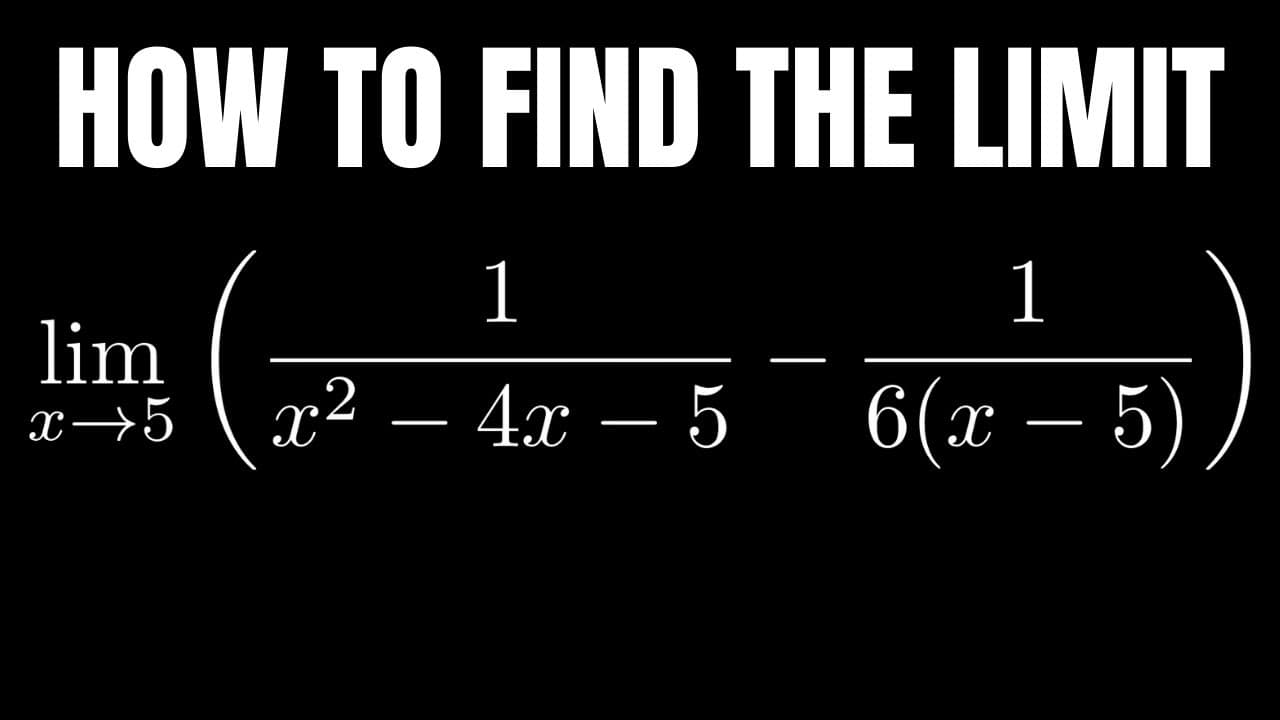
hi in this problem we're going to evaluate this limit so the first thing we should always try when evaluating limits is to take this number here and plug it in to see what happens and you see right away if you do that here you end up with five minus five which is zero so you get six times zero so you end up with zero on the bottom and you cannot ha... Read More
Key Insights
- 🔌 Plugging in a value into a function is the first step in evaluating limits.
- 📁 If direct substitution doesn't yield a defined result, further manipulations like factoring may be necessary.
- 😑 Finding the least common denominator is crucial when dealing with fractions to simplify expressions.
- 😑 Factoring can help simplify complex expressions and allow for the cancellation of common factors in limit evaluations.
- ⛔ Multiple approaches, including multiplying by the least common denominator, can be employed to simplify limit evaluations involving fractions.
- 😑 Simplifying complex expressions through factoring and fraction manipulation can lead to a clearer path to finding the limit value.
- 🤩 Cancellation of common factors and simplification of fractions play a key role in evaluating limits involving complex expressions.
Install to Summarize YouTube Videos and Get Transcripts
Explore YouTube Video Summarizer or Get YouTube Transcript Extractor
Questions & Answers
Q: What is the first step in evaluating limits?
The first step is usually to plug in the given value into the function and see if it yields a defined result. If not, further manipulations like factoring may be required.
Q: How does factoring help in evaluating limits?
Factoring helps simplify complex expressions and allows for the cancellation of common factors, enabling a clearer path to evaluating the limit.
Q: Why is it important to find the least common denominator when dealing with fractions?
Finding the least common denominator ensures that the fractions have a common base, making it easier to add or subtract them to simplify the expression.
Q: What is the significance of the shortcut demonstrated in the video?
The shortcut streamlines the process of evaluating limits by efficiently handling fraction subtraction through finding the least common denominator and simplifying the expression.
Summary & Key Takeaways
-
Evaluating limits involves plugging in a value, but sometimes factorization and fraction manipulation is needed.
-
In this video, a shortcut for evaluating a limit involving factoring and fraction subtraction is demonstrated.
-
The process involves factoring, finding the least common denominator, and simplifying to find the limit.
Read in Other Languages (beta)
Share This Summary 📚
Summarize YouTube Videos and Get Video Transcripts with 1-Click
Try YouTube Summary with ChatGPT & Claude or YouTube Transcript Generator
Explore More Summaries from The Math Sorcerer 📚



Summarize YouTube Videos and Get Video Transcripts with 1-Click
Try YouTube Summary with ChatGPT & Claude or YouTube Transcript Generator