Annual Interest Varying with Debt Maturity
TL;DR
The interest rate charged for borrowing money can vary depending on the length of time the loan is for, with longer-term loans usually having higher interest rates due to increased risk.
Transcript
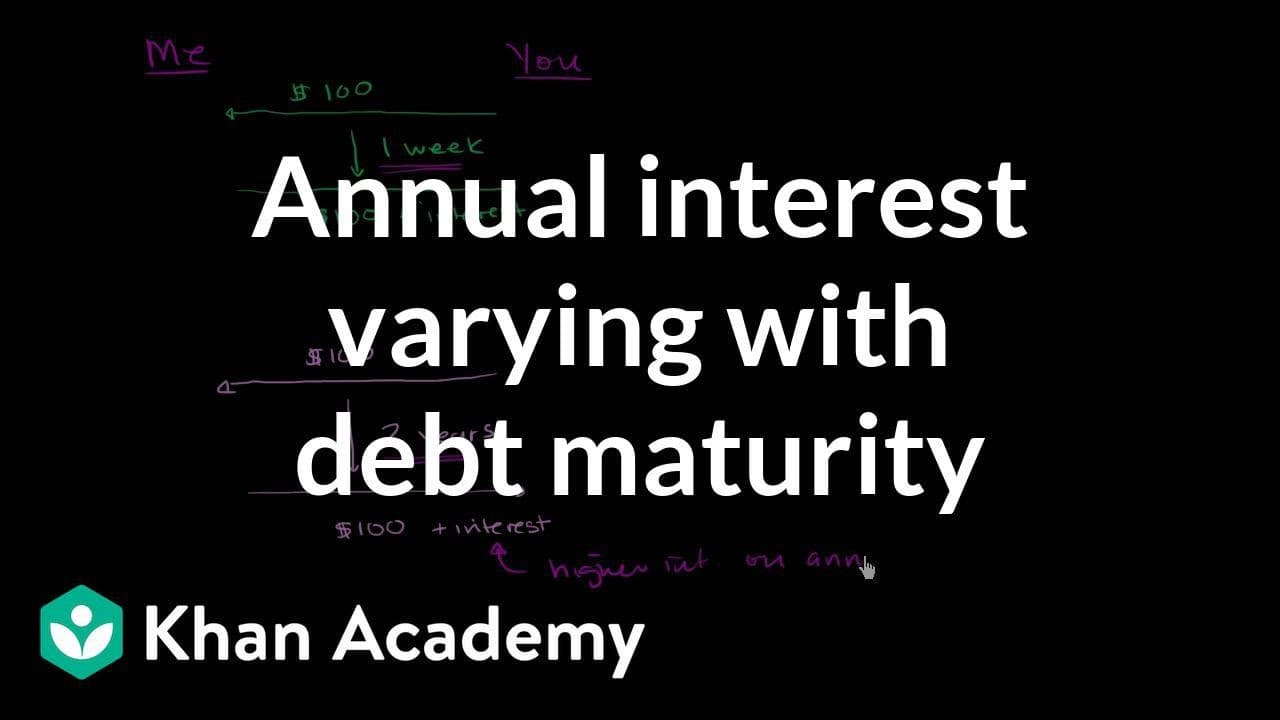
Let's think about 2 different scenarios where I might borrow money from you, So this is me over here, and this is you in the first scenario, I borrow money from you for a relatively short amount of time, so I'm gonna borrow $100 from you and then in 1 week I will pay that $100 back to you I will pay back the $100, and then I will pay some interest.... Read More
Key Insights
- 😘 Borrowing money for a shorter duration is generally considered less risky and tends to have lower interest rates.
- 🥺 Longer-term loans are riskier due to increased uncertainty, leading to higher interest rates.
- ☠️ The perceived risk of the borrower, such as credit rating and legitimacy, influences the interest rate charged.
- ☠️ The concept of different interest rates based on loan duration applies to both individual and institutional borrowing.
- 😘 A lower interest rate for long-term borrowing can indicate potential economic issues or a deflationary period.
- 🎮 The yield curve plays a role in determining interest rates and will be further explored in the next video.
- 🤑 Lenders assess the predictability and potential risks involved in lending money over different timeframes.
Install to Summarize YouTube Videos and Get Transcripts
Explore YouTube Video Summarizer or Get YouTube Transcript Extractor
Questions & Answers
Q: Why might short-term borrowing have a lower interest rate compared to long-term borrowing?
Short-term borrowing is generally considered less risky as there is more predictability. Lenders have a better sense of what the world will look like in a week compared to two years, leading to lower interest rates.
Q: Can long-term borrowing ever have a lower interest rate than short-term borrowing?
While it is less common, there are situations where long-term borrowing might have a lower interest rate. This could indicate potential economic issues or a deflationary period.
Q: How does the perceived risk of borrowing affect the interest rate?
The perceived risk of the borrower plays a significant role in determining the interest rate. Factors such as credit rating, legitimacy, and the possibility of unforeseen events influence the interest rate charged.
Q: How does the concept of different interest rates for different loan lengths apply to lending to corporations or the government?
Similar to individual borrowing, lenders consider the length of the loan and perceived risk when lending to corporations or the government. Higher-risk loans tend to have higher interest rates, reflecting the increased uncertainty over a longer period of time.
Summary & Key Takeaways
-
The video explores two scenarios: borrowing $100 for a week and borrowing $100 for two years, examining the difference in interest rates.
-
Short-term borrowing is considered less risky, as there is more predictability, while long-term borrowing has more uncertainty.
-
Higher interest rates are often charged for long-term loans due to the increased risk involved.
Read in Other Languages (beta)
Share This Summary 📚
Summarize YouTube Videos and Get Video Transcripts with 1-Click
Try YouTube Summary with ChatGPT & Claude or YouTube Transcript Generator
Explore More Summaries from Khan Academy 📚



Summarize YouTube Videos and Get Video Transcripts with 1-Click
Try YouTube Summary with ChatGPT & Claude or YouTube Transcript Generator