What Is the Role of Attachment in Child Development?
TL;DR
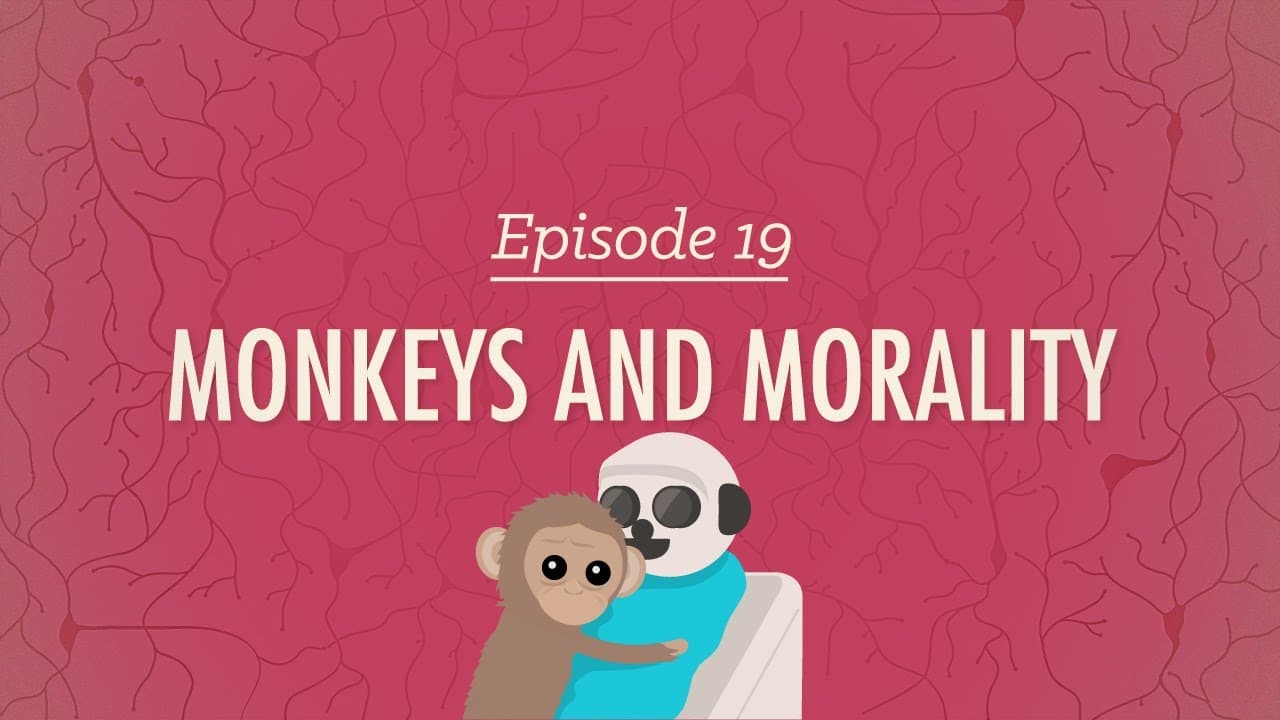
Attachment is essential for emotional and psychological development, as evidenced by Harlow's experiments showing that comfort and touch are more important than food for well-being. Mary Ainsworth identified three attachment styles in children, which are influenced by caregiver responsiveness, and disruptions in attachment can lead to significant long-term psychological issues.
Transcript
So you’ve probably seen a little kid react to a sudden bang or a terrifying clown or some strange Santa at the mall, right? Yeah, not pretty. That child probably immediately reached for a parent, looking for comfort, and that same kid might freak out if she was separated from her adult of choice, especially is she was in an unfamiliar environment. ... Read More
Key Insights
- Attachment is crucial for emotional and psychological development, as shown by Harlow's monkey experiments, revealing the importance of touch and comfort over mere sustenance.
- Mary Ainsworth's 'strange situation' experiment identified three main attachment styles in children: secure, insecure ambivalent, and insecure avoidant, influenced by caregiver responsiveness.
- Disruptions in early attachment can lead to long-term psychological issues, as seen in neglected children and Harlow's monkeys, highlighting the need for nurturing environments.
- Parenting styles—authoritarian, permissive, and authoritative—affect child development, with authoritative parenting often leading to better outcomes in children's self-concept and behavior.
- Self-concept develops significantly by age 12, influenced by early experiences and parenting, impacting a child's confidence, independence, and social interactions.
- Lawrence Kohlberg's theory of moral development outlines three stages: preconventional, conventional, and postconventional, showing how moral reasoning evolves over a lifetime.
- Kohlberg's Heinz Dilemma illustrates moral reasoning stages, emphasizing the shift from self-interest to societal norms and eventually to universal ethical principles.
- Critics argue Kohlberg's focus on moral reasoning overlooks the gap between thought and action, suggesting a need to consider moral behavior alongside reasoning.
Install to Summarize YouTube Videos and Get Transcripts
Explore YouTube Video Summarizer or Get YouTube Transcript Extractor
Questions & Answers
Q: What did Harlow's monkey experiments reveal about attachment?
Harlow's experiments revealed that attachment is not solely based on the provision of food but is significantly influenced by the need for comfort and touch. Baby monkeys preferred a soft, cloth-covered surrogate mother over a wire one with a feeding bottle, highlighting the importance of emotional security in attachment.
Q: How did Mary Ainsworth categorize attachment styles?
Mary Ainsworth categorized attachment styles into three main types: secure, insecure ambivalent, and insecure avoidant. Securely attached children explore their environment confidently with a caregiver present, while insecurely attached children may exhibit anxiety or indifference towards strangers and separation from caregivers.
Q: What are the potential effects of disrupted attachment in early childhood?
Disrupted attachment in early childhood can lead to long-term psychological issues, such as anxiety, social withdrawal, and difficulty forming healthy relationships. Studies on neglected children and Harlow's monkeys show that early deprivation of nurturing care can result in emotional and behavioral disturbances.
Q: How do parenting styles influence child development?
Parenting styles—authoritarian, permissive, and authoritative—affect child development significantly. Authoritative parenting, which balances demands with responsiveness, often leads to positive outcomes in children's self-concept, behavior, and emotional well-being, while authoritarian and permissive styles may result in less favorable developmental outcomes.
Q: What is Kohlberg's theory of moral development?
Kohlberg's theory of moral development outlines three stages: preconventional, conventional, and postconventional. It suggests that moral reasoning evolves from a focus on self-interest to adherence to social norms and eventually to the consideration of universal ethical principles, reflecting a maturation of moral understanding over time.
Q: What does the Heinz Dilemma illustrate about moral reasoning?
The Heinz Dilemma illustrates the stages of moral reasoning by presenting a scenario where a man must decide whether to steal a drug to save his wife. Kohlberg used responses to this dilemma to categorize individuals into different stages of moral development, highlighting the progression from self-interest to societal norms and ethical principles.
Q: What are some criticisms of Kohlberg's theory?
Critics of Kohlberg's theory argue that it focuses too much on moral reasoning rather than moral action, suggesting a disconnect between what individuals think they should do and what they actually do. This criticism points to the need to consider both moral reasoning and behavior in understanding moral development.
Q: How is self-concept related to child development?
Self-concept, or an understanding of oneself, develops significantly by age 12 and is influenced by early experiences and parenting. A positive self-concept is associated with confidence, independence, and sociability, and is shaped by how children perceive their abilities, characteristics, and similarities or differences with others.
Summary & Key Takeaways
-
The video delves into the significance of attachment in child development, highlighting Harlow's monkey experiments which demonstrated the necessity of comfort and touch over mere sustenance for emotional well-being.
-
Mary Ainsworth's 'strange situation' experiment identified three attachment styles in children, influenced by caregiver responsiveness, while disruptions in attachment can lead to long-term psychological issues.
-
The video also explores parenting styles and their impact on self-concept development, alongside Kohlberg's stages of moral development, emphasizing the evolution of moral reasoning from childhood to adulthood.
Read in Other Languages (beta)
Share This Summary 📚
Summarize YouTube Videos and Get Video Transcripts with 1-Click
Try YouTube Summary with ChatGPT & Claude or YouTube Transcript Generator
Explore More Summaries from CrashCourse 📚




Summarize YouTube Videos and Get Video Transcripts with 1-Click
Try YouTube Summary with ChatGPT & Claude or YouTube Transcript Generator