How to Find the Area of a Parallelogram Using Vectors
TL;DR
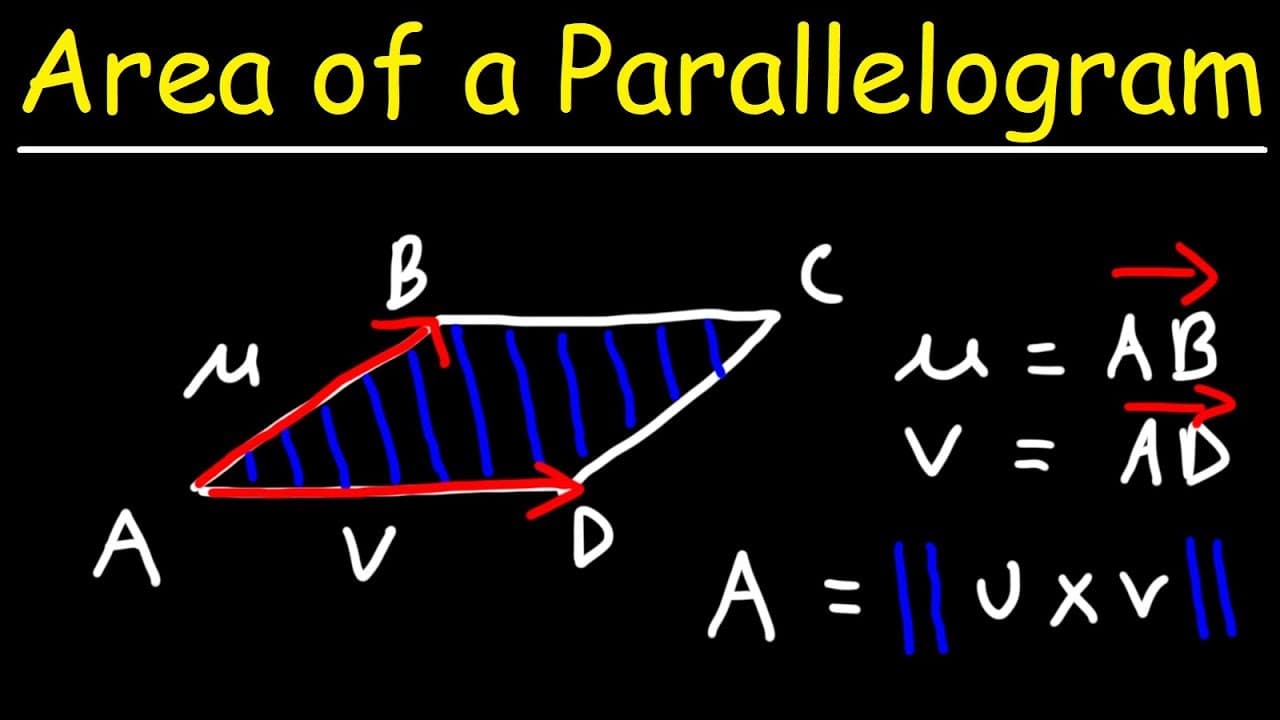
To find the area of a parallelogram formed by two vectors, calculate the magnitude of the cross product of those vectors. This involves creating a matrix with the vectors and computing the determinant, which ultimately gives the area as the square root of the sum of the squares of the components of the resulting vector.
Transcript
in this video we're going to talk about how to find the area of a parallelogram given four points that are at the corners of the parallelogram now let me give you a basic idea of what we need to do so let's say we have two vectors vector u and vector v these two vectors can be used to form a parallelogram and our goal is to find the area of the par... Read More
Key Insights
- 💁 Vectors can be used to form a parallelogram.
- 😵 The area of a parallelogram can be found using the cross product of two vectors.
- 😵 The determinant of a 2x2 matrix can be used to find the components of the cross product.
- 😵 The magnitude of the cross product represents the area of the parallelogram.
- 🤘 The negative sign in the magnitude calculation indicates the direction of the area vector.
- 🪈 The order of the vectors affects the final result.
- 😵 The cross product formula is specific to parallelograms and may not apply to other polygons.
Install to Summarize YouTube Videos and Get Transcripts
Explore YouTube Video Summarizer or Get YouTube Transcript Extractor
Questions & Answers
Q: How can we find the area of a parallelogram given its coordinates?
To find the area, we can use the cross product of two vectors formed by the given coordinates. First, we calculate the vectors by subtracting the coordinates of two opposite corners. Then, we create a 3x3 matrix with the components of these vectors, find its determinant, and calculate its magnitude.
Q: Why is it necessary to use the cross product and not other methods?
The cross product is specifically used to find the area of a parallelogram. It gives a direction perpendicular to the plane of the parallelogram, which helps in calculating the magnitude of the vector representing the area.
Q: What is the significance of the negative sign in the magnitude calculation?
The negative sign indicates the direction of the vector. In this context, it signifies that the vector representing the area is pointing in the opposite direction to the chosen orientation of the parallelogram.
Q: Can this method be used to find the area of any polygon?
No, this method is specific to parallelograms. Different formulas and techniques exist for calculating the area of other types of polygons, such as triangles, rectangles, and circles.
Summary & Key Takeaways
-
The video discusses how to find the area of a parallelogram given the coordinates of its four corners.
-
It explains the concept of vectors and how they can be used to form a parallelogram.
-
The video demonstrates the calculation process using a specific example.
Read in Other Languages (beta)
Share This Summary 📚
Summarize YouTube Videos and Get Video Transcripts with 1-Click
Try YouTube Summary with ChatGPT & Claude or YouTube Transcript Generator
Explore More Summaries from The Organic Chemistry Tutor 📚

Summarize YouTube Videos and Get Video Transcripts with 1-Click
Try YouTube Summary with ChatGPT & Claude or YouTube Transcript Generator