How to Find the Equation of a Plane from a Point and Normal Vector
TL;DR
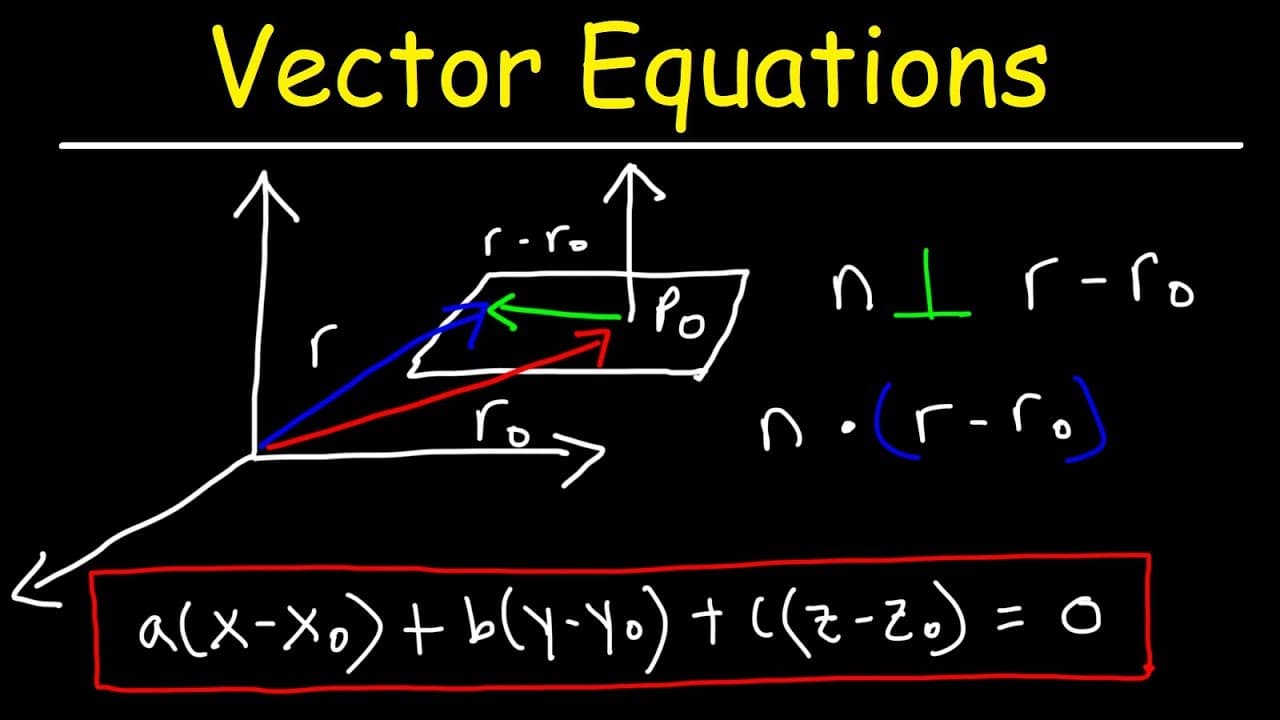
To find the equation of a plane using a point and a perpendicular normal vector, use the formula A(X - X0) + B(Y - Y0) + C(Z - Z0) = 0. Here, A, B, and C are the components of the normal vector, while (X0, Y0, Z0) represents the point on the plane. This method ensures that the dot product of the normal vector and any vector in the plane is zero.
Transcript
in this video we're going to talk about how to find the equation of a plane using a point and a vector that's perpendicular to the plane in fact those are the two things that we need in order to define a plane let's start with a picture so here we have a 3d coordinate system this is going to be x y and z and let's draw a plane somewhere in this reg... Read More
Key Insights
- ✈️ To define a plane, you need a point on the plane and a vector that is perpendicular to it.
- 🫥 The dot product of the normal vector and any vector on the plane is zero.
- ✈️ The equation of a plane can be found using the formula A(X - X0) + B(Y - Y0) + C(Z - Z0) = 0.
- 😥 A, B, and C represent the components of the normal vector, while X0, Y0, and Z0 are the coordinates of the point on the plane.
- 🔚 The equation of a plane is in the form Ax + By + Cz = D, where D is a constant term.
- ✈️ Understanding how to find the equation of a plane is crucial in geometry and physics applications.
- 🫥 The dot product allows us to determine whether two vectors are perpendicular or not.
Install to Summarize YouTube Videos and Get Transcripts
Explore YouTube Video Summarizer or Get YouTube Transcript Extractor
Questions & Answers
Q: What are the two things needed to define a plane?
A point on the plane and a vector that is perpendicular to it.
Q: How can you determine if two vectors are orthogonal or perpendicular?
If the dot product of the two vectors equals zero, they are orthogonal or perpendicular to each other.
Q: How do you find the equation of a plane using a point and normal vector?
Using the formula A(X - X0) + B(Y - Y0) + C(Z - Z0) = 0, where A, B, and C are the components of the normal vector, and X0, Y0, and Z0 are the coordinates of the point.
Q: Can you provide an example of finding the equation of a plane?
Let's say A is 3, B is 6, C is 5, X0 is 2, Y0 is -5, and Z0 is 3. Plugging these values into the formula, we get 3x + 6y + 5z = -9 as the equation of the plane.
Summary & Key Takeaways
-
To define a plane, you need a point on the plane (P0) and a vector (N) that is perpendicular to it.
-
The dot product of the normal vector (N) and the vector from P0 to any other point on the plane (R - R0) equals zero.
-
Using the formula, A(X - X0) + B(Y - Y0) + C(Z - Z0) = 0, you can find the equation of the plane.
Read in Other Languages (beta)
Share This Summary 📚
Summarize YouTube Videos and Get Video Transcripts with 1-Click
Try YouTube Summary with ChatGPT & Claude or YouTube Transcript Generator
Explore More Summaries from The Organic Chemistry Tutor 📚


Summarize YouTube Videos and Get Video Transcripts with 1-Click
Try YouTube Summary with ChatGPT & Claude or YouTube Transcript Generator