2015 AP Chemistry free response 6 | Studying for the AP Chemistry exam? | Chemistry | Khan Academy
TL;DR
When a cation has a polarizing effect on a large anion, ionic compounds exhibit significant covalent character.
Transcript
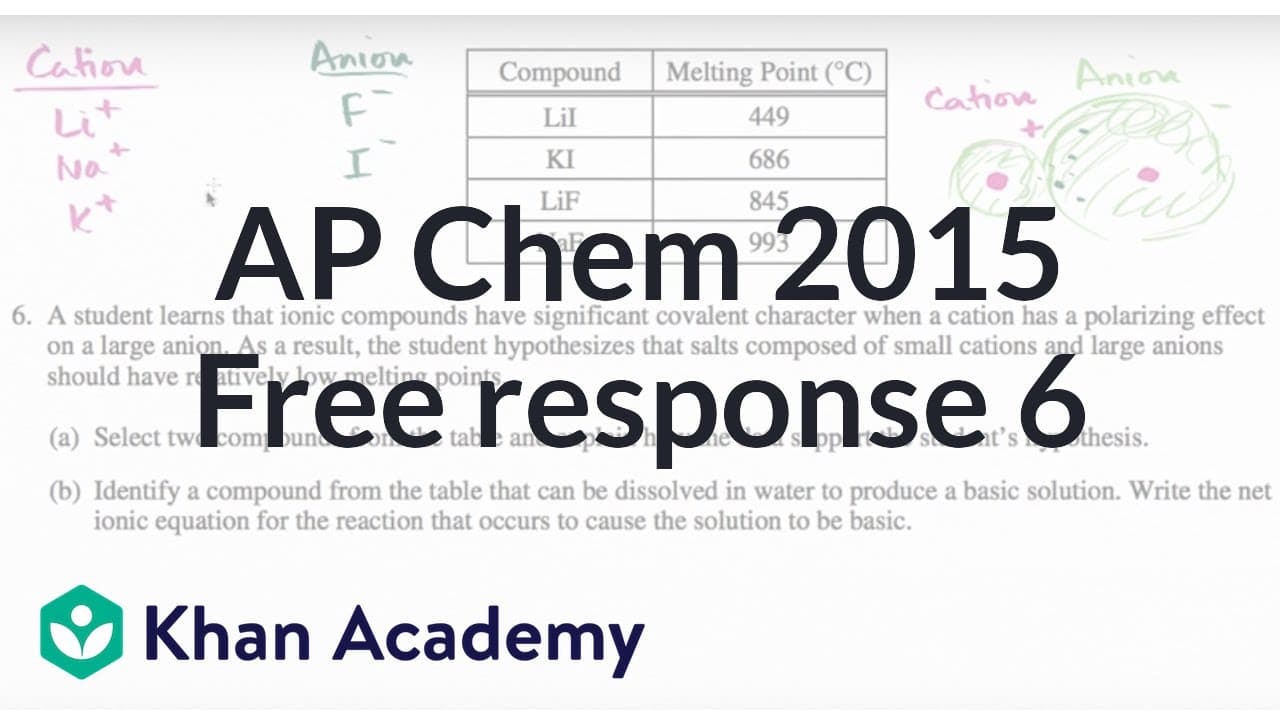
- [Voiceover] A student learns that ionic compounds have significant covalent character when a cation has a polarizing effect on a large anion. So what are they talking about? So if I have a cation, so this is my cation, and then this is my large anion, my large anion right over here. And actually, let me do it this way, let me make it a little bit... Read More
Key Insights
- 🈂️ Cations have a positive charge, while anions have a negative charge.
- 🥺 The polarizing effect of a cation on a large anion leads to significant covalent character in ionic compounds.
Install to Summarize YouTube Videos and Get Transcripts
Explore YouTube Video Summarizer or Get YouTube Transcript Extractor
Questions & Answers
Q: What is the relationship between cations and anions in ionic compounds?
Cations have fewer electrons than protons, resulting in a positive charge, while anions have more electrons than protons, resulting in a negative charge.
Q: How does the polarizing effect of a cation impact covalent character in ionic compounds?
The polarizing effect causes electrons in the anion's cloud to be drawn towards the cation, resulting in shared electrons and increased covalent character.
Q: Why do salts with small cations and large anions have lower melting points?
It is easier to break the solid lattice structure of these salts due to the relatively weaker electrostatic forces between the smaller cations and larger anions.
Q: How do lithium iodide and sodium fluoride exemplify the small cation and large anion hypothesis?
Lithium iodide has a small cation and a large anion, resulting in significant covalent character and a low melting point. Sodium fluoride, with a larger cation and smaller anion, exhibits higher melting point.
Summary & Key Takeaways
-
Ionic compounds have covalent character when a cation polarizes a large anion.
-
Electrons in the anion's cloud may be drawn towards the cation, resulting in shared electrons and covalent character.
-
Salts with small cations and large anions have lower melting points due to the ease of breaking their solid lattice structure.
Read in Other Languages (beta)
Share This Summary 📚
Summarize YouTube Videos and Get Video Transcripts with 1-Click
Try YouTube Summary with ChatGPT & Claude or YouTube Transcript Generator
Explore More Summaries from Khan Academy 📚



Summarize YouTube Videos and Get Video Transcripts with 1-Click
Try YouTube Summary with ChatGPT & Claude or YouTube Transcript Generator