What Conditions Are Required for Comparing Means?
TL;DR
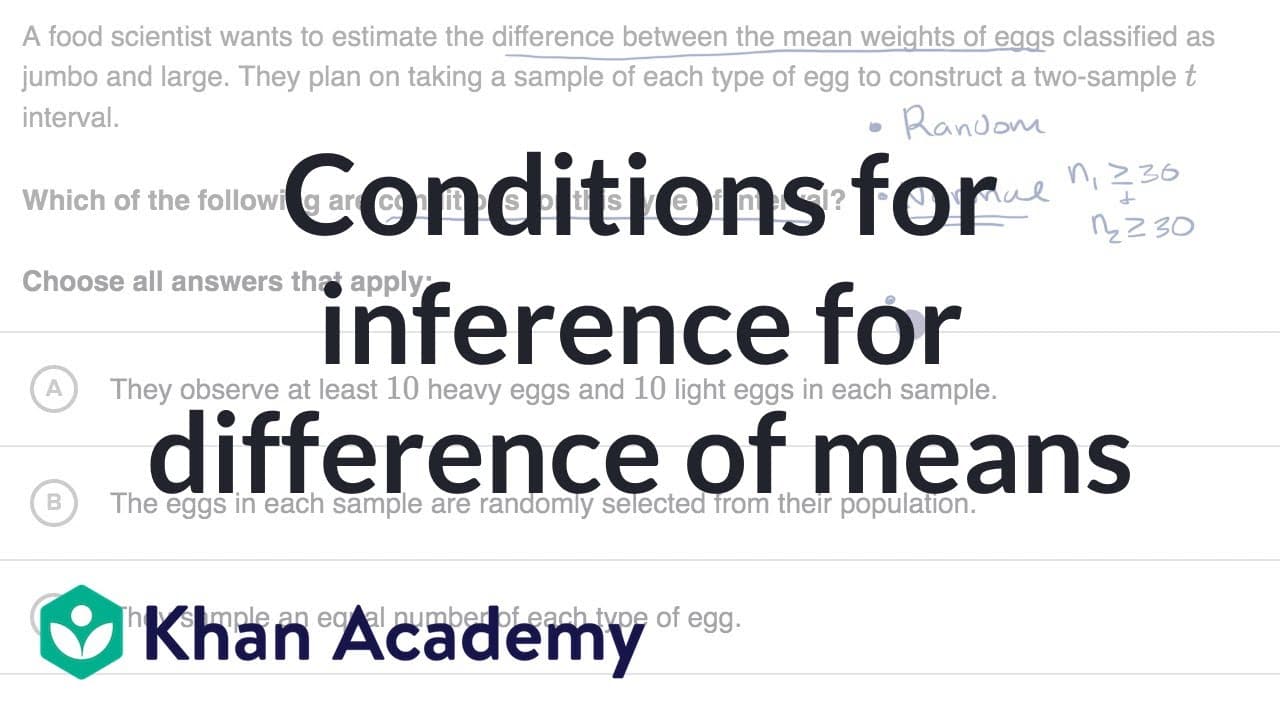
To compare the mean weights of jumbo and large eggs using a two-sample t interval, three conditions must be met: random sampling, normal distribution of sample data, and independence of samples. Observing at least 10 eggs of each type is not required for means but applies to proportions. Equal sample sizes are not necessary for this inference.
Transcript
- [Instructor] A food scientist wants to estimate the difference between the mean weights of eggs classified as jumbo and large. They plan on taking a sample of each type of egg to construct a two-sample t interval. Which of the following are conditions for this type of interval? So before I even look at these choices, and they say choose all answe... Read More
Key Insights
- 👷 Three conditions must be met for constructing a two-sample t interval: random, normal, and independence.
- 🥡 The random condition involves taking random samples or conducting experiments with random assignments.
- 🍧 The normal condition for means includes having a normal underlying distribution, sample sizes greater than or equal to 30, or roughly symmetric data.
- 👷 Equal sample sizes for each type of egg are not necessary for constructing a two-sample t interval.
- 🪺 Observing at least 10 heavy eggs and 10 light eggs in each sample is a condition for constructing a two-sample t interval for proportions.
- ❓ The independence condition ensures that samples are independent of each other.
Install to Summarize YouTube Videos and Get Transcripts
Explore YouTube Video Summarizer or Get YouTube Transcript Extractor
Questions & Answers
Q: What are the conditions for constructing a two-sample t interval?
The conditions for constructing a two-sample t interval include the random condition (taking random samples), the normal condition (either having a normal underlying distribution or having sample sizes greater than or equal to 30 or roughly symmetric data), and the independence condition (either using replacement or having sample sizes no more than 10% of the population).
Q: Is it necessary to have equal sample sizes for each type of egg in a two-sample t interval?
No, it's not necessary to have equal sample sizes for each type of egg when constructing a two-sample t interval. The sample sizes can be different as long as the other conditions are met.
Q: Can the random condition be met when observing at least 10 heavy eggs and 10 light eggs in each sample?
No, observing at least 10 heavy eggs and 10 light eggs in each sample is the condition for constructing a two-sample t interval for proportions, not means. For means, the random condition involves taking truly random samples or conducting experiments with random assignments.
Q: What does the independence condition mean in constructing a two-sample t interval?
The independence condition in constructing a two-sample t interval requires that either the individual observations are done with replacement in both samples or that the sample size for both samples is no more than 10% of the population. This condition ensures that the samples are independent of each other.
Summary & Key Takeaways
-
In order to construct a two-sample t interval, certain conditions must be met, including the random condition (taking random samples), the normal condition (where the sample sizes are either greater than or equal to 30 or the data is roughly symmetric), and the independence condition (samples are either done with replacement or are no more than 10% of the population).
-
Observing at least 10 heavy eggs and 10 light eggs in each sample is not a condition for constructing a two-sample t interval for means; it's only relevant when dealing with proportions.
-
Having equal sample sizes for each type of egg is not necessary for constructing a two-sample t interval for comparing means.
Read in Other Languages (beta)
Share This Summary 📚
Summarize YouTube Videos and Get Video Transcripts with 1-Click
Try YouTube Summary with ChatGPT & Claude or YouTube Transcript Generator
Explore More Summaries from Khan Academy 📚



Summarize YouTube Videos and Get Video Transcripts with 1-Click
Try YouTube Summary with ChatGPT & Claude or YouTube Transcript Generator