Complex number polar form intuition exercise | Precalculus | Khan Academy
TL;DR
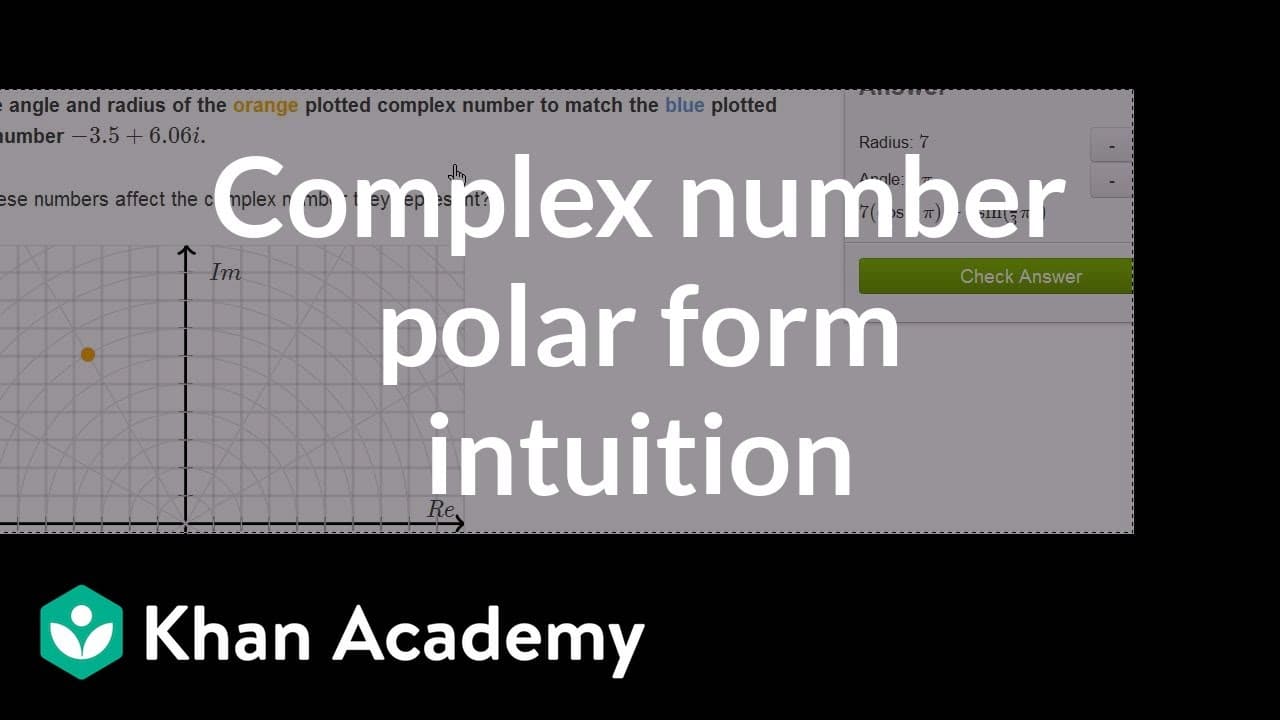
Adjusting the angle and radius of a complex number to match another complex number on the polar plane.
Transcript
We're asked to adjust the angle in radius of the orange plotted complex number-- so that's this right over here-- to match the blue plotted complex number negative 3.5 plus 6.06i. So this is this one right over here. So just to get our bearings, this vertical axis, this is the imaginary axis. This horizontal axis is the real axis. The real part of ... Read More
Key Insights
- 💁 Complex numbers can be represented in both rectangular and polar form.
- 🧘 Adjusting the angle and radius of a complex number changes its position on the complex plane.
- #️⃣ Euler's identity relates exponential functions, trigonometric functions, and complex numbers.
- ✈️ The unit circle is useful in understanding angles and trigonometric functions in the complex plane.
- 💁 Converting from polar to rectangular form requires evaluating cosine and sine functions.
- 🥳 The real and imaginary parts of a complex number can be compared to verify equality.
- #️⃣ The adjustment of angle and radius is a fundamental concept in complex number manipulation.
Install to Summarize YouTube Videos and Get Transcripts
Explore YouTube Video Summarizer or Get YouTube Transcript Extractor
Questions & Answers
Q: How are the angle and radius adjusted to match another complex number?
The angle (also known as the argument) is increased or decreased to align with the desired complex number, while the radius (modulus) is adjusted to bring the point closer or farther from the origin.
Q: What is Euler's identity and how is it used in complex numbers?
Euler's identity states that e^(iθ) = cos(θ) + i sin(θ), where θ is the angle in radians. It allows us to represent a complex number in polar form.
Q: How is the complex number in polar form converted to rectangular form?
The complex number in polar form is written as r(cosθ + i sinθ), where r is the radius and θ is the angle. This can be expanded to r cosθ + i r sinθ, giving the real and imaginary parts separately.
Q: Why do we use the unit circle when dealing with angles in the complex plane?
The unit circle simplifies calculations and visualization since it has a radius of 1 and allows us to easily determine the cosine and sine values for different angles.
Summary & Key Takeaways
-
The video demonstrates adjusting the angle and radius of a complex number to match another complex number on the polar plane.
-
The process involves plotting the complex numbers on the complex plane, adjusting the angle and radius, and verifying the result.
-
Euler's identity is used to represent the complex number in polar form, which is converted to the standard rectangular form.
Read in Other Languages (beta)
Share This Summary 📚
Summarize YouTube Videos and Get Video Transcripts with 1-Click
Try YouTube Summary with ChatGPT & Claude or YouTube Transcript Generator
Explore More Summaries from Khan Academy 📚



Summarize YouTube Videos and Get Video Transcripts with 1-Click
Try YouTube Summary with ChatGPT & Claude or YouTube Transcript Generator