Introduction to Finite Element Analysis
TL;DR
This video provides an introduction to Finite Element Analysis (FEA), explaining its types, definitions, terminologies, and applications.
Transcript
hello friends in today's lecture we'll be studying the introduction to the subject known as Fe or finite elemental analysis so before introducing ourselves to this topic let us understand the learning objectives of today's lecture so first thing will be understanding the types of solving an engineering problem basically in this we will be understan... Read More
Key Insights
- ❓ There are three methods to solve engineering problems: analytical, experimental, and numerical.
- ❓ FEA is a numerical method that is used for solving complex engineering problems using mathematical models and assumptions.
- 👻 Meshing is an important concept in FEA, as it allows for assigning geometrical properties to materials and structures.
- 😨 FEA can save costs in industries like car manufacturing by simulating boundary conditions and understanding forces and damage control.
- 🗂️ FEA divides complex geometries into simpler elements, such as triangles or quadrilaterals, for analysis.
- 🧘 Nodes are the endpoints of elements in FEA and are used to define the position of a structure.
- 👾 Degrees of freedom refer to the possible ways in which a body can move, with 6 degrees of freedom in space and 3 degrees of freedom in a plane.
Install to Summarize YouTube Videos and Get Transcripts
Explore YouTube Video Summarizer or Get YouTube Transcript Extractor
Questions & Answers
Q: What are the three methods used to solve engineering problems?
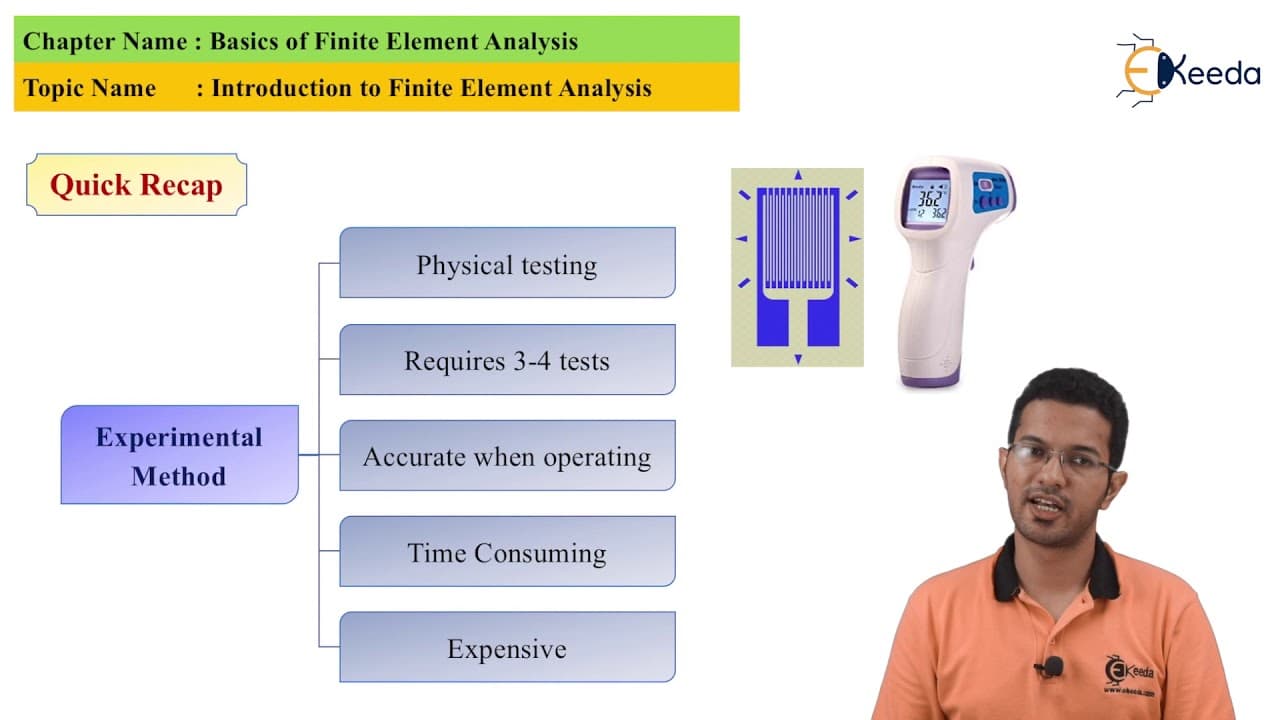
The three methods are analytical (hand calculations), experimental (physical testing), and numerical (software-based techniques).
Q: What is the advantage of the experimental method?
The experimental method allows for testing while the machine is in operation, providing accurate results without the need to stop the machine.
Q: How does finite element analysis (FEA) work?
FEA breaks down complex geometries into smaller parts, solves each part using numerical methods, and then integrates the solutions to obtain an accurate solution for the original problem.
Q: What is the purpose of meshing in finite element analysis?
Meshing assigns geometrical properties to materials, allowing for accurate analysis by simulating the behavior of different materials and structures.
Summary & Key Takeaways
-
The video introduces the three methods of solving engineering problems: analytical (hand calculations), experimental (physical testing), and numerical (software-based techniques).
-
It emphasizes the importance of numerical methods, particularly finite element analysis (FEA), for solving complex engineering problems with the help of mathematical models and assumptions.
-
The concept of meshing is explained, highlighting its role in assigning geometrical properties to materials, allowing for accurate analysis.
Read in Other Languages (beta)
Share This Summary 📚
Summarize YouTube Videos and Get Video Transcripts with 1-Click
Try YouTube Summary with ChatGPT & Claude or YouTube Transcript Generator
Explore More Summaries from Ekeeda 📚






Summarize YouTube Videos and Get Video Transcripts with 1-Click
Try YouTube Summary with ChatGPT & Claude or YouTube Transcript Generator