What Are the Best Calculus Books for Self-Study?
TL;DR
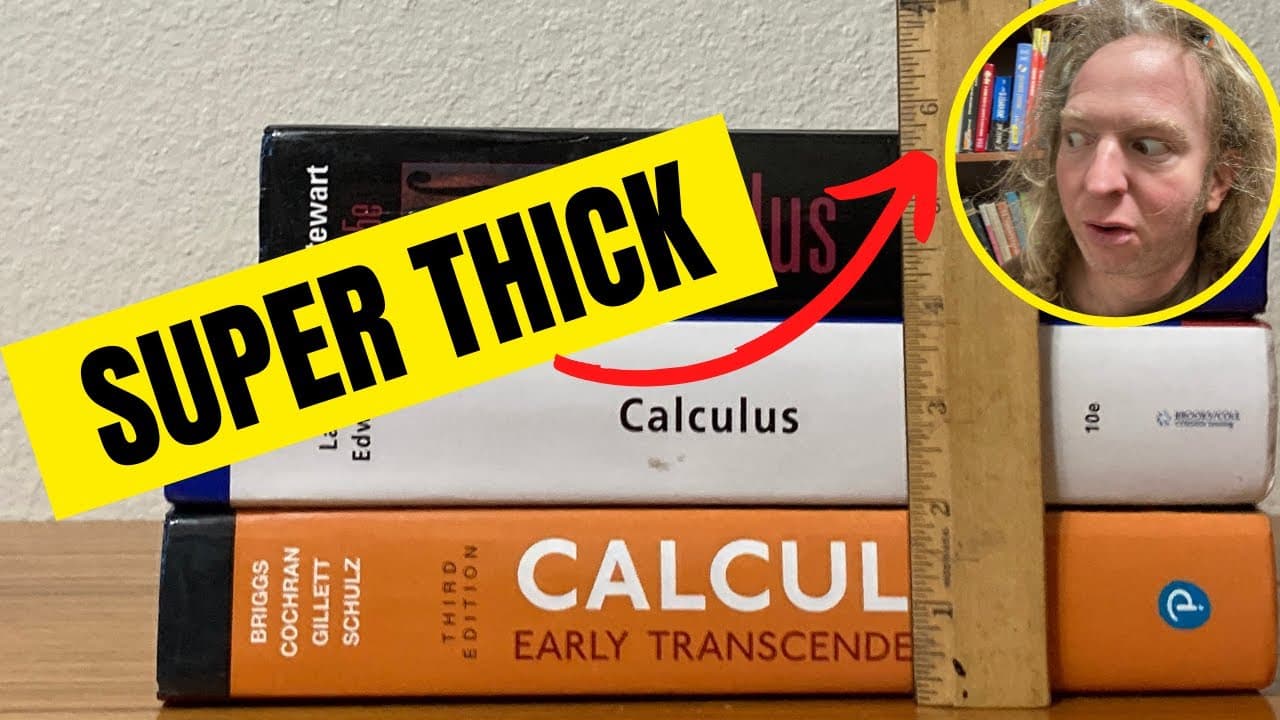
The best calculus books for self-study are James Stewart's 'Calculus', Larson's 'Calculus', and Briggs' 'Calculus: Early Transcendentals'. Each offers comprehensive coverage of calculus topics, numerous practice problems, and solutions for odd-numbered exercises, making them effective for learners. They cater to various skill levels and provide foundational knowledge essential for mastering calculus concepts.
Transcript
in this video we're going to be looking at three super thick math books i mean look how thick these books are yeah i mean completely insane these books will help you learn calculus you can use these for self-study and because these books are just so thick you can actually do tons of problems and you don't even need to get all three even just one of... Read More
Key Insights
- 📔 James Stewart's calculus book covers a wide array of topics, extending from basic calculus principles to advanced differential equations and calculus III concepts.
- 😫 Larson's calculus book, ideal for instructors, presents a structured approach with comprehensive coverage of calculus topics and challenging problem sets.
- 🤳 Briggs' calculus book stands out for its fresh perspective and engaging approach, making it a favorite for self-study and exploration of varied practice problems.
- 🤳 All three books emphasize the importance of practice in mastering calculus concepts, offering solutions to odd-numbered problems for enhanced self-assessment.
- 🔁 Despite potential challenges in understanding certain topics, persistence, additional resources, and repeated practice are crucial for improving math proficiency.
- 📙 The calculus books cater to a diverse audience, ranging from students seeking self-study resources to instructors looking for comprehensive teaching materials.
- 🤑 The books' rich content and ample practice problems make them valuable tools for enhancing mathematical skills, understanding calculus principles, and mastering problem-solving techniques.
Install to Summarize YouTube Videos and Get Transcripts
Explore YouTube Video Summarizer or Get YouTube Transcript Extractor
Questions & Answers
Q: What are the key differences among the calculus books by James Stewart, Larson, and Briggs?
Each book offers comprehensive coverage of calculus topics, with varying approaches to explanations and practice problems. Stewart's book is a classic choice with rich content, Larson's book is instructor-friendly, and Briggs' book offers a fresh perspective.
Q: How do the calculus books facilitate self-study and practice?
All three books provide a wealth of practice problems, with solutions to odd-numbered questions for self-assessment. This feature allows learners to reinforce concepts, hone problem-solving skills, and track their progress effectively.
Q: What are the notable topics covered in the calculus books?
The books cover a range of topics from basic calculus principles to advanced concepts like sequences, series, vectors, and differential equations. Each book delves into differentiation, integration, and their applications extensively.
Q: How do the calculus books address common challenges in understanding mathematical concepts?
While the books offer thorough explanations, some readers may find certain topics challenging to grasp initially. Persistence and practice with the abundant problem sets, coupled with seeking additional resources or clarification, can help overcome these obstacles effectively.
Summary & Key Takeaways
-
Three thick math books on calculus: James Stewart's, Larson's, and Briggs'.
-
Comprehensive coverage of calculus topics including functions, derivatives, integrals, and applications.
-
Rich in practice problems essential for self-study and improving mathematical skills.
Read in Other Languages (beta)
Share This Summary 📚
Summarize YouTube Videos and Get Video Transcripts with 1-Click
Try YouTube Summary with ChatGPT & Claude or YouTube Transcript Generator
Explore More Summaries from The Math Sorcerer 📚

Summarize YouTube Videos and Get Video Transcripts with 1-Click
Try YouTube Summary with ChatGPT & Claude or YouTube Transcript Generator