Shared Memory System
TL;DR
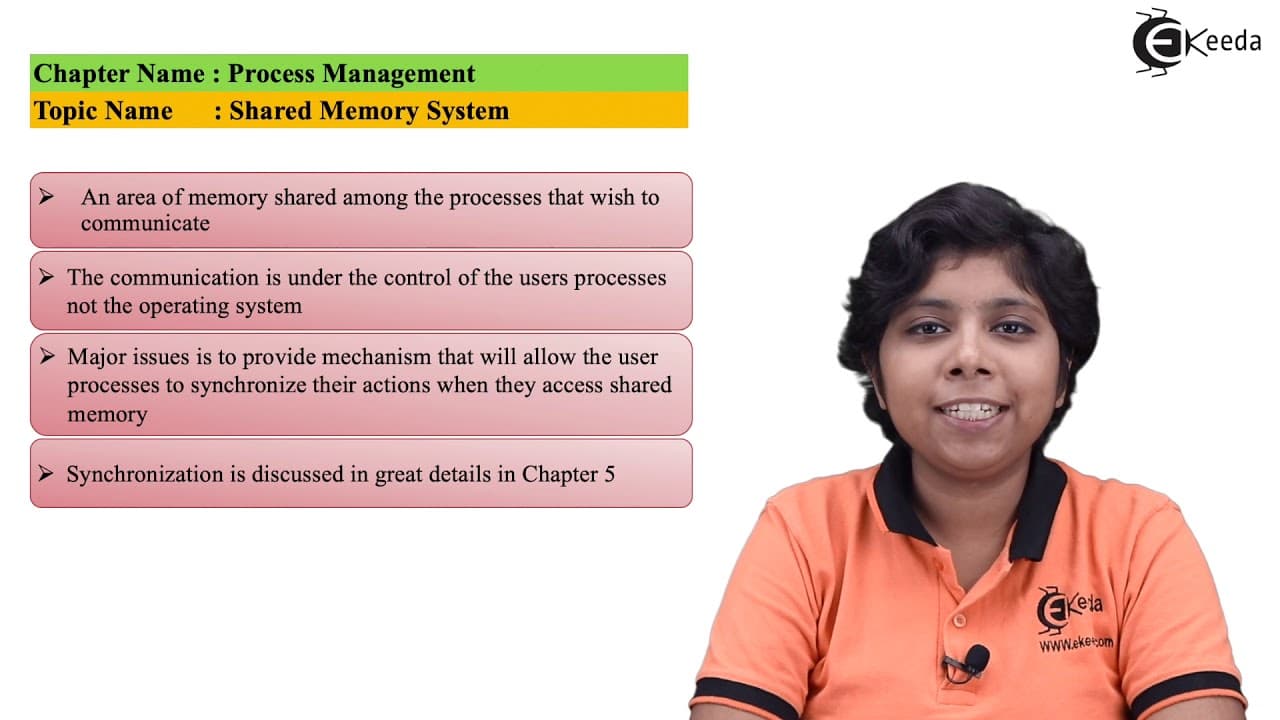
This video discusses how a shared memory system can be implemented in inter process communication, allowing processes to exchange information through a shared memory region.
Transcript
click the Bell icon to get latest videos from akira hello friends today we will discuss that how a shared memory system can be implemented in a inter process communication or IPC in the cooperating processes when the cooperating processes are communicating with each other via shared memory then a shared memory region is first need to be established... Read More
Key Insights
- 👻 Shared memory system allows processes to communicate by sharing a common memory region.
- 💱 The process creating the shared memory becomes the owner, and other processes can join the region to exchange data.
- 🛟 Producer-consumer problem can be used to implement a shared memory system in various contexts, like client-server programs.
- 🍗 Synchronization is necessary to prevent conflicts when multiple processes try to access the shared memory simultaneously.
- ⛔ The shared buffer in a shared memory system can be unbounded or bounded, depending on the capacity limit.
- ❓ In an unbounded buffer, the producer can keep producing, while the consumer consumes from the buffer.
- ⛔ In a bounded buffer, there are limits on the buffer size, and the producer has to wait if the buffer is full.
Install to Summarize YouTube Videos and Get Transcripts
Explore YouTube Video Summarizer or Get YouTube Transcript Extractor
Questions & Answers
Q: How does a shared memory system work in inter process communication?
In a shared memory system, a shared memory region is established for processes to exchange information. The process creating the region is the owner, and other processes can join and read/write data from the region.
Q: How can a shared memory system be implemented using a producer-consumer problem?
In a producer-consumer problem, a producer produces input, which is consumed by the consumer. In the shared memory system, the producer can write data to a shared buffer, while the consumer reads and processes the data from the same buffer.
Q: What is the difference between an unbounded buffer and a bounded buffer in a shared memory system?
In an unbounded buffer, the producer can keep producing items without any size limit, and the consumer can consume them from the buffer. In a bounded buffer, there is a capacity limit, and the producer can only produce a certain number of items before waiting for the consumer to free up space.
Q: How does synchronization solve the problem of simultaneous access to shared memory in a shared memory system?
Synchronization ensures that the producer and consumer do not access the shared memory simultaneously, avoiding conflicts. Techniques like locks, semaphores, or condition variables can be used to control the access and ensure proper synchronization.
Summary & Key Takeaways
-
In inter process communication, a shared memory region is established for processes to communicate with each other.
-
The process creating the shared memory region is the owner, and other processes can join and exchange information within the region.
-
Shared memory system can be implemented using a producer-consumer problem, allowing multiple processes to produce and consume data from a shared buffer.
Read in Other Languages (beta)
Share This Summary 📚
Summarize YouTube Videos and Get Video Transcripts with 1-Click
Try YouTube Summary with ChatGPT & Claude or YouTube Transcript Generator
Explore More Summaries from Ekeeda 📚






Summarize YouTube Videos and Get Video Transcripts with 1-Click
Try YouTube Summary with ChatGPT & Claude or YouTube Transcript Generator