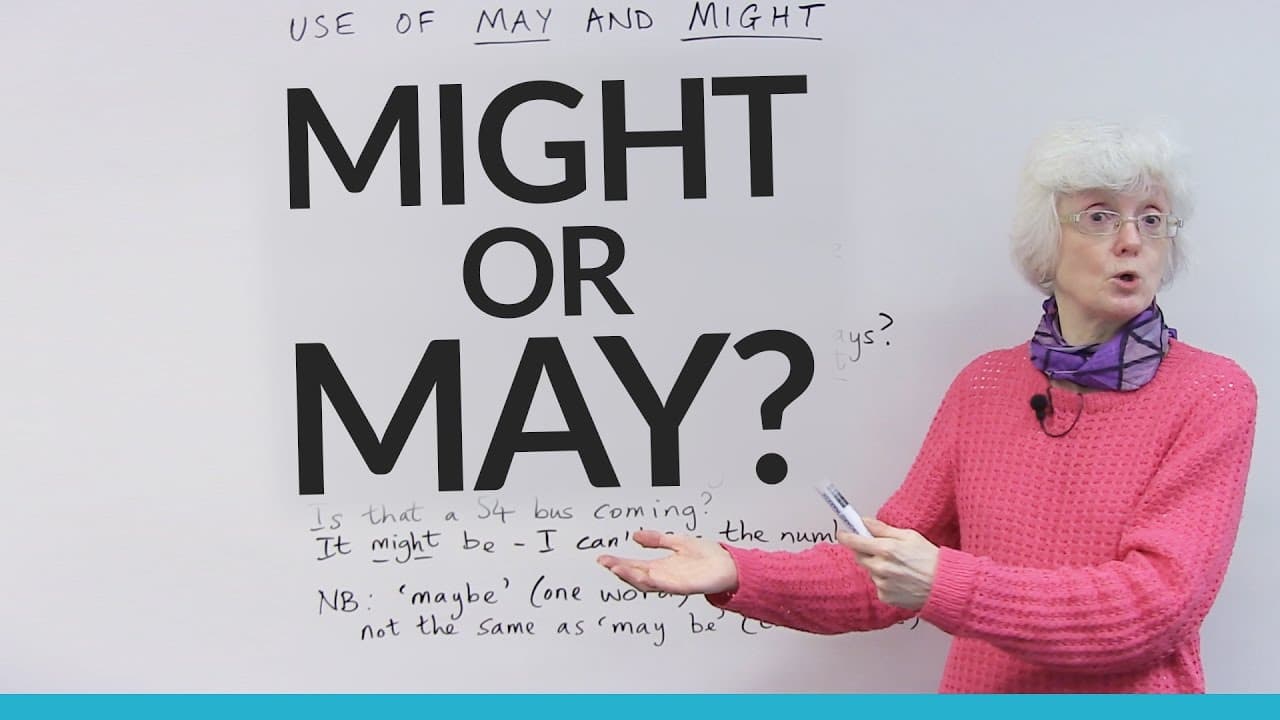
MAY or MIGHT?
TL;DR
"May" suggests a possibility with varying degrees of politeness, while "Might" indicates a lesser likelihood.
Transcript
Hi. I'm Gill at www.engvid.com and today the lesson is about the two words "may" and "might", and I know these can be a little bit confusing because they are connected. "May" and "might" come from the same verb, but it's a rather strange verb that is only used in certain ways. So, I'm just going to give you a few examples to show how these words ar... Read More
Key Insights
- 🫦 "May" is preferred for more definite possibilities or permission requests, while "might" introduces a bit more uncertainty or doubt.
- 🎚️ The distinction between "may" and "might" is subtle but crucial in conveying varying levels of likelihood in English.
- 🤩 Politeness is a key aspect in using "may" for formal requests or permission-seeking situations.
- ❓ Understanding the nuanced differences between modal verbs like "may" and "might" enhances language proficiency and accuracy.
Install to Summarize YouTube Videos and Get Transcripts
Explore YouTube Video Summarizer or Get YouTube Transcript Extractor
Questions & Answers
Q: What is the primary difference between using "may" and "might" when seeking permission?
The use of "may" is more direct and assertive, indicating a higher probability, while "might" implies a lesser likelihood or more doubt in the scenario.
Q: How does the level of politeness vary between saying "Can I" and "May I" when making a request?
"Can I" is considered less polite than "May I," which is seen as a more courteous and respectful way of seeking permission in English.
Q: In what context would someone use "might" instead of "may" to express a possibility?
"Might" is typically employed when there is a sense of doubt or a lower likelihood of the event happening compared to the use of "may."
Q: Why do English learners sometimes confuse the usage of "maybe" and "may be"?
The confusion arises from "maybe" being a single word meaning "perhaps," while "may be" is two words indicating a specific possibility or likelihood in a sentence.
Summary & Key Takeaways
-
"May" and "Might" are verbs derived from the same root, often used to express possibility or seek permission politely.
-
"May" is used for more straightforward permission requests and emphasizing likelihood, while "Might" implies a remote chance or less certainty.
-
The distinction between "may" and "might" lies in the level of probability or doubt conveyed in a statement.
Read in Other Languages (beta)
Share This Summary 📚
Summarize YouTube Videos and Get Video Transcripts with 1-Click
Try YouTube Summary with ChatGPT & Claude or YouTube Transcript Generator
Explore More Summaries from Learn English with Gill · engVid 📚





Summarize YouTube Videos and Get Video Transcripts with 1-Click
Try YouTube Summary with ChatGPT & Claude or YouTube Transcript Generator