Active Attacks and Security Mechanisms | Cryptography and System Security (Reshoot)
TL;DR
Active attacks involve modifying and creating new messages, while security services aim to detect and recover from these attacks.
Transcript
hello and welcome back to the course today we are going to see tube attacks and the security services as far as the active attacks are concerned they are different from the passive attack in terms of making the message modified and creating the new message by the attackers so as we have seen in the passive attacks uh it it is only i think nothing b... Read More
Key Insights
- 👊 Active attacks involve modifying and creating new messages, making them different from passive attacks that only involve message reading.
- 👊 Detection and data recovery are crucial in mitigating the impact of active attacks.
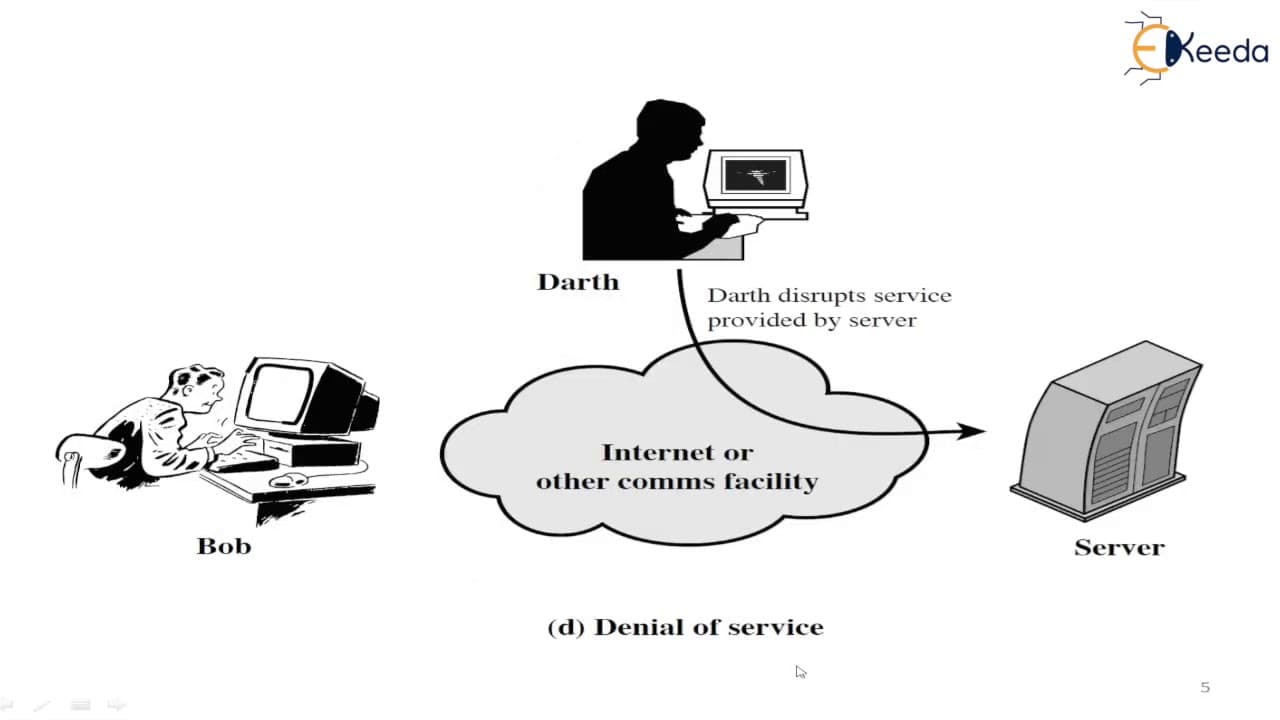
- 👊 The four categories of active attacks are masquerade, replay, modification of messages, and denial of service.
- 🐕🦺 Security services aim to achieve goals such as data confidentiality, data integrity, non-repudiation, authentication, access control, and availability.
Install to Summarize YouTube Videos and Get Transcripts
Explore YouTube Video Summarizer or Get YouTube Transcript Extractor
Questions & Answers
Q: What is the difference between active and passive attacks?
Active attacks involve modifying or creating new messages, while passive attacks only involve message reading.
Q: Can active attacks be prevented?
Preventing active attacks is difficult, but detection and data recovery can help mitigate their impact.
Q: What are the four categories of active attacks?
The four categories of active attacks are masquerade, replay, modification of messages, and denial of service.
Q: How does masquerade attack work?
In a masquerade attack, the attacker generates a message that appears to be from one party to another party, even though the message was not actually sent by the sender.
Q: What is the goal of data confidentiality?
The goal of data confidentiality is to protect data from unauthorized disclosure, ensuring it is only accessible to authorized users.
Q: How does data integrity affect message transmission?
Data integrity ensures that the data received is identical to what was sent, preventing modification or tampering during transmission.
Q: Explain the concept of non-repudiation in security services.
Non-repudiation prevents the sender or receiver from denying their involvement in a message transmission, providing proof of message origin and receipt.
Q: Why is access control an important security service?
Access control prevents unauthorized individuals from accessing resources or data, ensuring the security and privacy of stored information.
Summary & Key Takeaways
-
Active attacks involve modifying or creating new messages, which is different from passive attacks that only involve message reading.
-
Preventing active attacks is difficult, but detection and data recovery are possible.
-
Four categories of active attacks include masquerade, replay, modification of messages, and denial of service.
Read in Other Languages (beta)
Share This Summary 📚
Summarize YouTube Videos and Get Video Transcripts with 1-Click
Try YouTube Summary with ChatGPT & Claude or YouTube Transcript Generator
Explore More Summaries from Ekeeda 📚






Summarize YouTube Videos and Get Video Transcripts with 1-Click
Try YouTube Summary with ChatGPT & Claude or YouTube Transcript Generator