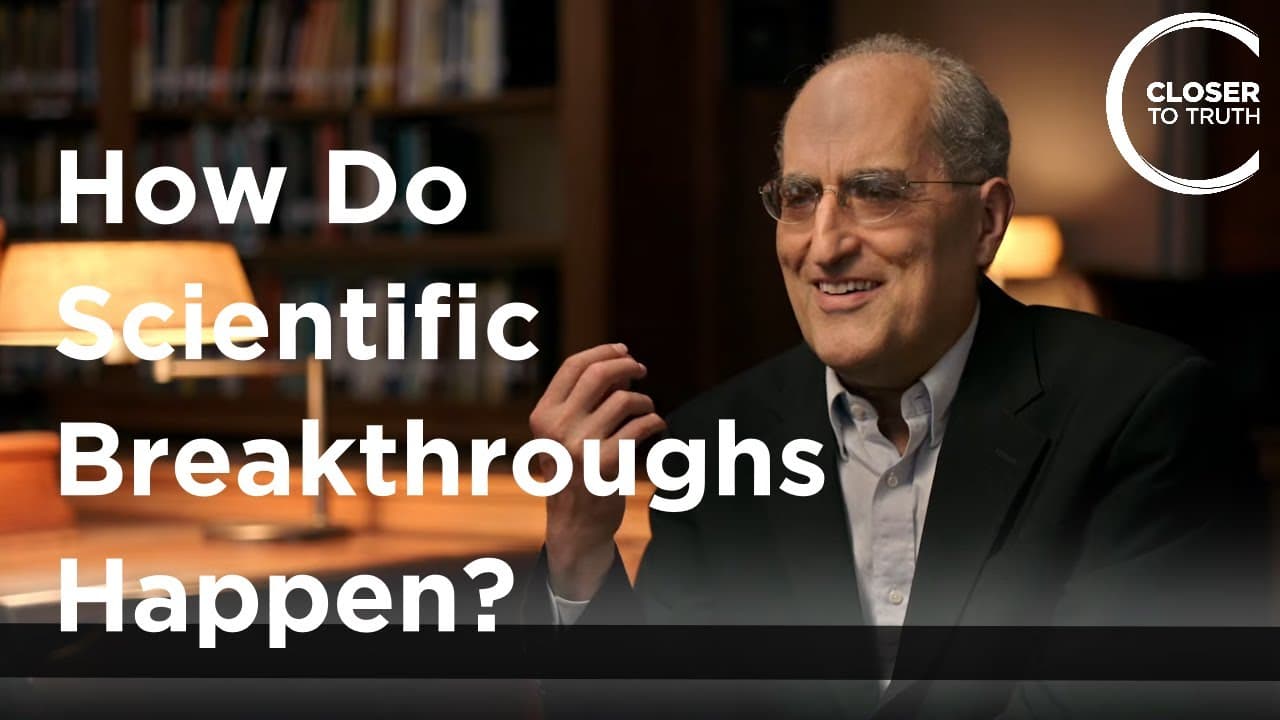
Edward Witten - How Do Scientific Breakthroughs Happen?
TL;DR
Mathematician Ed Uh transitioned from a history major to winning the Fields Medal in mathematics and becoming an influential physicist, driven by the exciting discoveries and advancements in elementary particle physics during the 50s, 60s, and early 70s.
Transcript
ed uh you began as a history major at brandeis and then you won the fields medal which is in mathematics uh and were the only physicists to have won a fields medal how did that transition happen well after some hesitations i recognized that the age of about 21 that my talent was really in math and physics and that's the direction i should go in and... Read More
Key Insights
- 💢 The period from the 50s to early 70s was a golden era of discovery in elementary particle physics, driving Ed Uh's interest in the subject.
- 🗾 The discovery of the J/ψ particle and the establishment of the standard model during Ed Uh's graduate studies solidified his passion for physics.
- ⌛ The mathematics required for the standard model, non-abelian gauge theory, was unfamiliar to both physicists and mathematicians at the time.
- 🥺 Ed Uh's interest in exploring the mathematical issues arising in the standard model led to his transition to studying string theory in the mid-80s.
- 🤗 Progress in string theory in the mid-80s opened up new possibilities and applications for physics and mathematics.
- 💪 Ed Uh's work in string theory helped overcome challenges in understanding the behavior of quantum systems at strong coupling.
- 😀 The unification and reduction of the five existing string theories into one theory, known as M-theory, was a significant development in the field.
Install to Summarize YouTube Videos and Get Transcripts
Explore YouTube Video Summarizer or Get YouTube Transcript Extractor
Questions & Answers
Q: How did Ed Uh transition from being a history major to winning the Fields Medal in mathematics?
Ed Uh recognized his talent for math and physics at the age of 21 and decided to pursue graduate studies in physics. Exciting discoveries in elementary particle physics during that time, including the J/ψ particle and the establishment of the standard model, solidified his interest in the field.
Q: What specific discoveries in elementary particle physics excited Ed Uh?
Ed Uh was initially unaware of the specific discoveries in elementary particle physics when he made the decision to pursue physics. However, the period of discovery, including the J/ψ particle and the establishment of the standard model, captivated him and drove his interest in the subject.
Q: What mathematics was required for the standard model that was unfamiliar to physicists and mathematicians at the time?
The mathematics required for the standard model was non-abelian gauge theory, which extended Maxwell's linear equations to a non-linear version. This extension allowed for the interaction and scattering of waves, necessitating quantum mechanical treatment. Solving the equations of the standard model was a challenging problem and remains largely unsolved today.
Q: How did Ed Uh's interest shift from the standard model to string theory?
Ed Uh's interest in the mathematical issues arising in the standard model led him to explore the application of physics to mathematics. In the mid-80s, progress in string theory opened up a new arena for the application of physics, sparking Ed Uh's transition to studying string theory.
Key Insights:
- The period from the 50s to early 70s was a golden era of discovery in elementary particle physics, driving Ed Uh's interest in the subject.
- The discovery of the J/ψ particle and the establishment of the standard model during Ed Uh's graduate studies solidified his passion for physics.
- The mathematics required for the standard model, non-abelian gauge theory, was unfamiliar to both physicists and mathematicians at the time.
- Ed Uh's interest in exploring the mathematical issues arising in the standard model led to his transition to studying string theory in the mid-80s.
- Progress in string theory in the mid-80s opened up new possibilities and applications for physics and mathematics.
- Ed Uh's work in string theory helped overcome challenges in understanding the behavior of quantum systems at strong coupling.
- The unification and reduction of the five existing string theories into one theory, known as M-theory, was a significant development in the field.
- Ed Uh's lecture at USC in 1995, where he unified the string theories, resulted from an attempt to disprove some of the theories but ended up reducing the number of theories through the concept of M-theory.
Summary & Key Takeaways
-
Ed Uh started as a history major but realized his talent was in math and physics, leading him to pursue graduate school in physics and become fascinated by elementary particle physics.
-
The period between the 50s and early 70s was an era of incredible discovery in elementary particle physics, which excited Ed Uh and drew him into the subject.
-
The discovery of the J/ψ particle and the establishment of the standard model of particle physics during Ed Uh's time in graduate school cemented his interest in the field.
Read in Other Languages (beta)
Share This Summary 📚
Summarize YouTube Videos and Get Video Transcripts with 1-Click
Try YouTube Summary with ChatGPT & Claude or YouTube Transcript Generator
Explore More Summaries from Closer To Truth 📚

Summarize YouTube Videos and Get Video Transcripts with 1-Click
Try YouTube Summary with ChatGPT & Claude or YouTube Transcript Generator