Problem No 3 on Bends - Fluid Kinematics - Fluid Mechanics 1
TL;DR
This content explains how to calculate the magnitude and resultant force on a bend in a pipe using principles of fluid dynamics.
Transcript
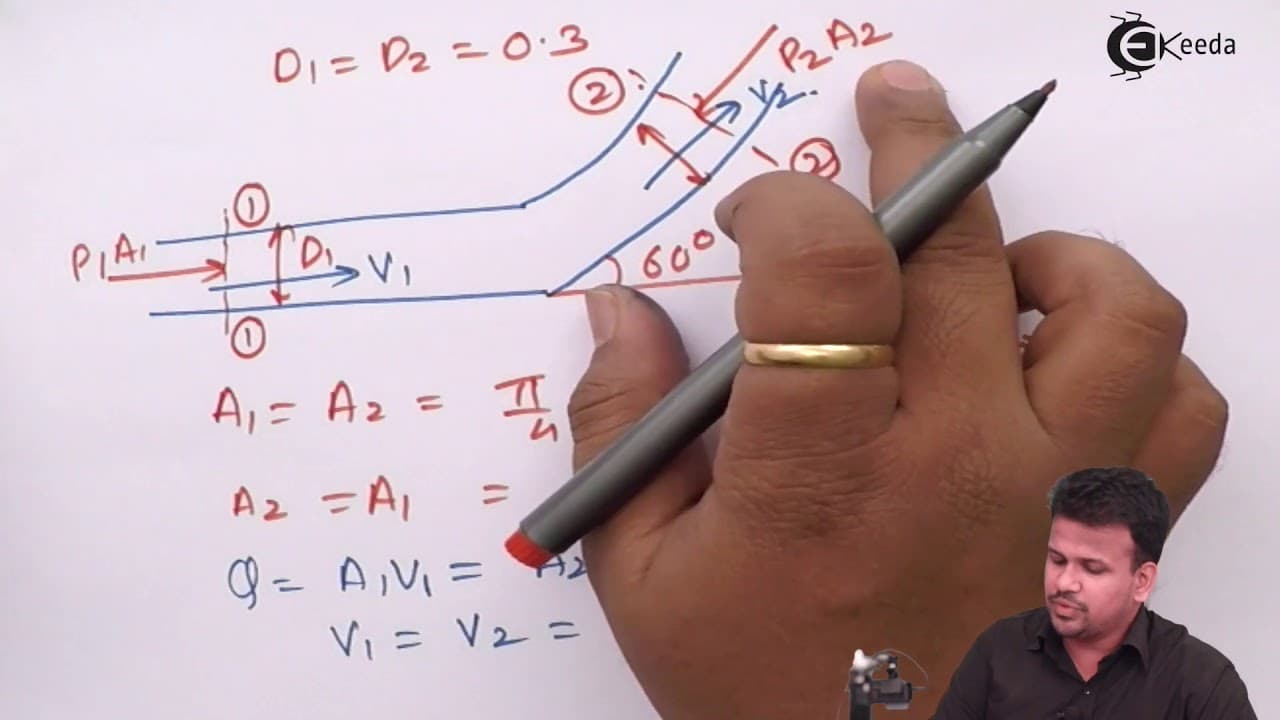
as we have studied fluid dynamics in fluid dynamics we have seen what is reynolds transport theorem navier stroke equation conservation of mass conservation of energy and conservation of momentum so taking all those concept into account let us solve few problems on mint so what is given to us a diameter a 300 mm diameter pipe carries water under a ... Read More
Key Insights
- 💆 Fluid dynamics involves studying concepts like Reynolds transport theorem, Navier-Stokes equation, and conservation principles (mass, energy, and momentum).
- 🤕 Calculating forces on a bend in a pipe requires considering parameters like diameter, pressure head, and velocity.
- 😵 The area of cross-section can be determined using the formula A = pi/4 * d^2, where d is the diameter.
- 🤕 The pressure heads at the inlet and outlet are assumed to be the same due to uniform pressure in the pipe.
- ❣️ The resultant force on the bend can be calculated by combining the forces in the x and y directions.
- 🔺 The calculated angle theta indicates the direction of the resultant force on the bend.
- 💐 Understanding fluid dynamics is essential for solving problems related to pipe systems and fluid flow.
Install to Summarize YouTube Videos and Get Transcripts
Explore YouTube Video Summarizer or Get YouTube Transcript Extractor
Questions & Answers
Q: What are the key concepts studied in fluid dynamics?
In fluid dynamics, key concepts include Reynolds transport theorem, Navier-Stokes equation, and the conservation principles of mass, energy, and momentum.
Q: What are the given parameters for the specific problem discussed?
The given parameters are the diameter of the pipe, pressure head, velocity, and the angle at which the pipe is turned.
Q: How is the area of cross-section calculated?
The area of cross-section is calculated using the formula A = pi/4 * d^2, where d is the diameter of the pipe.
Q: Why are the pressure heads at the inlet and outlet considered the same?
The pressure heads are considered the same because the pipe is assumed to have uniform pressure, resulting in a small force acting on the bend.
Q: How is the resultant force on the bend calculated?
The resultant force is calculated using the formula F = sqrt(Fx^2 + Fy^2), where Fx and Fy are the forces in the x and y directions, respectively.
Q: What is the significance of the calculated angle theta?
The calculated angle theta represents the direction of the resultant force on the bend, measured in degrees.
Summary & Key Takeaways
-
The content discusses the concepts of Reynolds transport theorem, Navier-Stokes equation, conservation of mass, energy, and momentum in fluid dynamics.
-
The problem given is to calculate the magnitude and resultant force on a bend in a pipe with a given diameter, pressure head, and velocity.
-
The analysis involves calculating the area of cross-section, velocities, pressures, and applying the principles of conservation of mass and momentum.
Read in Other Languages (beta)
Share This Summary 📚
Summarize YouTube Videos and Get Video Transcripts with 1-Click
Try YouTube Summary with ChatGPT & Claude or YouTube Transcript Generator
Explore More Summaries from Ekeeda 📚






Summarize YouTube Videos and Get Video Transcripts with 1-Click
Try YouTube Summary with ChatGPT & Claude or YouTube Transcript Generator