Shifting Powers: The Evolution of American Federalism from the Founding to Modern Day
TL;DR
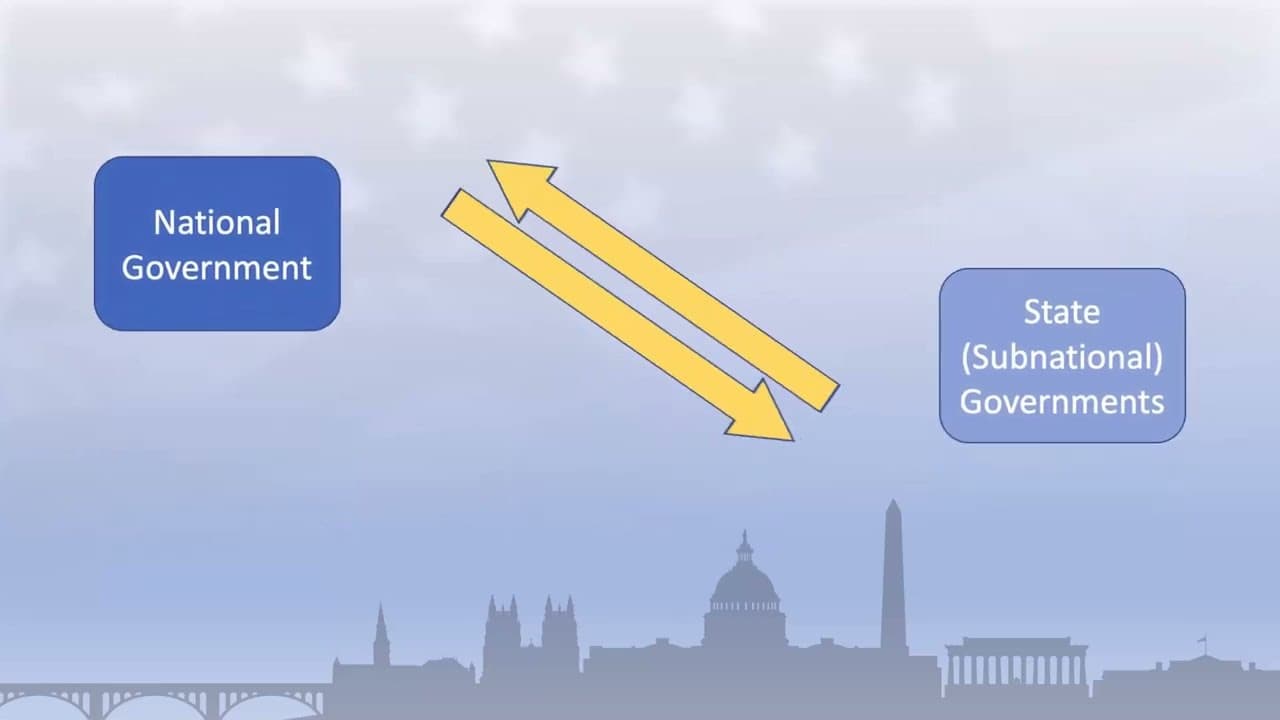
The distribution of power and authority in American federalism has shifted back and forth between the federal government and state governments throughout history.
Transcript
hey everyone and welcome back this is one of a series of videos looking at Key issues and Concepts in American politics in this video we're going to explore the evolution of American federalism over time you should remember from our previous video that Federalism is one of three ways to divide power between the national and subnational governments ... Read More
Key Insights
- ✊ American federalism divides power between the national and state governments.
- ✊ The distribution of power has shifted over time, with periods of greater state or federal power.
- 🗯️ Factors such as court decisions, economic crises, civil rights movements, and expansions of federal programs have influenced the evolution of American federalism.
- ✊ Power struggles between states and the federal government have shaped the balance of power.
- 💢 Different eras of federalism, including dual federalism, cooperative federalism, and new federalism, have characterized different periods in American history.
- 🗯️ The expansion of federal power has often been met with pushback and calls for states' rights.
- 💢 The Civil War and the Civil Rights era had significant impacts on the balance of power between the federal government and states.
Install to Summarize YouTube Videos and Get Transcripts
Explore YouTube Video Summarizer or Get YouTube Transcript Extractor
Questions & Answers
Q: What is federalism and how does it divide power in the United States?
Federalism is a system that divides power between the national and state governments. In the United States, it allows both levels of government to have their own specific powers that cannot be taken away by the other.
Q: How has the distribution of power in American federalism evolved over time?
Initially, more power was retained by the states when the Constitution was adopted. However, through court decisions, economic crises, civil rights movements, and expansions of federal programs, the federal government gradually gained more power, particularly in areas such as commerce regulation and civil rights enforcement.
Q: What role did the courts play in shaping American federalism?
The courts, particularly the Marshall Court, expanded the power of the federal government through landmark decisions. Cases such as McCulloch v. Maryland and Gibbons v. Ogden affirmed the federal government's authority to create a national bank and regulate interstate commerce, respectively, strengthening its power relative to the states.
Q: How did the Nullification Crisis and the Civil War affect federalism?
The Nullification Crisis in 1832 raised questions about the balance of power between the states and the federal government. South Carolina challenged federal tariffs, leading to a threat of military force from President Andrew Jackson. The crisis highlighted tensions between states' rights and federal power. The Civil War ultimately resulted in the defeat of the Confederacy and the abolition of slavery, establishing a stronger central government.
Summary & Key Takeaways
-
American federalism divides power between the national and state governments.
-
The Constitution adopted in 1787 established a federal system with more power retained by the states.
-
Over time, the federal government gained more power through court decisions, economic crises, civil rights movements, and expansions of federal programs.
-
There have been periods of dual federalism, cooperative federalism, and new federalism, shaping the balance of power between the federal and state governments.
Read in Other Languages (beta)
Share This Summary 📚
Summarize YouTube Videos and Get Video Transcripts with 1-Click
Try YouTube Summary with ChatGPT & Claude or YouTube Transcript Generator
Explore More Summaries from Noah Zerbe 📚



Summarize YouTube Videos and Get Video Transcripts with 1-Click
Try YouTube Summary with ChatGPT & Claude or YouTube Transcript Generator