Balancing of V Engines Numerical 1 - Balancing in Dynamics of Machinery - Dynamics of Machinery
TL;DR
This video discusses a numerical analysis of balancing V engines, including calculating primary and secondary forces.
Transcript
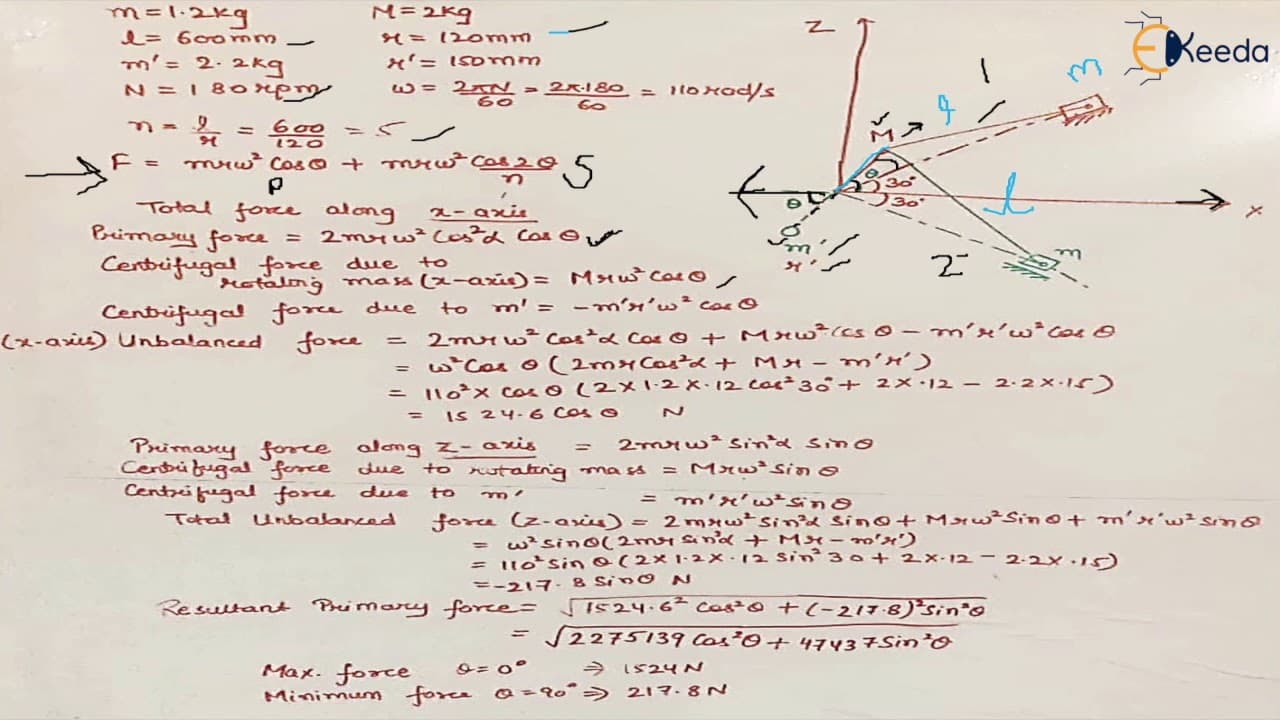
hello everyone in this video we'll discuss a numerical on balancing of v engines so in v engines we already know that two connecting rods they run a common crank shaft so in the question we are given that the cylinders of a v engine they are set at 60 degree angle that means the cylinders of both the engines for both the pistons here at this angle ... Read More
Key Insights
- 🥰 V engines have connecting rods that share a common crankshaft.
- 📳 Balancing V engines involves adding counter masses to reduce vibrations caused by unbalanced forces.
- ❓ Unbalanced forces can be calculated using equations for primary and secondary forces.
- 🔺 The value of the secondary force remains constant, while the primary force varies with the angle.
Install to Summarize YouTube Videos and Get Transcripts
Explore YouTube Video Summarizer or Get YouTube Transcript Extractor
Questions & Answers
Q: What is the purpose of balancing V engines?
Balancing V engines helps reduce vibrations caused by unbalanced forces created by reciprocating and rotating masses, improving engine performance and durability.
Q: How is the primary force along the x-axis calculated?
The primary force along the x-axis is obtained by adding the x-components of the forces produced by the connecting rods, rotating masses, and counter mass. The formula is 2m * r * ω^2 * cos^2(α) * cos(θ).
Q: Why are the centrifugal force effects of rotating masses not considered in calculating secondary forces?
The centrifugal force effects of rotating masses are not considered because they are caused by second harmonics of piston acceleration, which do not contribute to the secondary forces. Only the unbalanced forces from reciprocating parts are taken into consideration.
Q: How do you calculate the resultant primary force?
The resultant primary force is calculated by taking the square root of the sum of the square of the horizontal component and the square of the vertical component. The angle at which the resultant force acts is called the beta angle.
Summary & Key Takeaways
-
The video discusses the setup of a V engine with cylinders set at a 60-degree angle, connecting rod lengths of 600 mm, and a crank radius of 120 mm.
-
The video explains the calculation of primary and secondary forces using the equations for unbalanced forces along the x-axis and z-axis.
-
The video demonstrates how to calculate the resultant primary forces and maximum and minimum forces at different angles.
Read in Other Languages (beta)
Share This Summary 📚
Summarize YouTube Videos and Get Video Transcripts with 1-Click
Try YouTube Summary with ChatGPT & Claude or YouTube Transcript Generator
Explore More Summaries from Ekeeda 📚




Summarize YouTube Videos and Get Video Transcripts with 1-Click
Try YouTube Summary with ChatGPT & Claude or YouTube Transcript Generator