Periodicity of Continuous Time Signals (Problem 5) | Representation of Signals | Signals and Systems
TL;DR
This video discusses how to determine the periodicity of a continuous time signal and find its fundamental time period.
Transcript
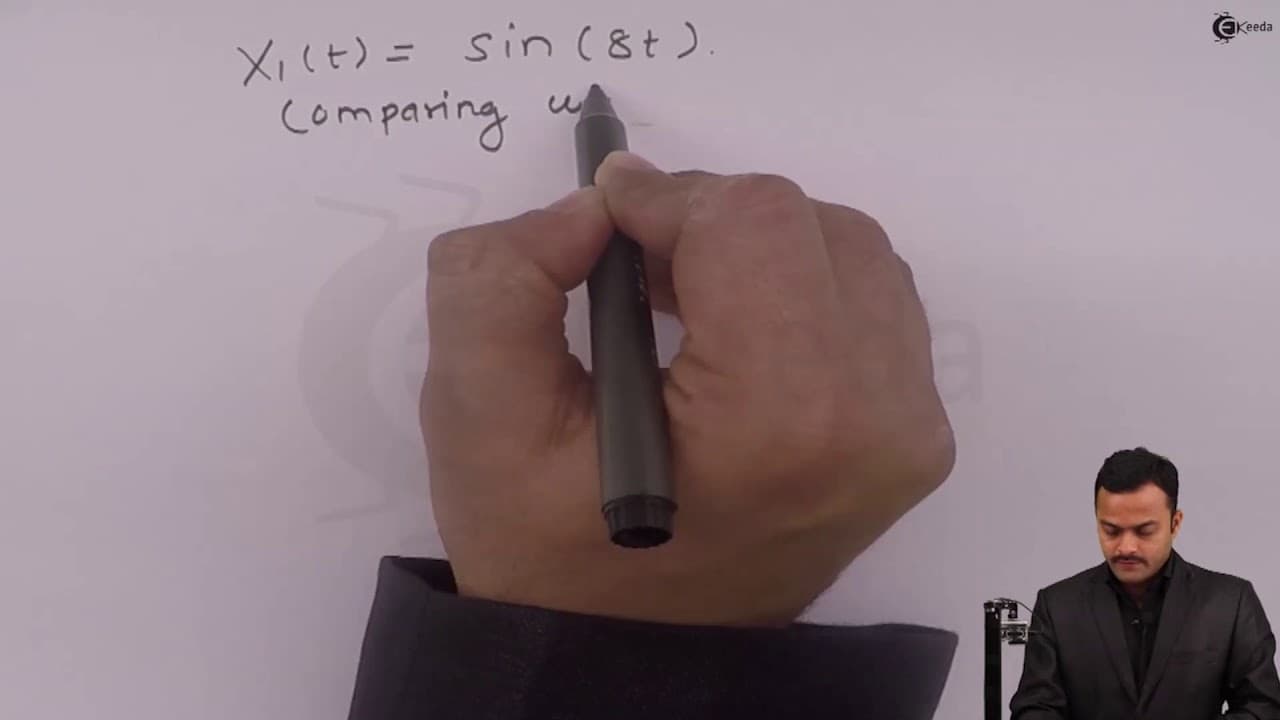
hi students in this video we are going to consider a continuous time signal and we will check its periodicity so the given signal x of t is 2 sine phi t multiplied by cos 3t so for this signal we need to check whether it is a periodic or not and if it is periodic we need to find out fundamental times so see how to solve you may be thinking this is ... Read More
Key Insights
- 📡 Continuous time signals can be periodic or non-periodic, and determining their periodicity is essential in signal analysis.
- 📡 Signals that are multiplications of two signals need to be converted into additions of two signals to determine their fundamental time period.
- 👨💼 Trigonometric formulas like sine a times cos b = (1/2)(sine(a+b) + sine(a-b)) can be used to simplify and analyze complex signals.
- 📡 Comparing converted signals with standard signals and solving equations helps determine the fundamental time periods of individual signals.
- 📡 The ratio of the fundamental time periods of individual signals can be used to ascertain the periodicity of the given signal.
Install to Summarize YouTube Videos and Get Transcripts
Explore YouTube Video Summarizer or Get YouTube Transcript Extractor
Questions & Answers
Q: How can we determine if a continuous time signal is periodic?
To determine the periodicity of a continuous time signal, we need to convert it into a addition or subtraction of two signals using trigonometric formulas and then check if the resulting signals have fundamental time periods.
Q: What is the formula used to convert a multiplication of two trigonometric functions into an addition?
The formula used is sine a times cos b equals (1/2) times (sine(a+b) plus sine(a-b)). Applying this formula helps simplify the given signal and express it as a combination of two signals.
Q: How can we find the fundamental time periods of the individual signals?
To find the fundamental time periods, we compare the converted signals with standard signals and solve equations to determine the values of omega. Omega is then used to calculate the fundamental time periods as 2 pi divided by omega.
Q: How do we determine the fundamental time period of a signal that is a multiplication of two signals?
By taking the ratio of the fundamental time periods of the individual signals and finding that it is a ratio of integers, we can conclude that the given signal is periodic. The fundamental time period of the given signal is then found using the formula LCM(numerator of t1, numerator of t2) divided by GCD(denominator of t1, denominator of t2).
Summary & Key Takeaways
-
The video explains the process of checking whether a given continuous time signal is periodic and finding its fundamental time period.
-
The signal in question is a multiplication of two signals, requiring the use of trigonometric formulas to convert it into an addition of two signals.
-
By comparing the converted signals with standard signals and solving equations, the fundamental time periods of the individual signals can be determined, leading to the identification of the given signal as periodic.
Read in Other Languages (beta)
Share This Summary 📚
Summarize YouTube Videos and Get Video Transcripts with 1-Click
Try YouTube Summary with ChatGPT & Claude or YouTube Transcript Generator
Explore More Summaries from Ekeeda 📚



Summarize YouTube Videos and Get Video Transcripts with 1-Click
Try YouTube Summary with ChatGPT & Claude or YouTube Transcript Generator