Worked example: Lewis diagram of the cyanide ion (CN⁻) | AP Chemistry | Khan Academy
TL;DR
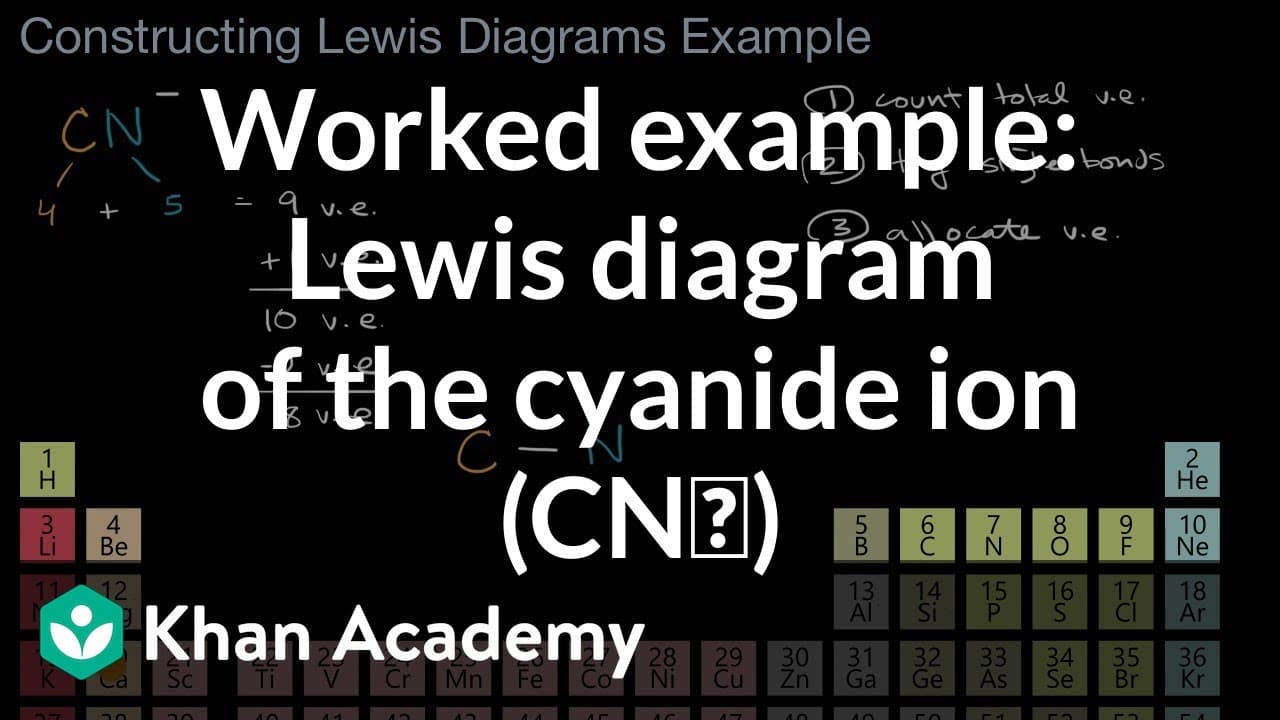
Learn how to construct a Lewis diagram for a cyanide anion, including accounting for valence electrons, allocating them to atoms, and representing charges.
Transcript
- [Instructor] In this video we're gonna try to get more practice constructing Lewis diagrams. And we're gonna try to do that for a cyanide anion. So this is interesting. This is the first time we're constructing a Lewis diagram for an ion. So pause this video and see if you can have a go at that. All right, now let's do this together. So we've alr... Read More
Key Insights
- 😑 Constructing Lewis diagrams for ions requires accounting for the total valence electrons and representing any charges.
- 🫀 Drawing single bonds between atoms helps allocate valence electrons and determine any remaining electrons.
- 🫀 Allocating valence electrons to atoms based on their electronegativity and the octet rule is crucial for a correct Lewis diagram.
- 🫀 Additional bonds can be made by converting lone pairs into covalent bonds to satisfy the octet rule for certain atoms.
Install to Summarize YouTube Videos and Get Transcripts
Explore YouTube Video Summarizer or Get YouTube Transcript Extractor
Questions & Answers
Q: How many valence electrons are there in a neutral carbon atom?
A neutral carbon atom has four valence electrons in its second shell.
Q: How do you account for the negative charge in a Lewis diagram for an ion?
The negative charge in an ion can be represented by adding an extra valence electron to the diagram.
Q: How do you determine which atom is the central atom in a Lewis diagram?
In cases where there are only two atoms, like in a cyanide anion, neither atom feels central, so you can simply choose one as the central atom.
Q: What should be done if an atom does not have an octet of valence electrons in the Lewis diagram?
If an atom does not have an octet, you can create additional bonds by using lone pairs from other atoms to satisfy the octet rule.
Summary & Key Takeaways
-
To construct a Lewis diagram for a cyanide anion, determine the total number of valence electrons (10 in this case) by counting individual atom valence electrons and accounting for the negative charge.
-
Start by drawing a single bond between the carbon and nitrogen atoms, accounting for two valence electrons.
-
Allocate the remaining eight valence electrons, giving nitrogen six lone pairs and carbon two valence electrons.
-
Consider whether additional bonds are needed to satisfy the octet rule, and adjust the diagram accordingly.
-
Finally, represent the negative charge by enclosing the entire molecule in brackets.
Read in Other Languages (beta)
Share This Summary 📚
Summarize YouTube Videos and Get Video Transcripts with 1-Click
Try YouTube Summary with ChatGPT & Claude or YouTube Transcript Generator
Explore More Summaries from Khan Academy 📚



Summarize YouTube Videos and Get Video Transcripts with 1-Click
Try YouTube Summary with ChatGPT & Claude or YouTube Transcript Generator