Watch This Statue Grow Out Of Nothing! 🗽
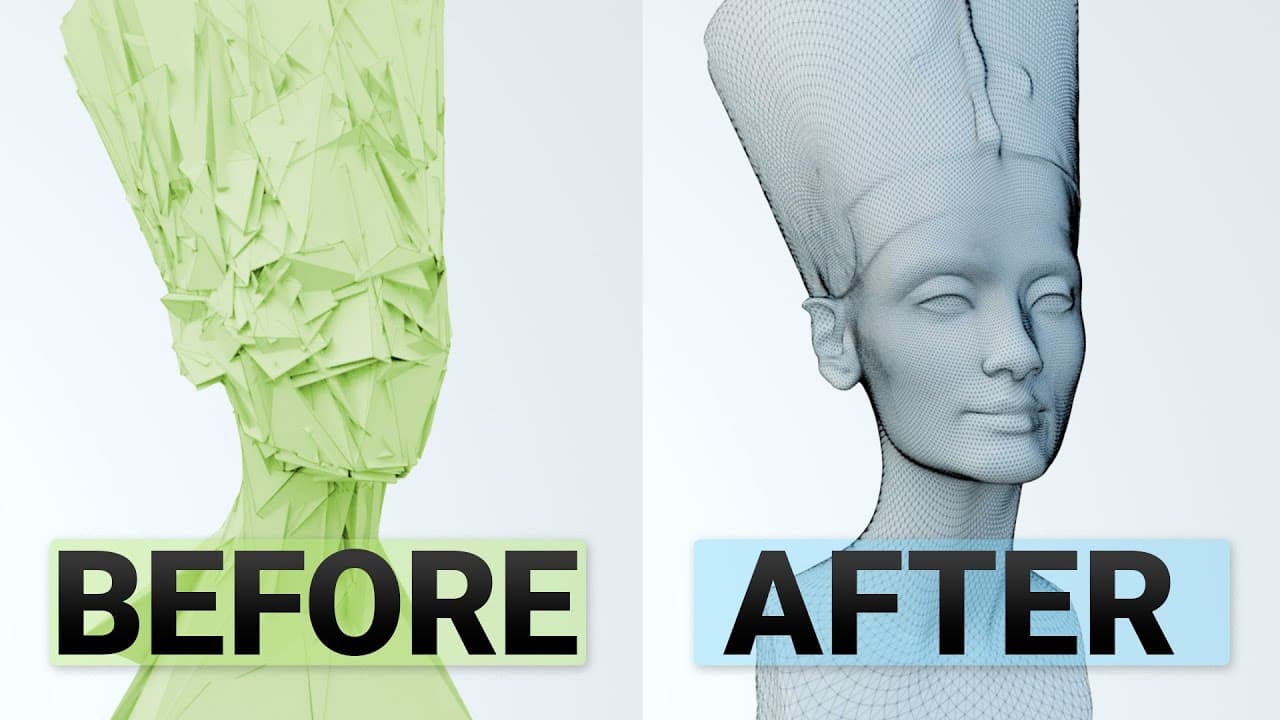
TL;DR
"Learn how differentiable rendering can create digital copies of real world objects and seamlessly integrate them into virtual environments."
Transcript
Dear Fellow Scholars, this is Two Minute Papers with Dr. Károly Zsolnai-Fehér. Today we are going to learn how to take any shape in the real world, make a digital copy of it, and place it into our virtual world. These can be done through something that we call differentiable rendering. What is that? Well, simple, we take a photograph, and find a ph... Read More
Key Insights
- 🌍 Differentiable rendering enables the integration of real world materials into virtual environments, enhancing the realism of virtual objects.
- ✋ Previous methods focused on capturing materials or geometry separately, but the new approach can capture both, albeit with a loss of high-frequency details in some cases.
- 🤳 Self-intersections in mesh geometry pose a challenge, but regularization techniques can help improve the results by guiding the solutions towards smoother geometry.
- 📰 The new method showcased in the paper demonstrates impressive convergence towards accurate geometry, even with complex shapes like a dragon.
- 👻 An isotropic remeshing step allows for further refinement of the geometry, resulting in more accurate and detailed representations.
- 🤗 The potential of importing real geometry into virtual worlds opens up possibilities for more sophisticated methods in the future.
- 🛟 While the current state of the technology may not be highly practical, it serves as a stepping stone for future developments in the field of virtual reality.
Install to Summarize YouTube Videos and Get Transcripts
Explore YouTube Video Summarizer or Get YouTube Transcript Extractor
Questions & Answers
Q: What is differentiable rendering and how does it work?
Differentiable rendering is a technique that takes a photograph and finds a photorealistic material model to simulate the object in a virtual world. This is achieved by matching the photograph with a material model in a light simulation program.
Q: Can differentiable rendering capture both geometry and materials accurately?
Yes, previous methods could only capture either materials or geometry, but the new approach can capture both. However, the trade-off is that some high-frequency details may be lost.
Q: What are the challenges in reproducing 3D geometry from a set of triangles?
The main challenge is dealing with self-intersections, which can result in tangled mesh geometry that is incorrect. Regularization techniques can help guide the solutions towards smoother results.
Q: Can the new method handle complex geometries?
Yes, the new method can handle complex geometries, as demonstrated by successfully reproducing the shape of a dragon. However, some details may still be lacking.
Summary & Key Takeaways
-
Differentiable rendering allows for the creation of photorealistic material models from photographs, enabling the integration of real materials into virtual worlds.
-
While previous methods focused on capturing materials or geometry separately, a new approach can jointly capture both, though some high-frequency details may be lost.
-
Self-intersections in mesh geometry can lead to tangled and incorrect results, but regularization techniques can smooth out the geometry, improving the results.
-
The new method proposed in the paper achieves impressive results, converging on accurate geometry and even working on textures.
Read in Other Languages (beta)
Share This Summary 📚
Summarize YouTube Videos and Get Video Transcripts with 1-Click
Try YouTube Summary with ChatGPT & Claude or YouTube Transcript Generator
Explore More Summaries from Two Minute Papers 📚




Summarize YouTube Videos and Get Video Transcripts with 1-Click
Try YouTube Summary with ChatGPT & Claude or YouTube Transcript Generator