Quantum Entanglement and the EPR Paradox
TL;DR
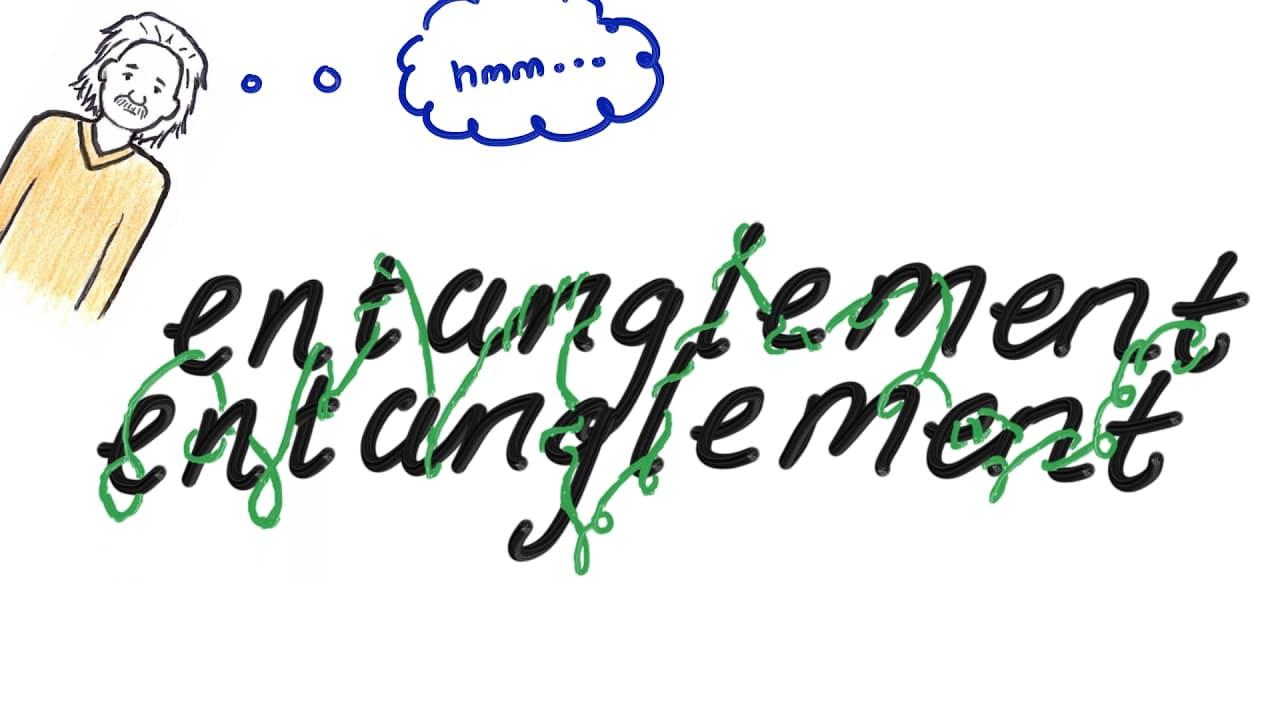
Entanglement is a quantum phenomenon where particles become inseparably linked, and it leads to crazy properties like the EPR paradox.
Transcript
Entanglement is often blamed for all the spooky weirdness of quantum mechanics. In this video I’ll explain what it really is and one of the coolest consequences: the EPR paradox. If you haven’t watched any of my other videos on quantum mechanics, you might want to watch these two- but I’ll have a really quick recap for everyone’s benefit There are ... Read More
Key Insights
- 💄 Entanglement occurs when particles are in a superposition of states, making the state of one particle dependent on the state of the other.
- ❓ In the EPR paradox, measuring the state of one entangled particle instantly affects the state of the other, regardless of distance.
- 🏛️ Entanglement violates our classical understanding of locality and challenges the theory of relativity.
- 🦾 Entanglement is a fundamental property of quantum mechanics and has implications for quantum computing.
- ❓ Entanglement cannot be explained through traditional concepts and requires a quantum understanding.
- 👨🔬 The phenomenon of entanglement was not initially taken seriously by the scientific community, but later research confirmed its existence and nonlocal properties.
- 🦾 Entanglement is a crucial aspect of quantum mechanics that continues to perplex scientists.
Install to Summarize YouTube Videos and Get Transcripts
Explore YouTube Video Summarizer or Get YouTube Transcript Extractor
Questions & Answers
Q: What is the difference between a superposition and a non-quantum scenario?
In a non-quantum scenario, a particle can be in an unknown but definite state, while in a superposition, a particle is simultaneously in multiple states until measured, and those states collapse to a single possibility.
Q: Why is entanglement considered unique to quantum mechanics?
Entanglement is unique to quantum mechanics because it describes a state where particles become inseparably linked, and it is impossible to describe the state of one particle without taking into account the other.
Q: Can the state of an electron in entanglement be a superposition of up and down?
Mathematically, the state of an electron in entanglement cannot be described as a superposition of up and down. Trying to do so would lead to contradictions and violation of conservation laws.
Q: How does entanglement result in nonlocality?
Entanglement leads to nonlocality because measuring the state of one entangled particle instantly affects the state of the other, regardless of their distance from each other. This contradicts the idea of information traveling slower than the speed of light.
Summary & Key Takeaways
-
Entanglement is a quantum phenomenon where particles can exist in multiple states simultaneously, known as superposition.
-
Measurement of particles in a superposition collapses their states to a single possibility.
-
Entanglement occurs when particles preserve this superposition relationship, making it impossible to describe the state of one particle without considering the other.
Read in Other Languages (beta)
Share This Summary 📚
Summarize YouTube Videos and Get Video Transcripts with 1-Click
Try YouTube Summary with ChatGPT & Claude or YouTube Transcript Generator
Explore More Summaries from Looking Glass Universe 📚




Summarize YouTube Videos and Get Video Transcripts with 1-Click
Try YouTube Summary with ChatGPT & Claude or YouTube Transcript Generator