Bootstrapping Main Ideas!!!
TL;DR
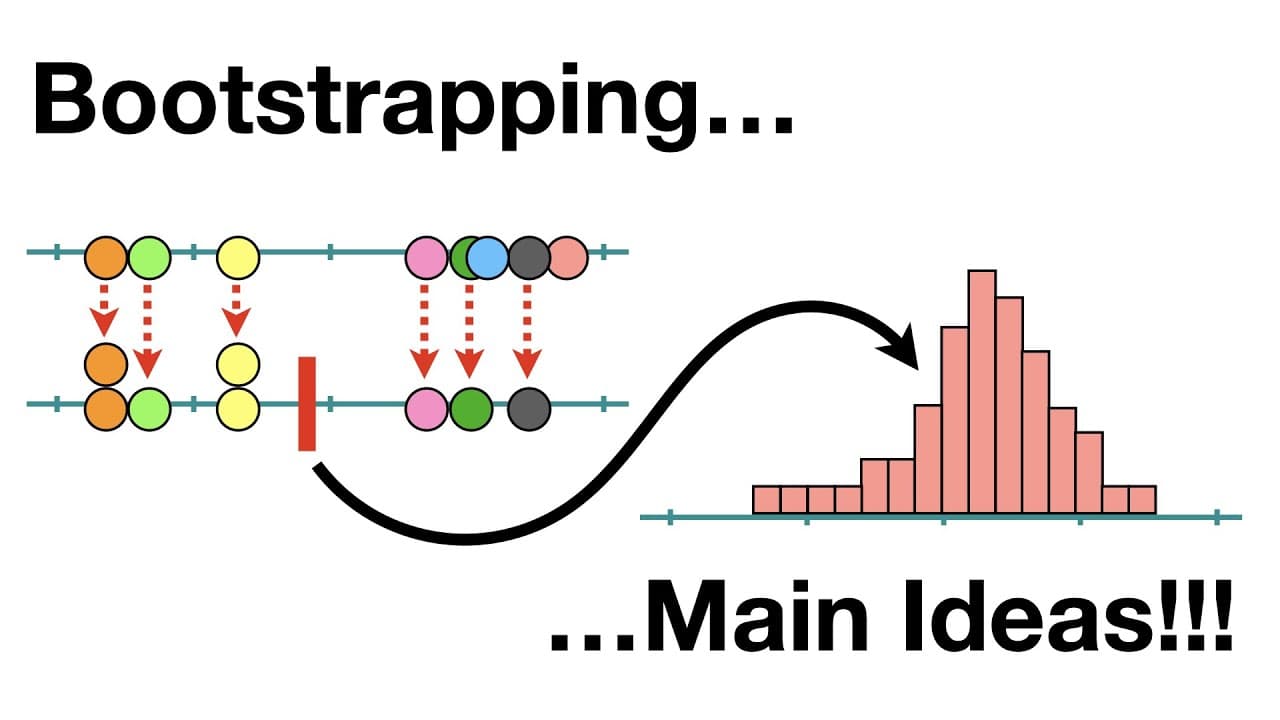
Bootstrapping is a statistical technique that allows for the estimation of uncertainty around a statistic by repeatedly sampling with replacement from the original dataset.
Transcript
quest hello i'm josh starmer and welcome to statquest today we're going to talk about bootstrapping part one main ideas now imagine we had a new drug to treat an illness and we gave that drug to 8 different people that had the illness for 5 of these people the drug appeared to help them feel better but for three people the drug appeared to make the... Read More
Key Insights
- ❓ Bootstrapping is a resampling technique used to estimate uncertainty around a statistic by randomly selecting values with replacement from the original dataset.
- ⌛ It is a cost-effective and time-saving alternative to replicating experiments multiple times.
- 🉐 By generating bootstrapped datasets and calculating the statistic of interest, insights into its distribution and variability can be gained.
- ❓ Bootstrapping can be used to calculate standard errors and confidence intervals without relying on specific formulas.
- 📈 It provides flexibility in analyzing various statistics and can be applied to any metric of interest.
- 🔁 The histogram of bootstrapped means can help assess the likelihood of obtaining different results if the experiment is repeated.
- 👻 Bootstrapping allows for the interpretation of initial results in the context of a distribution, aiding in statistical inference.
Install to Summarize YouTube Videos and Get Transcripts
Explore YouTube Video Summarizer or Get YouTube Transcript Extractor
Questions & Answers
Q: What is bootstrapping and how is it used in statistics?
Bootstrapping is a resampling technique used to estimate uncertainty around a statistic. It involves randomly selecting values from the original dataset with replacement to create bootstrapped datasets. These datasets are then used to calculate the statistic of interest, such as the mean or median, and to generate insights into its distribution.
Q: Why is bootstrapping advantageous compared to replicating experiments?
Bootstrapping is advantageous because it allows for the estimation of uncertainty without having to replicate experiments multiple times. By resampling from the original dataset, it captures the variability that can occur due to random factors. This makes it a cost-effective and time-saving approach for statistical analysis.
Q: How is bootstrapping used to calculate standard errors and confidence intervals?
Bootstrapping can be used to calculate standard errors and confidence intervals by creating a distribution of the statistic of interest. By repeatedly sampling from the bootstrapped datasets, the variability of the statistic can be assessed. The standard deviation of this distribution provides the standard error, while the range of values that encompass a certain percentage (e.g., 95%) of the distribution gives the confidence interval.
Q: What are some advantages of using bootstrapping in statistical analysis?
Some advantages of bootstrapping include its flexibility in analyzing various statistics, as it can be applied to any metric of interest. It also provides insights into the variability of the statistic and allows for the estimation of uncertainty without relying on specific formulas, making it applicable in different research areas and study designs.
Key Insights:
- Bootstrapping is a resampling technique used to estimate uncertainty around a statistic by randomly selecting values with replacement from the original dataset.
- It is a cost-effective and time-saving alternative to replicating experiments multiple times.
- By generating bootstrapped datasets and calculating the statistic of interest, insights into its distribution and variability can be gained.
- Bootstrapping can be used to calculate standard errors and confidence intervals without relying on specific formulas.
- It provides flexibility in analyzing various statistics and can be applied to any metric of interest.
- The histogram of bootstrapped means can help assess the likelihood of obtaining different results if the experiment is repeated.
- Bootstrapping allows for the interpretation of initial results in the context of a distribution, aiding in statistical inference.
- It is a valuable tool in statistics and machine learning that can be applied in a wide range of research areas.
Summary & Key Takeaways
-
Bootstrapping is an alternative to replicating experiments multiple times, which can be expensive and time-consuming.
-
It involves creating bootstrapped datasets by randomly selecting values from the original dataset with replacement.
-
The means of these bootstrapped datasets are then used to create a histogram, which provides insights into the variability of the statistic of interest.
Read in Other Languages (beta)
Share This Summary 📚
Summarize YouTube Videos and Get Video Transcripts with 1-Click
Try YouTube Summary with ChatGPT & Claude or YouTube Transcript Generator
Explore More Summaries from StatQuest with Josh Starmer 📚

Summarize YouTube Videos and Get Video Transcripts with 1-Click
Try YouTube Summary with ChatGPT & Claude or YouTube Transcript Generator