Free Expansion, Energy Transfer by Heat and Adiabatic Process
TL;DR
This video discusses free expansion, energy transfer by heat, and adiabatic processes, highlighting the concepts of work, heat transfer, and path functions.
Transcript
hello friends so in this video i am going to discuss free expansion energy transfer by heat and adiabatic process to discuss a free expansion let us consider a system consisting of both gas and vacuum which are separated by partition when the partition is removed the gas expands and fills the space of the vacuum here the expansion of gas against th... Read More
Key Insights
- 🫢 Free expansion occurs when a gas expands into a vacuum, and no work transfer takes place across the system boundary.
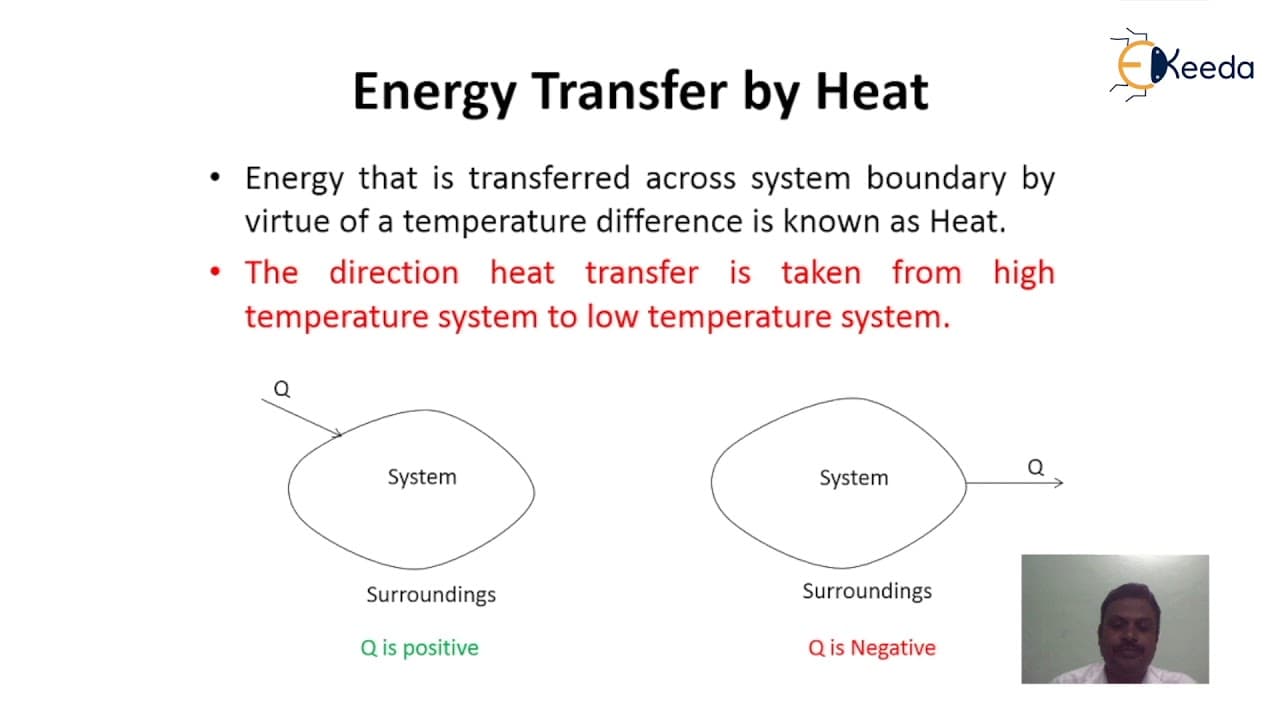
- 😘 Heat transfer always occurs from a region of higher temperature to a region of lower temperature.
- 🥵 Heat and work are both boundary phenomena observed at the boundaries of a system.
- 🥵 Adiabatic processes have no heat interaction with the surroundings.
- 🥵 The amount of heat involved in a process depends on the path followed during the process.
- 🚒 Adiabatic processes are common in engines, with the compression and expansion strokes considered to be adiabatic.
- 🥵 Heat transfer is mathematically represented as positive when added to the system and negative when rejected.
Install to Summarize YouTube Videos and Get Transcripts
Explore YouTube Video Summarizer or Get YouTube Transcript Extractor
Questions & Answers
Q: What is free expansion?
Free expansion refers to the expansion of a gas into a vacuum without any work transfer across the system boundary. In this process, the gas fills the space previously occupied by the vacuum.
Q: What is the difference between heat and work?
Heat and work are both boundary phenomena observed at the boundaries of a system. Heat transfer is due to a temperature difference, while work involves a change in volume. Heat and work are path functions and their amounts depend on the path followed during a process.
Q: What is an adiabatic process?
An adiabatic process is one in which no heat interaction takes place between the system and the surroundings. This means that the heat transfer in an adiabatic process is zero. The compression and expansion strokes of a Carnot heat engine are considered to be adiabatic.
Q: How is heat transfer represented mathematically?
Heat added to the system is taken as positive, while heat rejected from the system is taken as negative. The duration of heat transfer is from a higher temperature region to a lower temperature region. Heat transfer occurs through contact between bodies of different temperatures.
Summary & Key Takeaways
-
Free expansion occurs when a gas expands into a vacuum with no work transfer across the system boundary.
-
Heat transfer is the energy transfer due to temperature difference, always occurring from high to low temperature regions.
-
Adiabatic processes have no heat interaction with the surroundings, and the amount of heat involved in a process depends on the path followed.
Read in Other Languages (beta)
Share This Summary 📚
Summarize YouTube Videos and Get Video Transcripts with 1-Click
Try YouTube Summary with ChatGPT & Claude or YouTube Transcript Generator
Explore More Summaries from Ekeeda 📚

Summarize YouTube Videos and Get Video Transcripts with 1-Click
Try YouTube Summary with ChatGPT & Claude or YouTube Transcript Generator