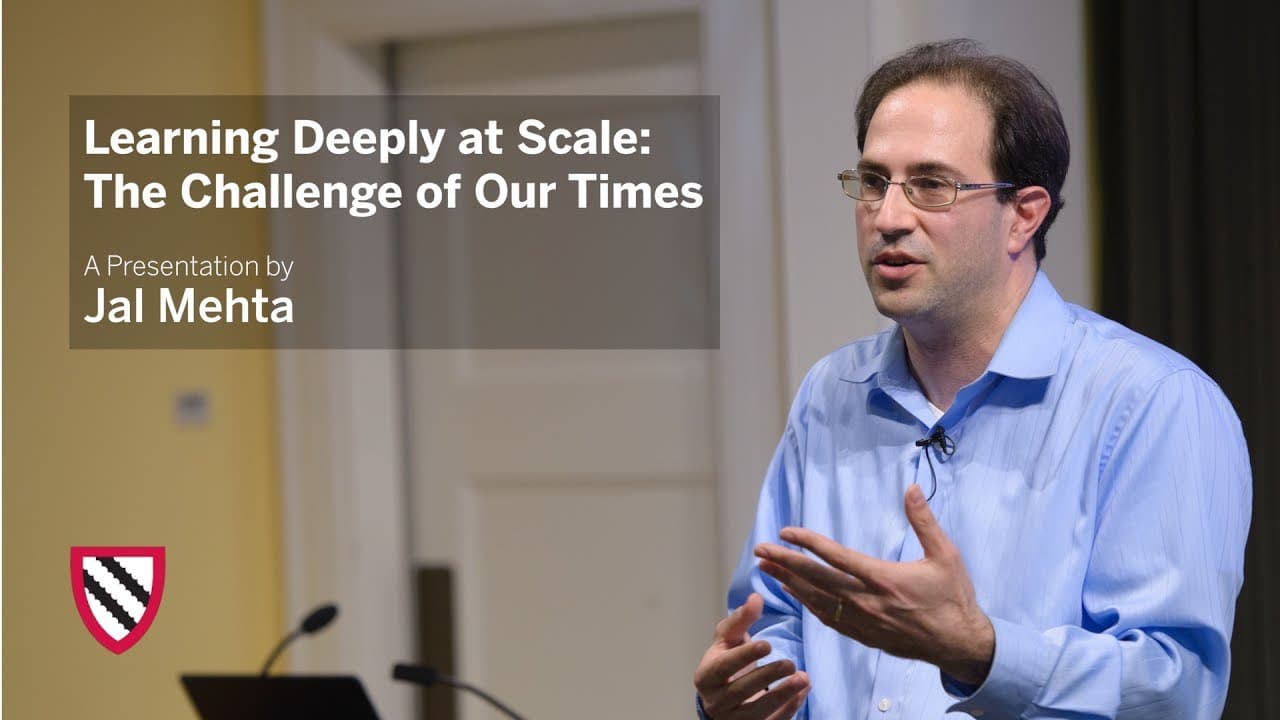
Jal Mehta | Learning Deeply at Scale: The Challenge of Our Times || Radcliffe Institute
TL;DR
Deeper learning is rare but valuable in schools, with challenges including the traditional grammar of schooling, unequal distribution of opportunities, and a focus on breadth over depth. However, there are also opportunities for change, such as improving teacher standards and training, shifting assessment methods, and creating vertically integrated communities of learning.
Transcript
[MUSIC PLAYING] - All right. So today I'm here to talk about Learning Deeply at Scale: the Challenge of our Times. So this comes out of a five-year research project that my doctoral colleague at the ed school, Sarah Fine, and I have been conducting. It's a study of ambitious instruction-- instruction which is rigorous, challenging, engaging-- in Am... Read More
Key Insights
- 🧑🎓 Deeper learning is not common in American schools, but it is valuable for students' engagement, motivation, and long-term success.
- ⛔ The traditional grammar of schooling, with its emphasis on coverage and standardized testing, limits opportunities for deeper learning.
- ❓ The unequal distribution of opportunities for deeper learning further widens educational inequities.
- 🧑🏫 Teacher standards need to prioritize content knowledge and provide ongoing professional development for teachers to support deeper learning.
- 🤔 Assessment methods should be shifted to prioritize higher-order thinking skills and application of knowledge.
Install to Summarize YouTube Videos and Get Transcripts
Explore YouTube Video Summarizer or Get YouTube Transcript Extractor
Questions & Answers
Q: What are the challenges to achieving deeper learning in American schools?
The challenges include the traditional grammar of schooling, which emphasizes coverage rather than in-depth learning, as well as the unequal distribution of opportunities for deeper learning. Additionally, student engagement and motivation can be hindered by a performance-oriented mindset.
Q: How can teacher standards be improved to support deeper learning?
Teacher standards should prioritize content knowledge, as this forms the foundation for deeper learning. Teachers should also be provided with ongoing professional development opportunities that introduce them to different pedagogical approaches and show them what deeper learning looks like.
Q: How can assessment methods be shifted to prioritize depth over breadth?
One approach is to move away from standardized tests that focus on regurgitating information and instead emphasize higher-order thinking skills, problem-solving, and the ability to apply knowledge in real-world contexts. Performance-based assessments, such as project-based tasks or open-ended essay questions, can be used to assess deeper learning.
Q: What are vertically integrated communities of learning?
Vertically integrated communities of learning involve students of different grade levels working together on a common task or domain. This allows for the sharing of knowledge, skills, and experiences across different levels of expertise and fosters a sense of collective identity and purpose.
Summary & Key Takeaways
-
Deeper learning is not common in American schools, with most classrooms focusing on covering material rather than engaging students in meaningful, in-depth learning experiences.
-
The traditional grammar of schooling, emphasis on breadth over depth, and unequal distribution of opportunities for deeper learning contribute to these challenges.
-
However, there are opportunities for change, such as improving teacher standards, shifting assessment methods to prioritize depth, and creating vertically integrated communities of learning.
Read in Other Languages (beta)
Share This Summary 📚
Summarize YouTube Videos and Get Video Transcripts with 1-Click
Try YouTube Summary with ChatGPT & Claude or YouTube Transcript Generator
Explore More Summaries from Harvard University 📚



Summarize YouTube Videos and Get Video Transcripts with 1-Click
Try YouTube Summary with ChatGPT & Claude or YouTube Transcript Generator