Tutorial: Rocket Science! (plus special announcement)
TL;DR
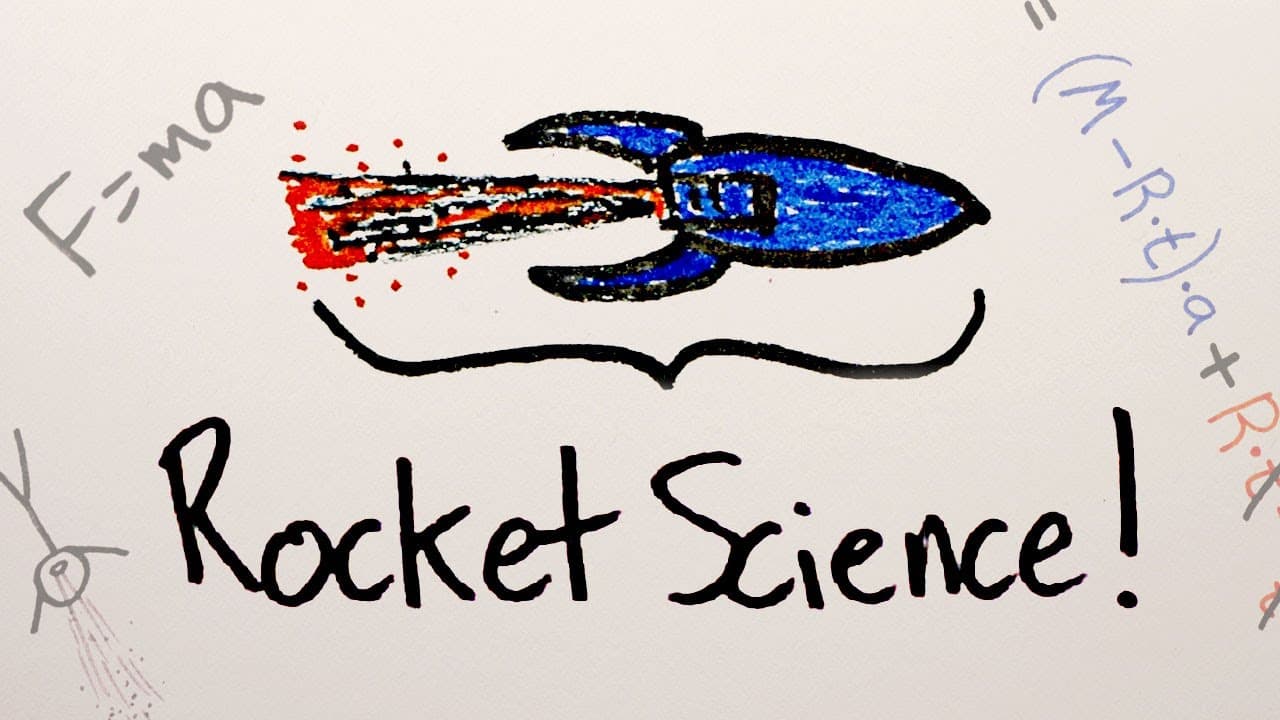
This video explains the basic dynamics of a rocket, including the forces of gravity and exhaust velocity.
Transcript
Hello, and welcome to the Minute Physics tutorial on basic Rocket Science. Before we get started, I'd like to quickly announce that I'm now making these videos at the perimeter institute for theoretical physics So keep your eyes out for plenty of upcoming videos about string theory black holes the Higgs Boson and so on Now, back to Rocket science. ... Read More
Key Insights
- 🚀 Rockets experience gravitational force, which affects their acceleration.
- 💆 Ejecting fuel changes the rocket's mass and acceleration.
- ☠️ The rate and velocity of the exhaust determine the amount of fuel needed for a rocket to hover.
- ☠️ The volume of the exhaust can be calculated using the rate and velocity of the exhaust.
- 🚀 Understanding basic rocket dynamics is essential for designing and launching rockets.
- 🚀 Rocket science involves complex calculations and considerations.
- 🖐️ Fuel consumption plays a crucial role in rocket flight and efficiency.
Install to Summarize YouTube Videos and Get Transcripts
Explore YouTube Video Summarizer or Get YouTube Transcript Extractor
Questions & Answers
Q: How does the force of gravity affect a rocket?
The force of gravity on a rocket is equal to the rocket's mass multiplied by the gravitational acceleration, causing it to fall downward.
Q: What happens to the mass and acceleration of a rocket when it starts ejecting fuel?
As fuel is ejected, the rocket's mass decreases, resulting in a change of acceleration.
Q: What determines the amount of fuel needed for a rocket to hover?
The amount of fuel needed for a rocket to hover is determined by the rate and velocity of the exhaust.
Q: How can the volume of the exhaust be calculated?
The volume of the exhaust can be calculated by multiplying the rate of exhaust by the velocity of the exhaust.
Summary & Key Takeaways
-
The force of gravity on a rocket with fuel is equal to the rocket's mass multiplied by the gravitational acceleration.
-
As fuel is ejected, the rocket's mass decreases, causing a change in acceleration.
-
The amount of fuel that needs to be expelled for a rocket to hover is determined by the rate and velocity of the exhaust.
Read in Other Languages (beta)
Share This Summary 📚
Summarize YouTube Videos and Get Video Transcripts with 1-Click
Try YouTube Summary with ChatGPT & Claude or YouTube Transcript Generator
Explore More Summaries from minutephysics 📚



Summarize YouTube Videos and Get Video Transcripts with 1-Click
Try YouTube Summary with ChatGPT & Claude or YouTube Transcript Generator