The Battle for Ratification: Federalists vs. Anti-Federalists and the Making of the US Constitution
TL;DR
Federalists and Anti-Federalists debated the ratification of the US Constitution, with the former supporting a strong federal government and the latter seeking stronger state governments and greater protection for individual rights.
Transcript
hey everyone and welcome back in an earlier video we looked at the various debates and compromises that resulted in the drafting of the US Constitution in Philadelphia in the summer of 1787 in this video we're going to look at the debates over ratification of the Constitution including the positions articulated by the Federalists and Anti-Federalis... Read More
Key Insights
- 💁 The debate over ratification between Federalists and Anti-Federalists shaped the formation of the US Constitution and its final text.
- 💪 The Federalists supported a strong federal government, while the Anti-Federalists favored stronger state governments and individual rights.
- 🥺 The Federalist Papers and Anti-Federalist papers played a crucial role in shaping the debates and led to the addition of a Bill of Rights.
Install to Summarize YouTube Videos and Get Transcripts
Explore YouTube Video Summarizer or Get YouTube Transcript Extractor
Questions & Answers
Q: Who were the Federalists and what were their main arguments for ratification?
The Federalists, including Madison and Hamilton, believed in expanding federal powers to counter the weaknesses of the Articles of Confederation. They argued that checks and balances in the Constitution and broad protection for property rights would prevent abuses of government power.
Q: What were the main concerns of the Anti-Federalists regarding the new constitution?
The Anti-Federalists, led by Henry and Adams, feared the concentration of power in the hands of the political elite. They preferred stronger state governments and demanded greater protection for individual rights, including a Bill of Rights.
Q: How did the Federalist Papers and Anti-Federalist papers contribute to the debates over ratification?
The Federalist Papers, written by Hamilton, Madison, and Jay, explained and defended the Constitution. The Anti-Federalist papers, written by various authors, raised concerns about individual liberties and state sovereignty. Both sets of papers shaped the debates and led to the addition of a Bill of Rights.
Q: What were the significant contributions of the Federalist Papers?
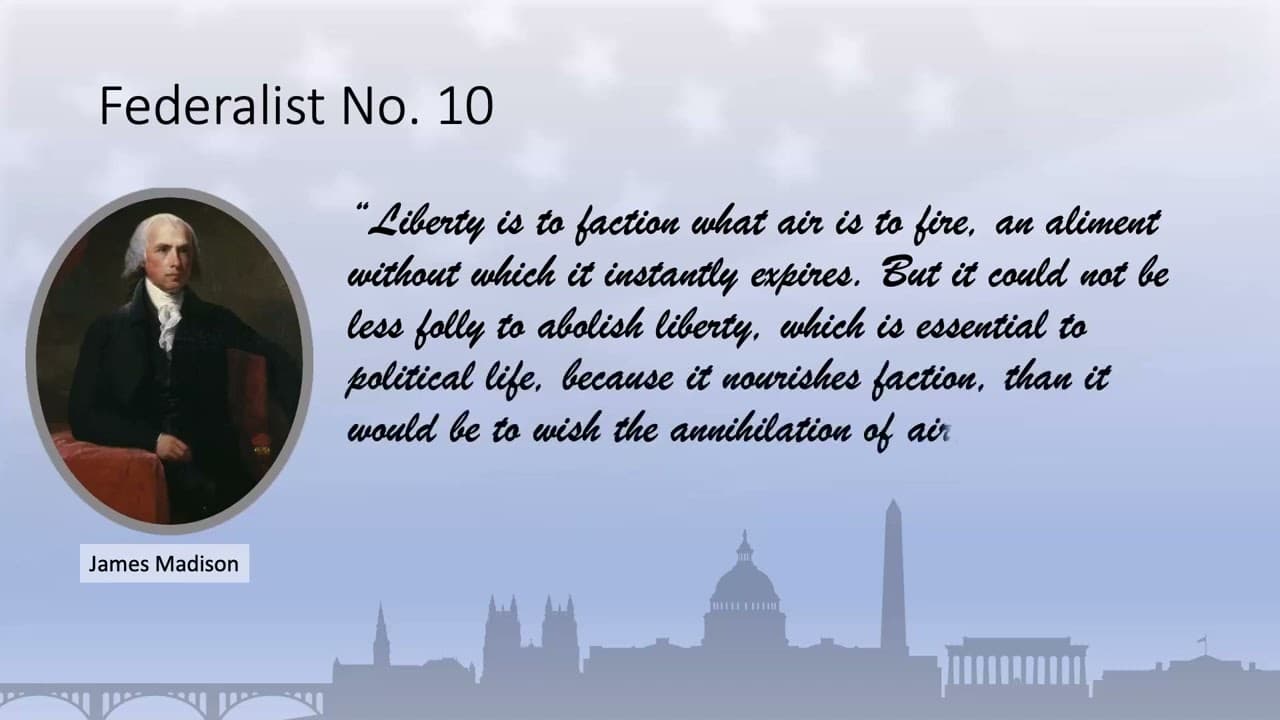
The Federalist Papers, particularly numbers 10, 51, 78, and 84, addressed the problems of factions, advocated for checks and balances, emphasized the importance of an independent judiciary, and argued against the inclusion of a Bill of Rights.
Summary & Key Takeaways
-
The debate over ratification pitted the Federalists, led by figures like Madison and Hamilton, against the Anti-Federalists, led by Henry and Adams.
-
Federalists supported ratification and expansion of federal powers, while Anti-Federalists favored stronger state governments and individual rights.
-
The Federalist Papers, published in local newspapers, and the Anti-Federalist papers shaped the debates and the addition of a Bill of Rights to protect individual liberties.
Read in Other Languages (beta)
Share This Summary 📚
Summarize YouTube Videos and Get Video Transcripts with 1-Click
Try YouTube Summary with ChatGPT & Claude or YouTube Transcript Generator
Explore More Summaries from Noah Zerbe 📚





Summarize YouTube Videos and Get Video Transcripts with 1-Click
Try YouTube Summary with ChatGPT & Claude or YouTube Transcript Generator