Optimal angle for a projectile part 2: Hangtime | Physics | Khan Academy
TL;DR
The time an object is in the air when thrown vertically can be calculated using its vertical velocity and the acceleration due to gravity.
Transcript
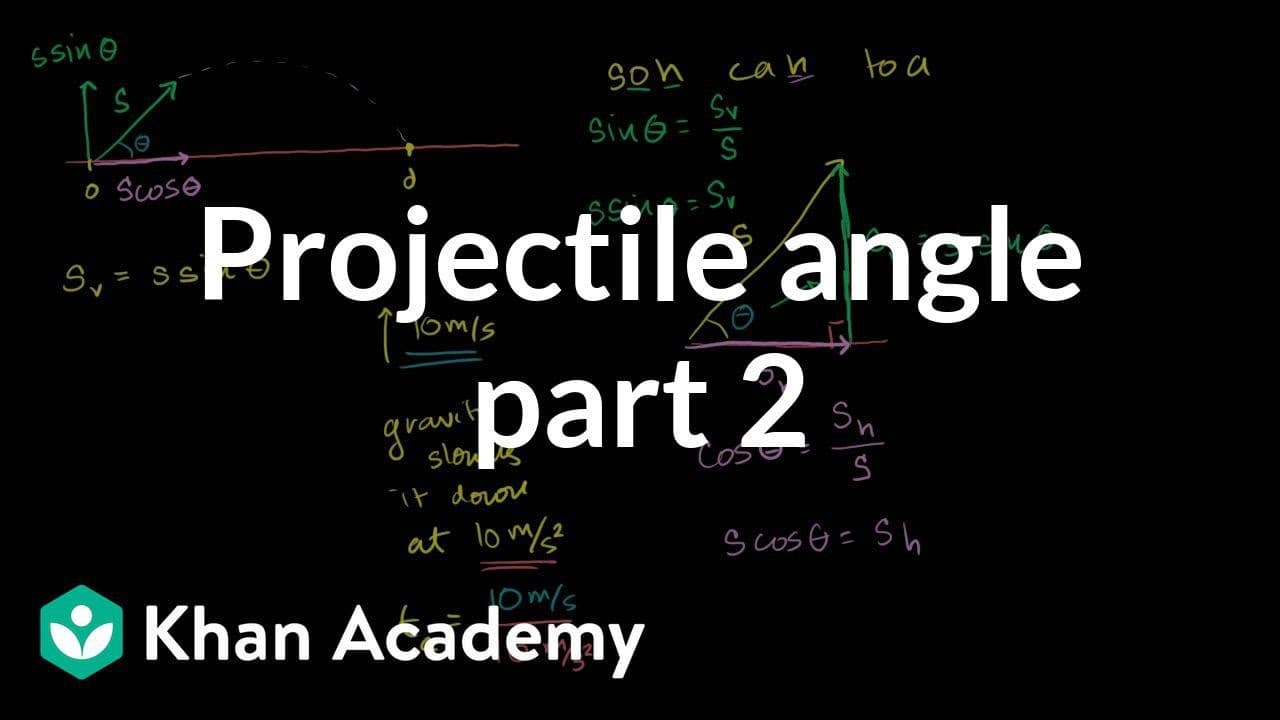
Let's figure out how long this object is going to be in the air given that its vertical velocity, or the magnitude of the vertical velocity is s sine of theta. So its speed in the vertical direction is s sine of theta. So how long is it going to be in the air? Well if I told you that something is going upwards at 10 meters per second and gravity is... Read More
Key Insights
- ⌛ Time in the air for an object thrown vertically is the sum of the time taken to reach maximum height and fall back down to the ground.
- 👱 The time in the air is determined by the object's vertical velocity and the acceleration due to gravity.
- 🥺 An increase in the object's upward velocity leads to a longer time in the air.
- 👱 The calculation assumes no air resistance, making it a simplified model.
- 👱 The formula for calculating time in the air is (2 * vertical velocity) / acceleration due to gravity.
- 👱 The time in the air is the same for the upward and downward journey of the object.
- 🍂 The acceleration due to gravity causes the object to decelerate and eventually fall back to the ground.
Install to Summarize YouTube Videos and Get Transcripts
Explore YouTube Video Summarizer or Get YouTube Transcript Extractor
Questions & Answers
Q: How can the time in the air of an object thrown vertically be calculated?
The time in the air can be calculated by dividing twice the vertical velocity of the object by the acceleration due to gravity. It represents the time taken for the object to reach maximum height and fall back to the ground.
Q: What is the significance of the acceleration due to gravity in calculating the time in the air?
The acceleration due to gravity acts as a deceleration force on the object, causing it to slow down and eventually stop before falling back. It plays a crucial role in determining the time taken for the object to be in the air.
Q: Does the upward velocity of the object affect the time in the air?
Yes, the greater the upward velocity, the longer the object will remain in the air. This is because it will take more time for the object to reach maximum height and then fall back down to the ground.
Q: Is air resistance taken into account in this calculation?
The calculation assumes no air resistance, making it a simplified and ideal scenario. In practical situations, air resistance would affect the motion of the object and alter the calculated time in the air.
Summary & Key Takeaways
-
An object thrown upwards at a speed of 10 meters per second will take 1 second to reach its maximum height and then another second to fall back to the ground.
-
The time in the air for an object thrown vertically is equal to twice the time it takes to reach maximum height.
-
The time in the air can be calculated using the formula: time = (2 * vertical velocity) / acceleration due to gravity.
Read in Other Languages (beta)
Share This Summary 📚
Summarize YouTube Videos and Get Video Transcripts with 1-Click
Try YouTube Summary with ChatGPT & Claude or YouTube Transcript Generator
Explore More Summaries from Khan Academy 📚



Summarize YouTube Videos and Get Video Transcripts with 1-Click
Try YouTube Summary with ChatGPT & Claude or YouTube Transcript Generator