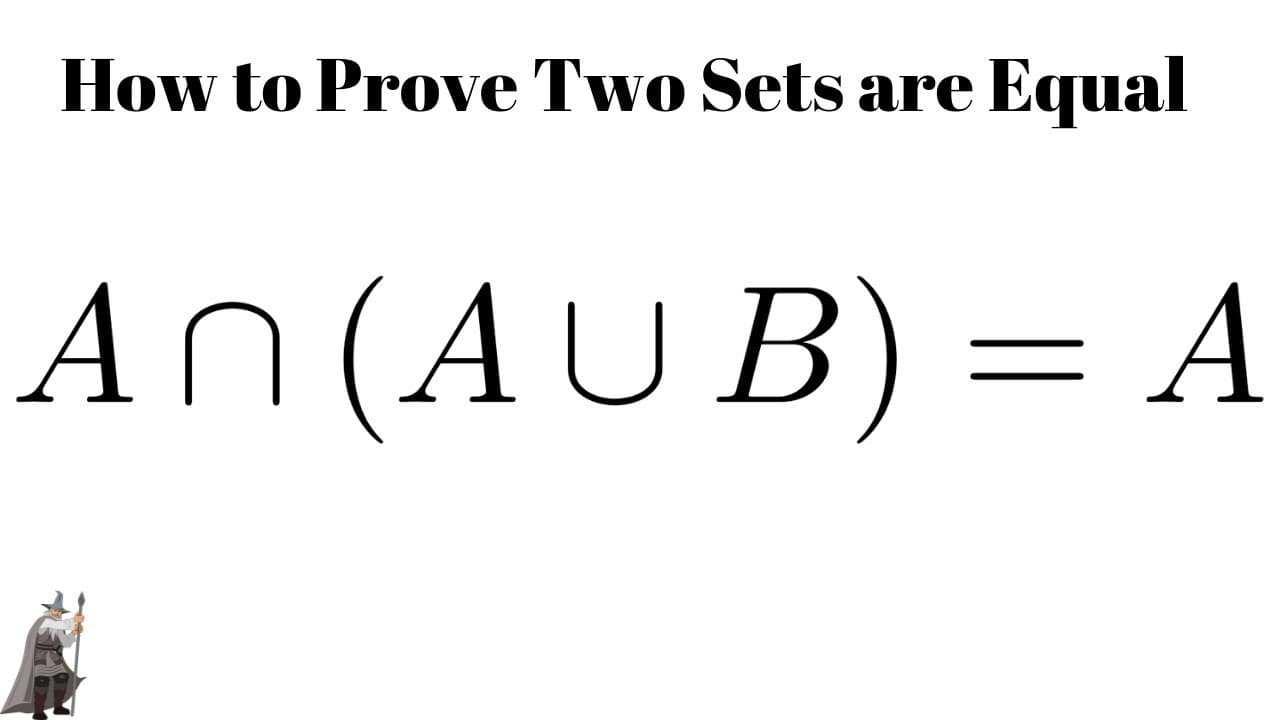
How to Prove Two Sets are Equal using the Method of Double Inclusion A n (A u B) = A
TL;DR
The video provides a proof showing that the intersection of set A with the union of set A and set B is equal to set A.
Transcript
hi everyone in this video we're going to prove that a intersection with a union B is equal to a so before we do the proof a couple things need to be noted so the first is the definition of Union so if you have a union B recall that this is the set of all X such that X is an a or X is in B so the or here is an inclusive or alright that's how or math... Read More
Key Insights
- 🎁 The video presents a proof of the intersection with union identity in a step-by-step manner.
- 🇪🇺 The definitions of union and intersection are explained clearly.
- 😫 The method of double inclusion is a powerful technique for proving set equality.
Install to Summarize YouTube Videos and Get Transcripts
Explore YouTube Video Summarizer or Get YouTube Transcript Extractor
Questions & Answers
Q: What is the definition of the union of two sets?
The union of sets A and B includes all elements that are either in set A, in set B, or in both sets.
Q: What is the definition of the intersection of two sets?
The intersection of sets A and B includes all elements that are both in set A and in set B.
Q: What is the method of double inclusion?
The method of double inclusion is used to prove set equality by demonstrating that each set is a subset of the other.
Q: How does the proof show that A intersection (A union B) is a subset of A?
The proof starts by assuming an element X in A intersection (A union B) and shows that X is also in A, confirming the subset relationship.
Q: How does the proof show that A is a subset of A intersection (A union B)?
The proof starts by assuming an element X in A and shows that X is also in A intersection (A union B), confirming the subset relationship.
Q: How is the term "arbitrary" used in the proof?
The term "arbitrary" indicates that any element can be chosen, allowing the proof to be applicable to all elements of the set.
Q: Why is it important to show that both sets are subsets of each other?
By showing that each set is a subset of the other, the proof establishes that they have the same elements, proving set equality.
Q: What does the method of double inclusion ultimately conclude?
The method of double inclusion concludes that set A intersection (A union B) is equal to set A.
Key Insights:
- The video presents a proof of the intersection with union identity in a step-by-step manner.
- The definitions of union and intersection are explained clearly.
- The method of double inclusion is a powerful technique for proving set equality.
- The proof emphasizes the importance of showing both subsets relations to establish set equality.
Summary & Key Takeaways
-
The video explains the definitions of union and intersection.
-
It introduces the method of double inclusion for proving set equality.
-
The proof is divided into two parts: showing that A intersection (A union B) is a subset of A, and showing that A is a subset of A intersection (A union B).
Read in Other Languages (beta)
Share This Summary 📚
Summarize YouTube Videos and Get Video Transcripts with 1-Click
Try YouTube Summary with ChatGPT & Claude or YouTube Transcript Generator
Explore More Summaries from The Math Sorcerer 📚
Summarize YouTube Videos and Get Video Transcripts with 1-Click
Try YouTube Summary with ChatGPT & Claude or YouTube Transcript Generator