Limits of combined functions: piecewise functions | AP Calculus AB | Khan Academy
TL;DR
The limits of functions approaching a specific value may not exist, but the sum or product of these functions can still have a limit.
Transcript
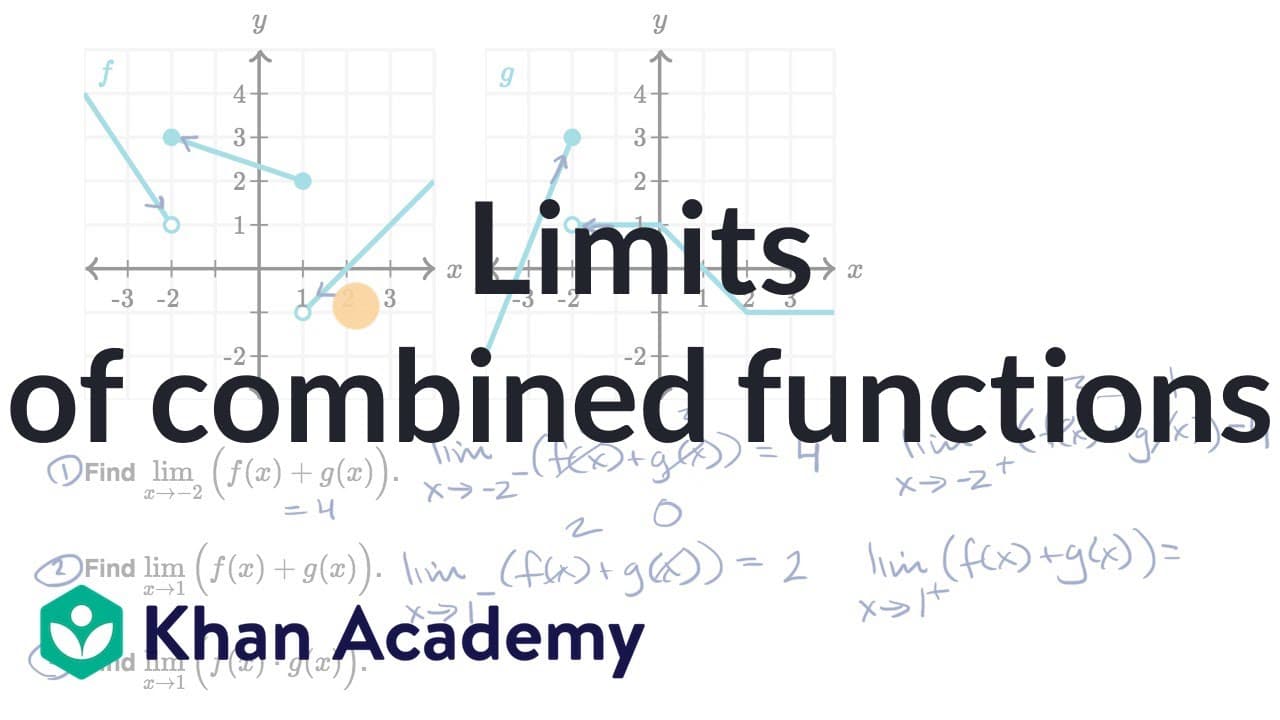
- [Instructor] We are asked to find these three different limits. I encourage you like always, pause this video and try to do it yourself before we do it together. So when you do this first one, you might just try to find the limit as x approaches negative two of f of x and then the limit as x approaches negative two of g of x and then add those tw... Read More
Key Insights
- ↔️ The limit of a function as it approaches a specific value may not exist if the function approaches different values from the left and right sides.
- ⛔ The sum or product of two functions can still have a limit even if the individual limits do not exist.
- 🫱 Evaluating the left-hand and right-hand limits separately can determine if the limit of the sum or product exists.
- 🍹 The existence of the limit of the sum or product depends on the specific behavior of the functions and cannot be assumed in all cases.
Install to Summarize YouTube Videos and Get Transcripts
Explore YouTube Video Summarizer or Get YouTube Transcript Extractor
Questions & Answers
Q: Why might the limit of a function as it approaches a specific value not exist?
The limit of a function may not exist if the function approaches different values from the left and right sides of the specific value. In such cases, the function does not approach a single value and the limit is said to be undefined.
Q: Can the sum or product of functions still have a limit if the individual limits do not exist?
Yes, it is possible for the sum or product of two functions to have a limit even if the individual limits do not exist. In these cases, the sum or product approaches a specific value regardless of the individual behavior of the functions.
Q: How can the limit of the sum or product be determined when the individual limits do not exist?
To find the limit of the sum or product when the individual limits do not exist, evaluate the left-hand limit and the right-hand limit separately. If these two limits approach the same value, then the limit of the sum or product exists and is equal to that common value.
Q: Do these examples prove that the sum or product of functions will always have a limit even if the individual limits do not exist?
No, these examples only demonstrate that it is possible for the sum or product of functions to have a limit in certain cases. The existence of the limit depends on the specific behavior of the functions and cannot be generalized for all cases.
Summary & Key Takeaways
-
When finding the limit of a function as it approaches a specific value, the individual limits of the function from the left and right may not exist.
-
However, the sum or product of two functions can still have a limit even if the individual limits do not exist.
-
In the examples provided, the sum of two functions approaches a limit of four, while the product of two functions approaches a limit of zero.
Read in Other Languages (beta)
Share This Summary 📚
Summarize YouTube Videos and Get Video Transcripts with 1-Click
Try YouTube Summary with ChatGPT & Claude or YouTube Transcript Generator
Explore More Summaries from Khan Academy 📚



Summarize YouTube Videos and Get Video Transcripts with 1-Click
Try YouTube Summary with ChatGPT & Claude or YouTube Transcript Generator