8. Binary Heaps
TL;DR
Binary heaps are a type of tree-like data structure that allow for efficient sorting and priority queue operations.
Transcript
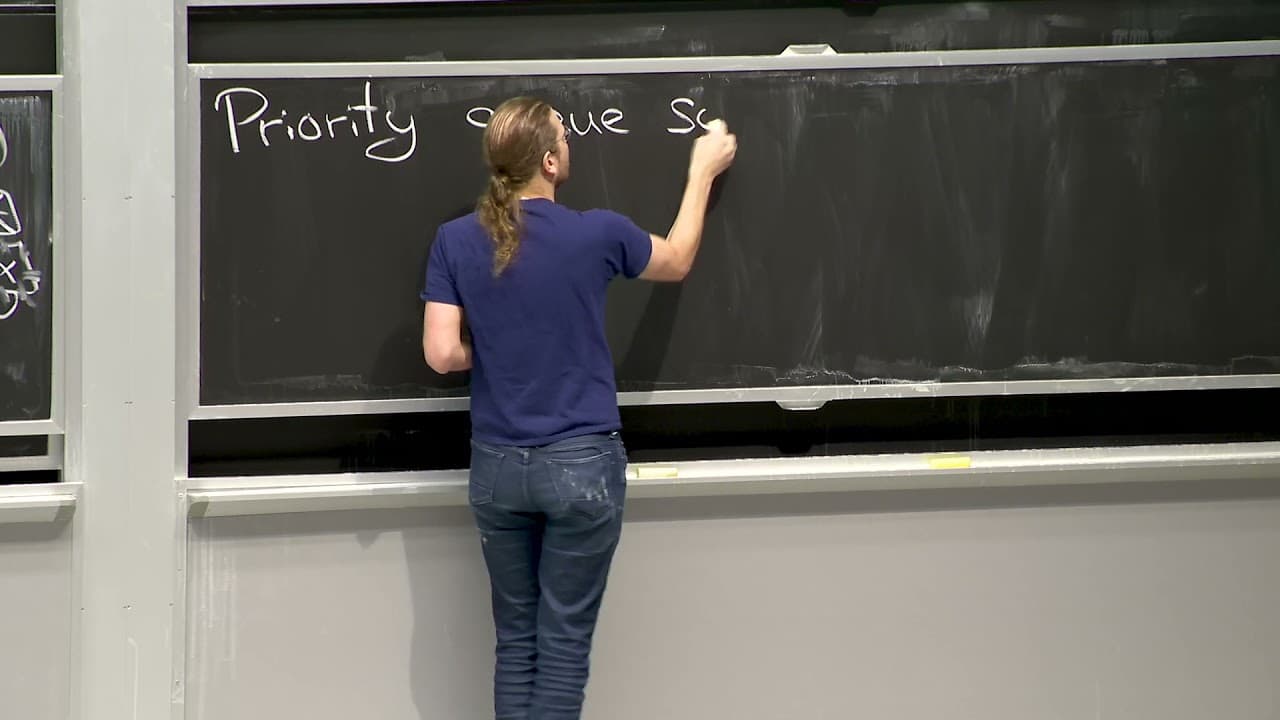
[SQUEAKING] [RUSTLING] [CLICKING] ERIK DEMAINE: All right, welcome back to 006 Data Structures. Today, we're going to cover a different kind of tree-like data structure called a heap-- a binary heap. It's going to let us solve sorting problem in a new way. Let me first remind you of a portion-- the problem we're going to be solving today is called ... Read More
Key Insights
- 🌲 Binary heaps are tree-like data structures that provide efficient sorting and priority queue operations.
- 👶 Binary heaps maintain a complete binary tree and satisfy the max-heap property, where every node is greater than or equal to its children.
- ❤️🩹 Inserting an item in binary heaps involves adding it to the end of the array and maintaining the max-heap property by swapping it with its parent if necessary.
- 🌲 Deleting the maximum item in binary heaps involves swapping it with the last item in the array, reducing the size of the heap, and then fixing the max-heap property by swapping the item down the tree if necessary.
Install to Summarize YouTube Videos and Get Transcripts
Explore YouTube Video Summarizer or Get YouTube Transcript Extractor
Questions & Answers
Q: What is the main advantage of using binary heaps for sorting algorithms?
The main advantage of binary heaps is that they provide an efficient in-place sorting algorithm, meaning that the sorting can be performed without requiring extra space other than the input array.
Q: How does the insert operation work in binary heaps?
The insert operation in binary heaps involves adding a new item at the end of the array and then maintaining the max-heap property by recursively swapping it with its parent until the property is satisfied.
Q: How is the max-heap property maintained in binary heaps?
The max-heap property in binary heaps is maintained by ensuring that every node is greater than or equal to both of its children. If a violation occurs, the nodes are swapped to restore the property.
Q: What is the time complexity of building a binary heap?
Building a binary heap can be done in linear time, O(n), by heapifying down the tree from the bottom up.
Summary & Key Takeaways
-
Binary heaps are tree-like data structures that maintain a complete binary tree and satisfy the max-heap property.
-
Binary heaps allow for efficient sorting and priority queue operations, such as finding the maximum item and removing it.
-
The insert operation in binary heaps involves inserting a new item at the end of the array and maintaining the max-heap property by swapping it with its parent if necessary.
-
The delete_max operation in binary heaps involves swapping the maximum item with the last item in the array, reducing the size of the heap, and then fixing the max-heap property by swapping the item down the tree if necessary.
Read in Other Languages (beta)
Share This Summary 📚
Summarize YouTube Videos and Get Video Transcripts with 1-Click
Try YouTube Summary with ChatGPT & Claude or YouTube Transcript Generator
Explore More Summaries from MIT OpenCourseWare 📚



Summarize YouTube Videos and Get Video Transcripts with 1-Click
Try YouTube Summary with ChatGPT & Claude or YouTube Transcript Generator