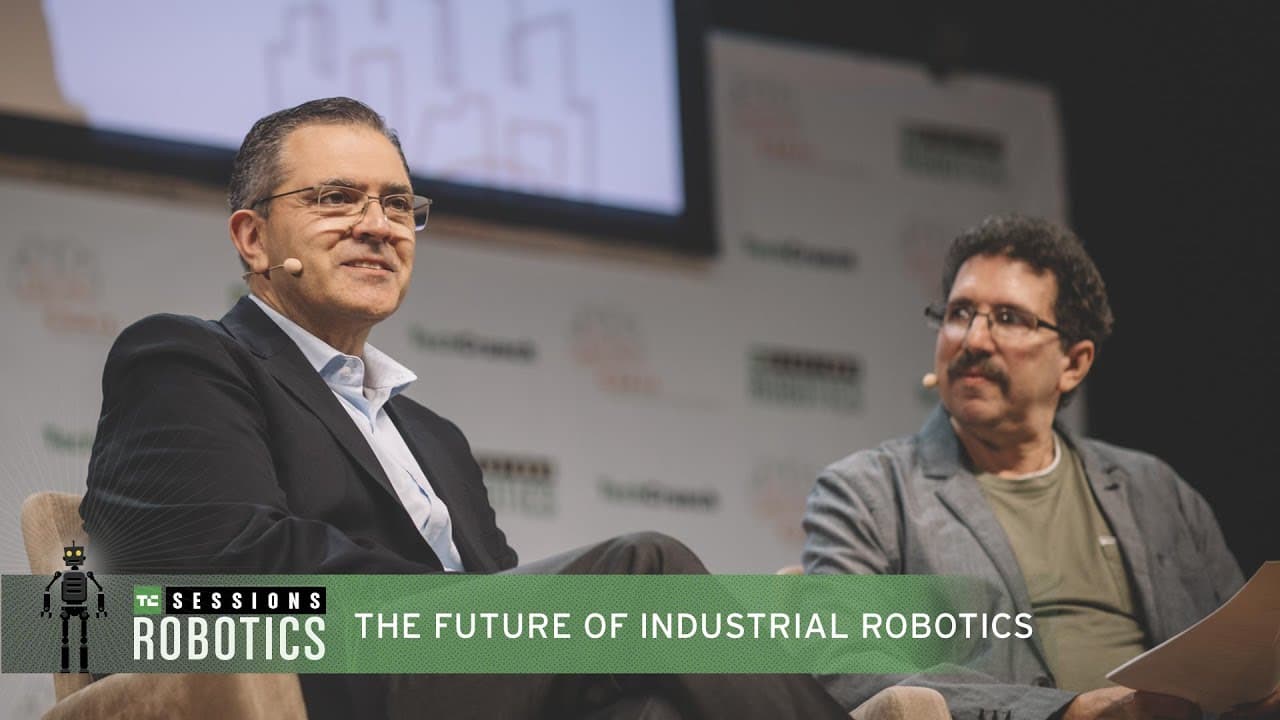
The Future of Industrial Robotics with Sami Atiya (ABB)
TL;DR
Industrial robots have evolved from performing repetitive tasks to now incorporating built-in intelligence, allowing for more flexibility and collaboration with humans.
Transcript
so I think we have that whole URL thing strained no no I'm Ron Miller from two creams this is Sammy atiyah from ABV and we're going to be discussing industrial robotics and just a reminder that this this session doesn't have a demo on stage but ABB does have a demo on the lobby and so during the breaks you can go check that out if you want so let's... Read More
Key Insights
- 🤖 The evolution of industrial robots has seen a shift from machines with limited capabilities to intelligent robots with built-in sensors and collaboration capabilities.
- 🤖 Collaborative robots that work alongside humans are a significant development in the industry, improving flexibility and efficiency.
- 🤖 Data collected from industrial robots enables real-time monitoring, predictive analytics, and process improvement.
- 🦺 Industrial robotics companies prioritize cybersecurity to protect their systems and maintain the safety of their products.
- 😨 The fear of robots taking over human jobs is unfounded, as historical examples show that technology advancements create new job opportunities.
- 🤖 Industrial robots continue to evolve, and developments in machine learning and artificial intelligence will further enhance their capabilities.
- 🤩 Simplifying the use of robots and making them more accessible for customers is a key focus for industrial robotics companies.
Install to Summarize YouTube Videos and Get Transcripts
Explore YouTube Video Summarizer or Get YouTube Transcript Extractor
Questions & Answers
Q: How have industrial robots evolved over the years in terms of their intelligence?
Industrial robots have made significant advancements in intelligence. Early robots could only perform repetitive tasks, while the current generation incorporates sensors and built-in intelligence for more complex functions.
Q: What are the key differences between a machine and a robot in an industrial setting?
Machines in an industrial setting are usually rigid and perform repetitive tasks. On the other hand, robots offer more flexibility and the ability to manage the flow of production, adding efficiency and adaptability.
Q: How do industrial robotics companies ensure the safety and security of their robots?
Industrial robotics companies prioritize cybersecurity by working with the best partners in the industry and conducting regular security analyses. They also incorporate measures like secure network connections and proper password protocols.
Q: Will industrial robots replace human jobs in the future?
Industrial robots have not led to a decrease in employment. In fact, countries with higher robot density in manufacturing sectors have seen an increase in jobs. Automation and robotics actually drive productivity and create new job opportunities.
Summary & Key Takeaways
-
Industrial robots have been present since 1974, but early models were limited to repetitive functions, lacking intelligence.
-
The current generation of industrial robots is much more intelligent, with built-in sensors and the ability to work collaboratively with humans.
-
The introduction of collaborative robots has allowed for the robots to work alongside humans in a production setting, increasing flexibility and efficiency.
Read in Other Languages (beta)
Share This Summary 📚
Summarize YouTube Videos and Get Video Transcripts with 1-Click
Try YouTube Summary with ChatGPT & Claude or YouTube Transcript Generator
Explore More Summaries from TechCrunch 📚






Summarize YouTube Videos and Get Video Transcripts with 1-Click
Try YouTube Summary with ChatGPT & Claude or YouTube Transcript Generator