Stanford CS229: Machine Learning | Summer 2019 | Lecture 12 - Bias and Variance & Regularization
TL;DR
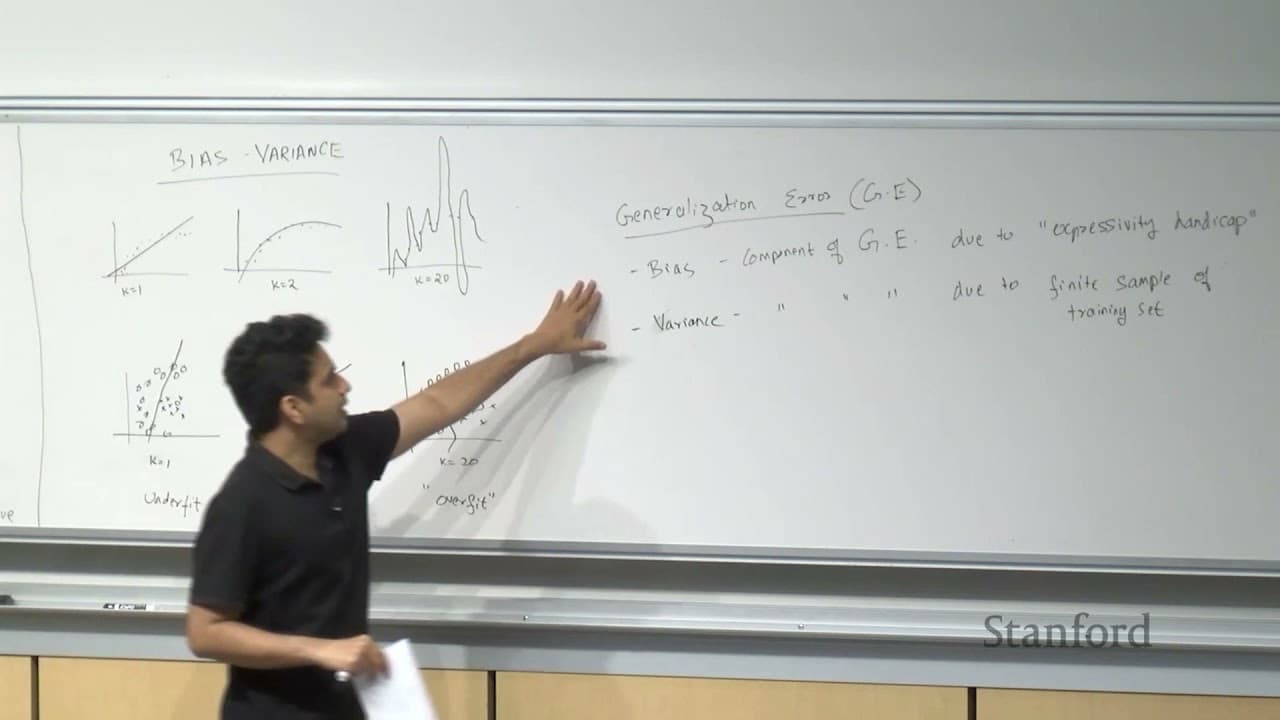
Bias and variance are key concepts in machine learning, and cross validation is used to evaluate model performance.
Transcript
okay welcome back everyone to lecture 12 of cs229 the topics for today are bias variance trade-off model selection and cross validation and regularization the three are are kind of somewhat related to each other and i would say bias variance trade off is probably one of the most important topics that you need to take away from this course it it it'... Read More
Key Insights
- 🎰 Bias-variance trade-off is a fundamental concept in machine learning that impacts model performance.
- 🚱 Neural networks are composed of linear models with non-linearities, requiring back propagation for training.
- ✋ Underfitting and overfitting refer to high bias and high variance, respectively, and affect generalization error.
Install to Summarize YouTube Videos and Get Transcripts
Explore YouTube Video Summarizer or Get YouTube Transcript Extractor
Questions & Answers
Q: What is the bias-variance trade-off and why is it important in machine learning?
The bias-variance trade-off refers to the balance between the simplicity and complexity of a model. High bias indicates underfitting, while high variance indicates overfitting. Finding the right trade-off is important for achieving good generalization performance.
Q: How are neural networks different from other models?
Neural networks are composed of linear models with non-linearities, allowing them to capture complex patterns in the data. They require back propagation, a technique that uses the chain rule of multivariate calculus, to train the model.
Q: What is the purpose of cross-validation in model evaluation?
Cross-validation is used to assess the performance of a model by splitting the dataset into training, validation, and testing sets. It helps in tuning hyperparameters and provides an estimate of how well the model will perform on unseen data.
Q: How do underfitting and overfitting impact generalization error?
Underfitting occurs when a model is too simple and fails to capture the underlying patterns in the data, resulting in high bias. Overfitting occurs when a model is too complex and fits the noise in the data, resulting in high variance. Both can lead to poor generalization performance.
Summary & Key Takeaways
-
Bias-variance trade-off is a fundamental concept in machine learning, distinguishing it from other fields and impacting model performance.
-
Neural networks are composed of linear models with non-linearities, and training them requires back propagation using the chain rule of multivariate calculus.
-
Underfitting and overfitting refer to models with high bias and high variance, respectively, and can affect generalization error.
-
Cross-validation is used to evaluate model performance, by splitting the dataset into training, validation, and testing sets, and tuning hyperparameters.
Read in Other Languages (beta)
Share This Summary 📚
Summarize YouTube Videos and Get Video Transcripts with 1-Click
Try YouTube Summary with ChatGPT & Claude or YouTube Transcript Generator
Explore More Summaries from Stanford Online 📚


Summarize YouTube Videos and Get Video Transcripts with 1-Click
Try YouTube Summary with ChatGPT & Claude or YouTube Transcript Generator