Absolute minima & maxima (entire domain) | AP Calculus AB | Khan Academy
TL;DR
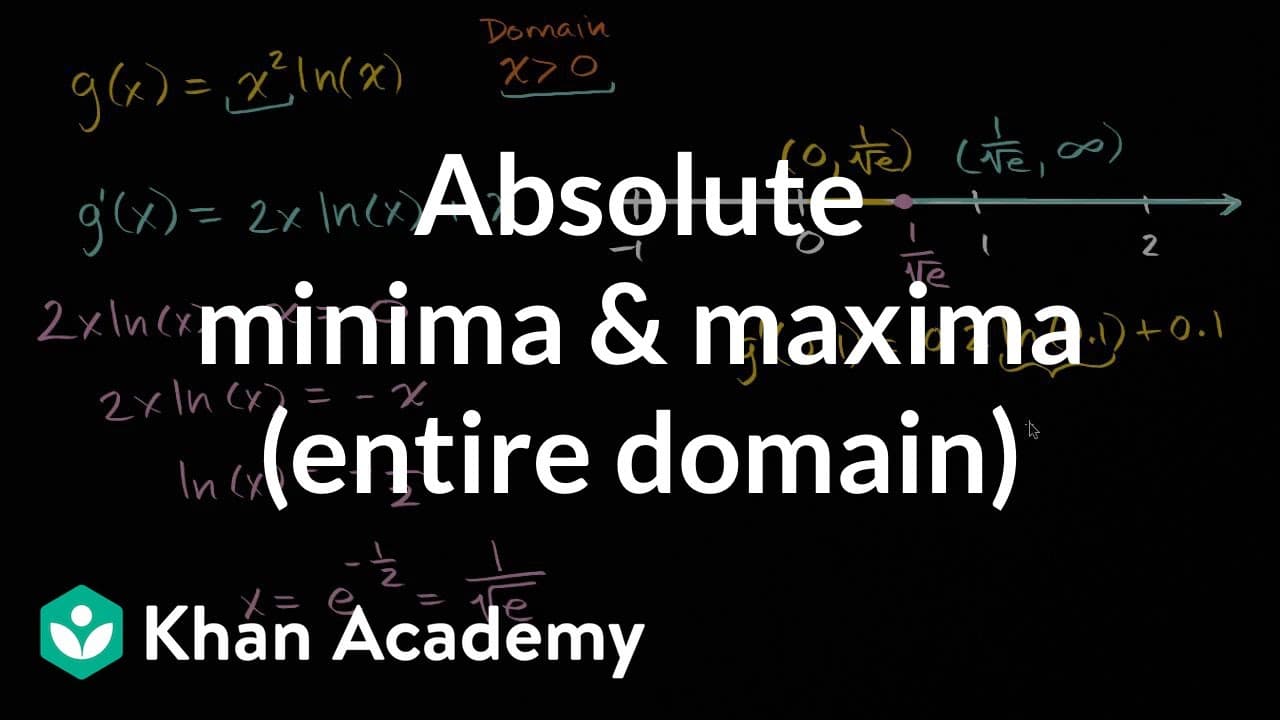
The video explains how to find the absolute extrema of a function using derivatives, and shows that the function has an absolute minimum but no absolute maximum.
Transcript
- [Voiceover] So we have the function g of x is equal to x squared times the natural log of x. And what I wanna do in this video is see if you can figure out the absolute extrema for g of x. So are there x values where g takes on an absolute maximum value, or an absolute minimum value. Sometimes you might call them a global maximum, or a global min... Read More
Key Insights
- 👈 The natural log of x is only defined for x > 0, and its domain must be considered when finding critical points of a function.
- 😥 Critical points are points where the derivative is either zero or undefined.
- 😥 The intervals around the critical point can be analyzed to determine if the function has an absolute minimum or maximum in those intervals.
Install to Summarize YouTube Videos and Get Transcripts
Explore YouTube Video Summarizer or Get YouTube Transcript Extractor
Questions & Answers
Q: What is the domain of the function g(x)?
The domain of g(x) is all real numbers greater than zero, as the natural log of x is only defined for x > 0.
Q: How is the derivative of the function g(x) calculated?
The derivative g'(x) is calculated using the product rule, resulting in 2xln(x) + x.
Q: What are the critical points of the function g(x)?
The only critical point is x = 1/sqrt(e), where g'(x) is equal to zero.
Q: Does the function g(x) have an absolute maximum?
No, the function does not have an absolute maximum as it continues to increase indefinitely for x > 1/sqrt(e).
Summary & Key Takeaways
-
The natural log of x is only defined for x > 0, and the domain of the function is all real numbers greater than zero.
-
The derivative of the function is found using the product rule, and the critical points are determined where the derivative is equal to zero or undefined.
-
The critical point is found to be x = 1/sqrt(e), and by analyzing the intervals around the critical point, it is determined that there is an absolute minimum but no absolute maximum.
-
The graph of the function confirms the results obtained analytically.
Read in Other Languages (beta)
Share This Summary 📚
Summarize YouTube Videos and Get Video Transcripts with 1-Click
Try YouTube Summary with ChatGPT & Claude or YouTube Transcript Generator
Explore More Summaries from Khan Academy 📚



Summarize YouTube Videos and Get Video Transcripts with 1-Click
Try YouTube Summary with ChatGPT & Claude or YouTube Transcript Generator