Control light with magnets and olive oil?! (Faraday effect)
TL;DR
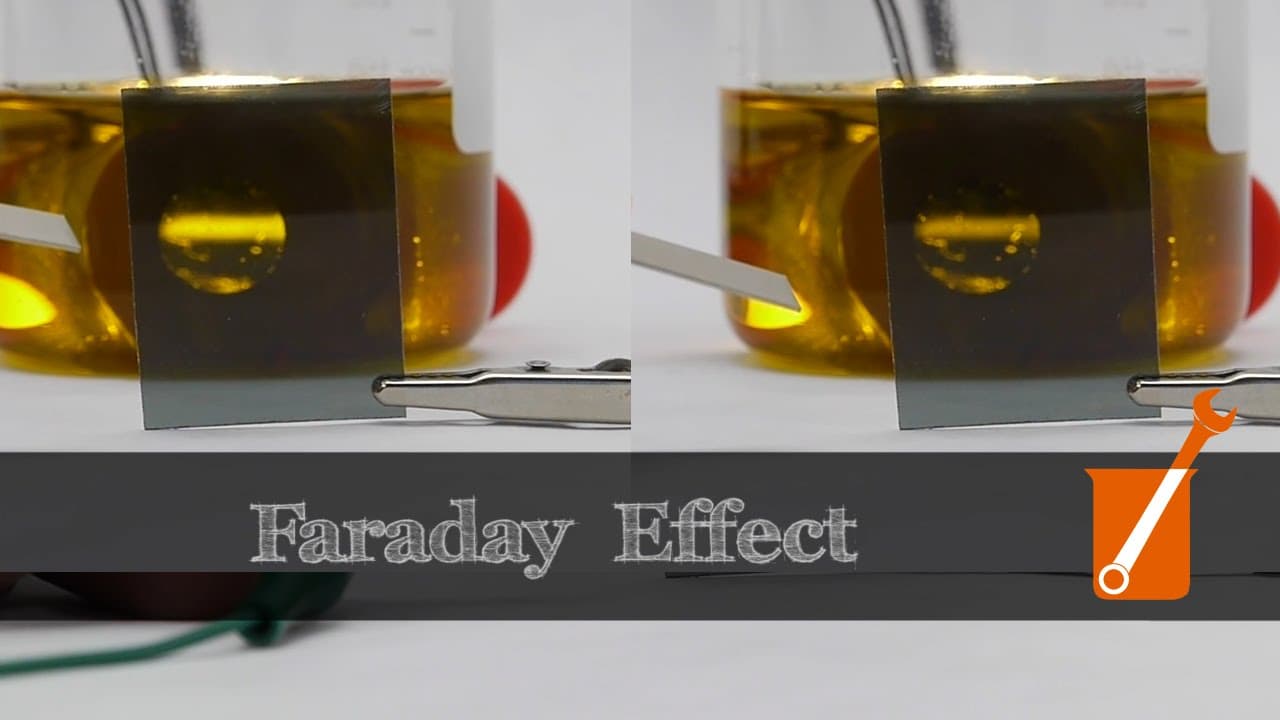
Light passing through a substance with a strong magnetic field can cause the polarization of the light to rotate, resulting in changes in brightness.
Transcript
take a look at this I've got a light source here and then I've got a polarizer in front of it and then over here I've got another polarizer and these are oriented 90° to each other they're crossed meaning that very little light gets through the pair but because they're imperfect even at 90° a small amount of light will leak through if it's very bri... Read More
Key Insights
- 🙂 The Faraday effect occurs when light passes through a substance with a magnetic field, causing a rotation in light polarization.
- 😎 The effect is observed in various transparent materials, such as olive oil, water, glass, and neodymium glass, but is less noticeable in air.
- 📶 The strength of the effect depends on factors such as the strength and orientation of the magnetic field, the material's verdict constant, and the quality of polarizers used.
- 💿 The Faraday effect has practical applications in creating efficient optical systems and devices.
- 😎 Magnetic materials can enhance the Faraday effect in plain glass or other substances.
- ❓ The Faraday effect can be observed and manipulated by using combinations of polarizers and Faraday rotators.
- 🙂 The rotation of light polarization can result in changes in brightness and transmission of light.
Install to Summarize YouTube Videos and Get Transcripts
Explore YouTube Video Summarizer or Get YouTube Transcript Extractor
Questions & Answers
Q: What is the Faraday effect and how does it occur?
The Faraday effect refers to the rotation of light polarization when passing through a substance with a magnetic field. It occurs due to the interaction between the magnetic field and the electrons in the material.
Q: Can the Faraday effect be observed in air or plain glass?
The Faraday effect can occur in air, but it is not easily visible due to the low density of air. Plain glass exhibits a minimal Faraday effect, but it can be enhanced by introducing magnetic materials like neodymium glass.
Q: What practical applications does the Faraday effect have?
The Faraday effect has practical applications, such as creating efficient optical systems and devices. For example, by using a combination of polarizers and a Faraday rotator, light can be manipulated to allow efficient transmission or complete blockage.
Q: What factors influence the strength of the Faraday effect?
The strength of the Faraday effect depends on the strength and direction of the magnetic field, the material's ability to perform the effect (verdict constant), and the quality of polarizers used.
Summary & Key Takeaways
-
The Faraday effect is observed when a magnetic field interacts with the electrons in a substance, causing a rotation in the polarization of light passing through.
-
The effect can be seen in various transparent materials, including olive oil, water, glass, and neodymium glass.
-
The strength of the effect depends on the strength and orientation of the magnetic field, as well as the material being used.
Read in Other Languages (beta)
Share This Summary 📚
Summarize YouTube Videos and Get Video Transcripts with 1-Click
Try YouTube Summary with ChatGPT & Claude or YouTube Transcript Generator
Explore More Summaries from Applied Science 📚






Summarize YouTube Videos and Get Video Transcripts with 1-Click
Try YouTube Summary with ChatGPT & Claude or YouTube Transcript Generator