De Moivre's Theorem Problem No 7
TL;DR
Learn how to solve a problem involving trigonometric functions using complex numbers and Demoir's theorem.
Transcript
click the bell icon to get latest videos from akira hello friends so let's start with the next problem which is based on DMOS theorem so here I am going to solve for different sub questions with the help of demoys theorem so here cos alpha plus cos beta plus cos gamma is given as 0 and the value of sine alpha plus sine beta plus sine gamma is given... Read More
Key Insights
- 👍 The problem in the content involves proving equations related to sine and cosine functions.
- 💁 Complex numbers in polar form are used to represent angles and derive the equations.
- ✖️ Demoir's theorem is utilized to multiply two complex numbers and obtain their amplitude and angle values.
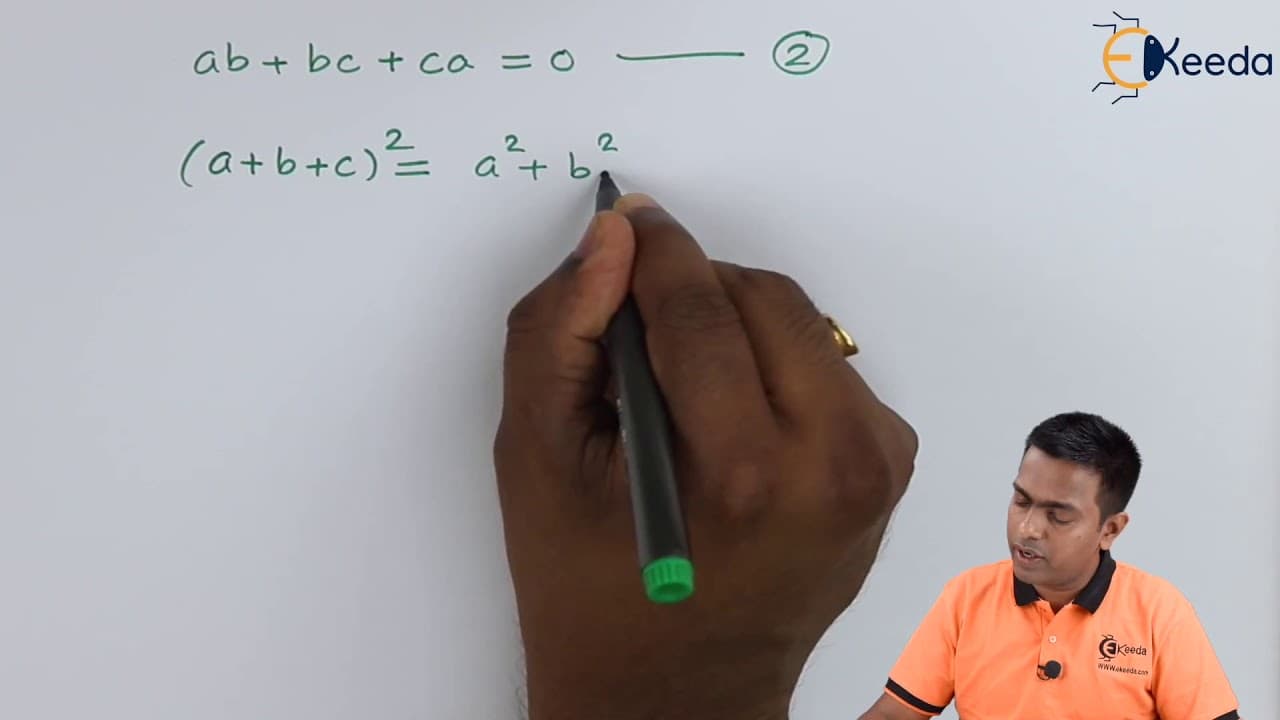
- #️⃣ Manipulating complex numbers and applying algebraic formulas help in solving the problem.
- 🥳 By comparing the real and imaginary parts of the complex numbers, various equations can be derived.
- 👨💼 The derived equations involve the square of sine and cosine functions.
- 👨💼 The final result shows that sine square alpha plus sine square beta plus sine square gamma is equal to 3 by 2.
Install to Summarize YouTube Videos and Get Transcripts
Explore YouTube Video Summarizer or Get YouTube Transcript Extractor
Questions & Answers
Q: What is the problem in the content that needs to be solved?
The problem involves proving equations involving sine and cosine functions, such as sine square alpha plus sine square beta plus sine square gamma equal to cos square alpha plus cos square beta plus cos square gamma equal to 3 by 2.
Q: How are complex numbers used to solve the problem?
Complex numbers in polar form are assumed to represent angles alpha, beta, and gamma. By manipulating these complex numbers and applying algebraic formulas and Demoir's theorem, the desired equations can be derived.
Q: What is Demoir's theorem?
Demoir's theorem states that when multiplying two complex numbers in polar form, their amplitude values are added, and their angle values are multiplied.
Q: How are the real and imaginary parts of the complex numbers compared to derive the equations?
The real parts of the complex numbers are added together, and the imaginary parts are added together. By comparing these sums to zero, various equations involving sine and cosine can be derived.
Q: How is the equation sine square alpha plus sine square beta plus sine square gamma equal to 3 by 2 derived?
By substituting the values of sine square and cosine square in terms of each other and simplifying the equation, it can be shown that sine square alpha plus sine square beta plus sine square gamma is equal to 3 by 2.
Summary & Key Takeaways
-
The content focuses on solving a problem involving trigonometric functions using complex numbers and Demoir's theorem.
-
The problem requires proving various equations related to sine and cosine functions.
-
The solution involves assuming complex numbers in polar form and using algebraic formulas and Demoir's theorem.
Read in Other Languages (beta)
Share This Summary 📚
Summarize YouTube Videos and Get Video Transcripts with 1-Click
Try YouTube Summary with ChatGPT & Claude or YouTube Transcript Generator
Explore More Summaries from Ekeeda 📚






Summarize YouTube Videos and Get Video Transcripts with 1-Click
Try YouTube Summary with ChatGPT & Claude or YouTube Transcript Generator