What Is Maximum Likelihood Estimation and How Does It Work?
TL;DR
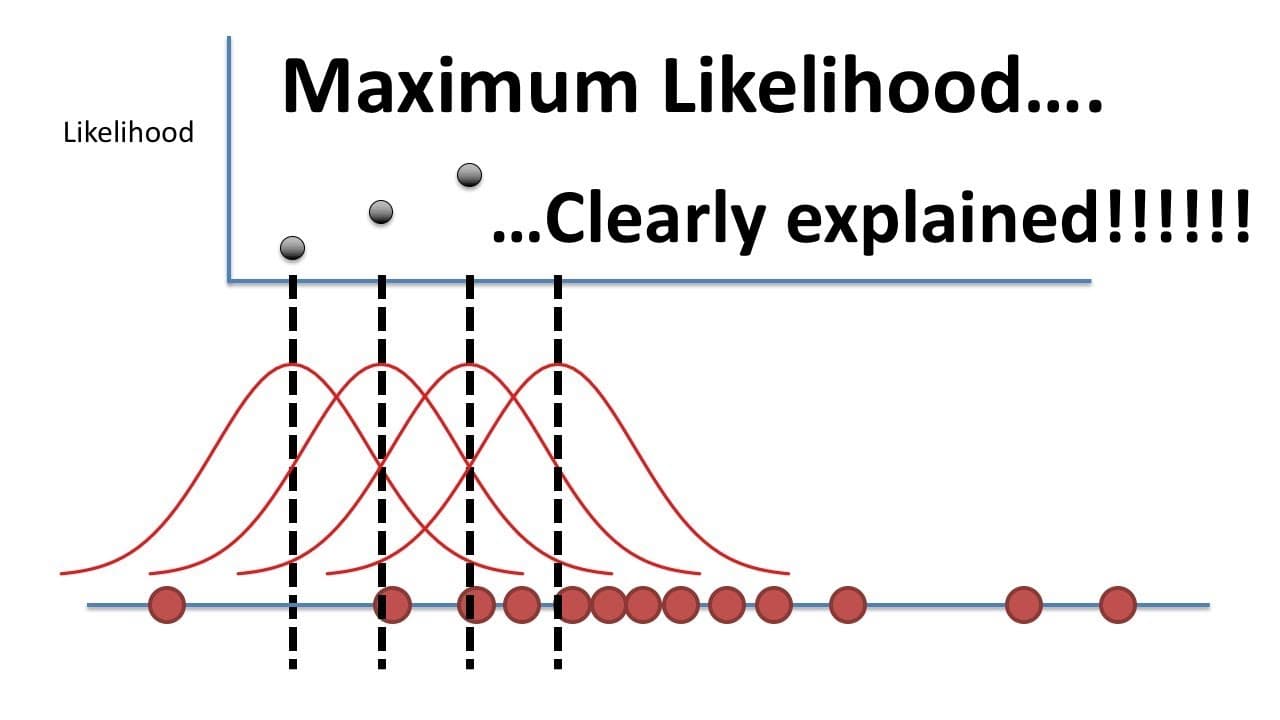
Maximum likelihood estimation (MLE) is a method for finding the optimal values for the parameters of a statistical distribution, such as mean and standard deviation, that best fit observed data. By maximizing the likelihood of observing the data, MLE enables accurate statistical analysis and fitting for various distributions, including normal, exponential, and gamma.
Transcript
stick quest chicken it's bad to the bone stand quiz check it out it's bad to the bone hello and welcome to stack quest stack quest is brought to you by the friendly folks in the genetics department at the University of North Carolina at Chapel Hill today we're going to be talking about maximum likelihood let's say we weighed a bunch of mice the goa... Read More
Key Insights
- 👋 Maximum likelihood estimation aims to find the best distribution fit for data by optimizing mean and standard deviation estimates.
- 😄 Normal distributions are commonly used due to their general applicability and ease of work in statistical analyses.
- 🆘 Adjusting parameters like mean and standard deviation helps maximize the likelihood of observing data for precise estimation.
- 🅰️ Different types of distributions, such as exponential and gamma, can also be fitted to data using maximum likelihood estimation techniques.
- ❓ The probability of observing data is assessed by shifting distribution parameters to find the optimal fit.
- ❓ Maximum likelihood estimation provides valuable insights into efficiently analyzing and interpreting data for statistical purposes.
- ❓ Understanding terminology distinctions like likelihood and probability is crucial in statistical analyses to interpret results accurately.
Install to Summarize YouTube Videos and Get Transcripts
Explore YouTube Video Summarizer or Get YouTube Transcript Extractor
Questions & Answers
Q: What is the goal of maximum likelihood estimation in statistics?
The main objective of maximum likelihood estimation is to find the most suitable distribution to fit data by determining optimal parameters like mean and standard deviation.
Q: Why are normal distributions often chosen for fitting data in statistics?
Normal distributions are preferred for their versatility and simplicity in representing data, allowing for easier analysis and general applicability across various experiments.
Q: How does maximum likelihood estimation involve optimizing the likelihood of observing data?
By adjusting parameters like mean and standard deviation to maximize the probability of observing the data, the best-fit distribution can be determined through maximum likelihood estimation.
Q: What distinguishes likelihood from probability in statistics terminology?
Likelihood specifically refers to finding optimal distribution parameters, like mean and standard deviation, to fit observed data, while probability has a broader meaning in everyday language.
Summary & Key Takeaways
-
Maximum likelihood estimation involves finding the best distribution fit for data by determining optimal mean and standard deviation estimates.
-
Normal distributions are commonly used for fitting data due to their general applicability and ease of work.
-
By maximizing the likelihood of observing the data, precise estimates for mean and standard deviation can be obtained.
Read in Other Languages (beta)
Share This Summary 📚
Summarize YouTube Videos and Get Video Transcripts with 1-Click
Try YouTube Summary with ChatGPT & Claude or YouTube Transcript Generator
Explore More Summaries from StatQuest with Josh Starmer 📚



Summarize YouTube Videos and Get Video Transcripts with 1-Click
Try YouTube Summary with ChatGPT & Claude or YouTube Transcript Generator