Buffer capacity | Acids and bases | AP Chemistry | Khan Academy
TL;DR
Buffer capacity refers to how much acid or base a buffer can neutralize before the pH changes significantly.
Transcript
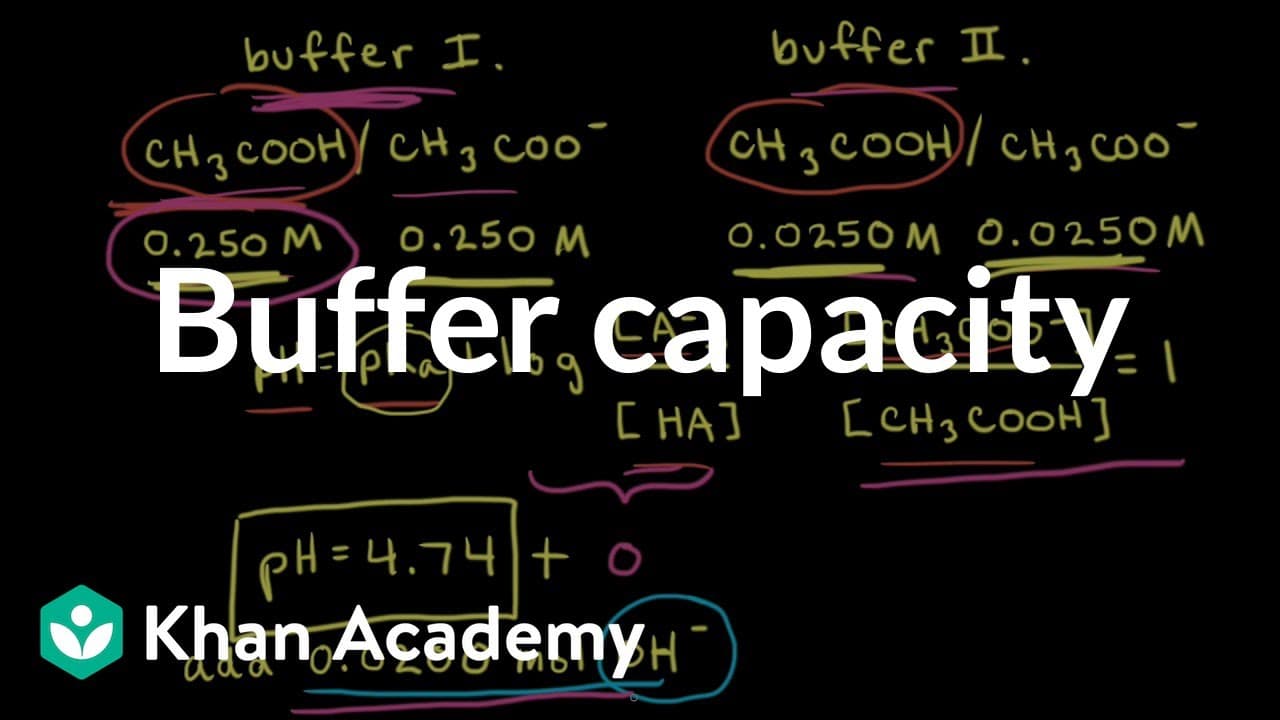
- [Instructor] Buffer capacity refers to the amount of acid or base a buffer can neutralize before the pH changes by a large amount. An increased buffer capacity means an increased amount of acid or base neutralized before the pH changes dramatically. Let's compare two buffers; buffer solution one and buffer solution two, and see which one has the ... Read More
Key Insights
- ⚾ Buffer capacity depends on the concentration of weak acid and its conjugate base.
- ✋ Higher concentrations of weak acid and conjugate base result in increased buffer capacity.
- ⚾ Buffer solutions with unequal concentrations of weak acid and conjugate base have different capacities for neutralizing acid or base.
- 😥 The Henderson-Hasselbalch equation is used to calculate the pH of a buffer solution.
Install to Summarize YouTube Videos and Get Transcripts
Explore YouTube Video Summarizer or Get YouTube Transcript Extractor
Questions & Answers
Q: What is buffer capacity?
Buffer capacity refers to the ability of a buffer solution to resist changes in pH when an acid or base is added. It depends on the concentration of weak acid and its conjugate base in the buffer.
Q: How does buffer capacity change with concentration?
Higher concentrations of weak acid and its conjugate base result in increased buffer capacity. This means the buffer can neutralize more acid or base before the pH changes significantly.
Q: How can the Henderson-Hasselbalch equation be used to calculate pH?
The Henderson-Hasselbalch equation relates pH to the concentration of weak acid and its conjugate base in a buffer solution. By plugging in the appropriate values, the pH can be calculated.
Q: How does unequal concentrations of weak acid and conjugate base affect buffer capacity?
Buffer solutions with unequal concentrations of weak acid and conjugate base have different capacities for neutralizing base or acid. A higher concentration of weak acid allows for better neutralization of added base, while a higher concentration of conjugate base enables better neutralization of added acid.
Summary & Key Takeaways
-
Buffer capacity is determined by the concentration of weak acid and its conjugate base in a buffer solution.
-
Higher concentrations of weak acid and conjugate base result in higher buffer capacity.
-
Buffer solutions with unequal concentrations of weak acid and conjugate base have different capacities for neutralizing base or acid.
Read in Other Languages (beta)
Share This Summary 📚
Summarize YouTube Videos and Get Video Transcripts with 1-Click
Try YouTube Summary with ChatGPT & Claude or YouTube Transcript Generator
Explore More Summaries from Khan Academy 📚



Summarize YouTube Videos and Get Video Transcripts with 1-Click
Try YouTube Summary with ChatGPT & Claude or YouTube Transcript Generator