First law of thermodynamics / internal energy | Thermodynamics | Physics | Khan Academy
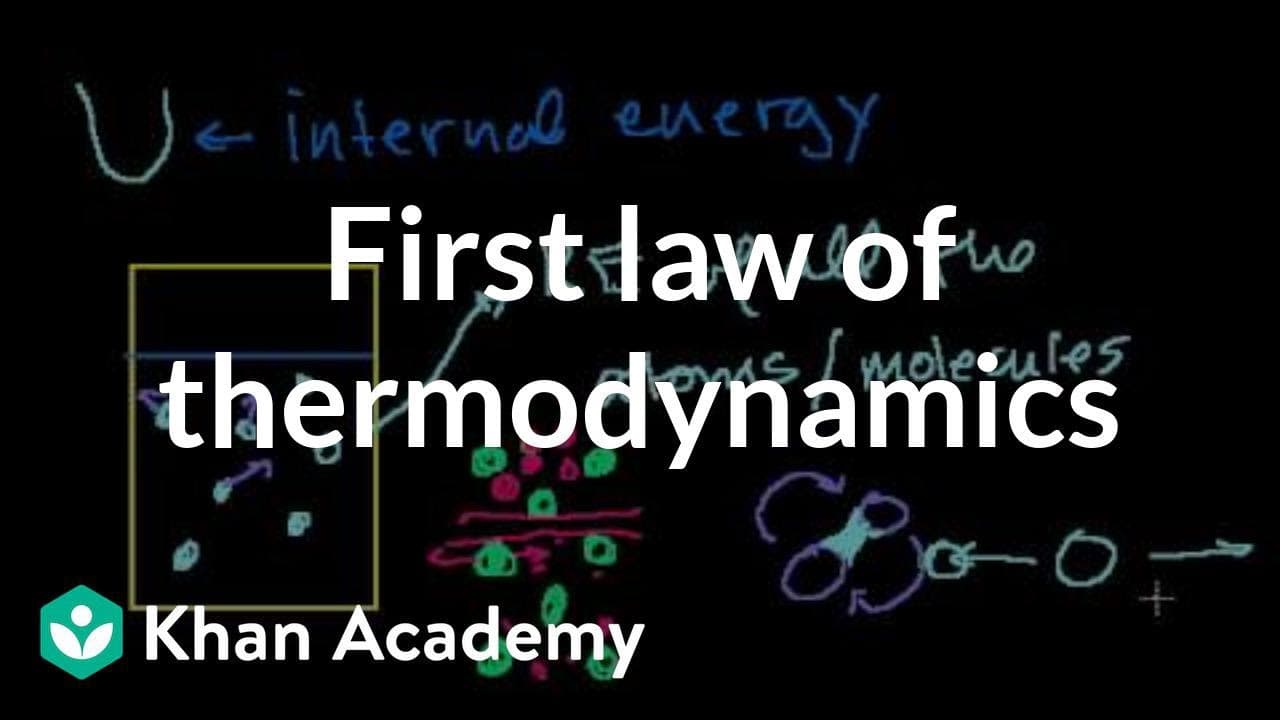
TL;DR
Energy cannot be created or destroyed, only transformed from one form to another, as stated by the first law of thermodynamics.
Transcript
I've now done a bunch of videos on thermodynamics, both in the chemistry and the physics playlist, and I realized that I have yet to give you, or at least if my memory serves me correctly, I have yet to give you the first law of thermodynamics. And I think now is as good a time as any. The first law of thermodynamics. And it's a good one. It tells ... Read More
Key Insights
- 👮 The first law of thermodynamics emphasizes the principle of energy conservation, stating that energy cannot be created or destroyed.
- ❓ Energy transformation occurs in various situations, such as the conversion of kinetic energy to potential energy and the transfer of energy through friction.
- 💁 The internal energy of a system is a comprehensive measure of all forms of energy contained within it.
Install to Summarize YouTube Videos and Get Transcripts
Explore YouTube Video Summarizer or Get YouTube Transcript Extractor
Questions & Answers
Q: What does the first law of thermodynamics state?
The first law of thermodynamics states that energy cannot be created or destroyed, only transformed into different forms.
Q: How is kinetic energy transformed into potential energy?
In the example of throwing a ball upwards, as the ball decelerates and gains height, its kinetic energy is converted into potential energy.
Q: What happens to kinetic energy when air resistance is present?
When air resistance is present, the ball's kinetic energy is transferred to air particles through friction, resulting in a decrease in kinetic energy.
Q: What does the internal energy of a system encompass?
The internal energy of a system includes all forms of energy present, such as kinetic energy, potential energy, bond energy, and electrical potential.
Summary & Key Takeaways
-
The first law of thermodynamics states that energy cannot be created or destroyed, only transformed into different forms.
-
Examples of energy transformation include the conversion of kinetic energy into potential energy, and the transfer of kinetic energy to air particles through friction, resulting in an increase in temperature (heat).
-
The internal energy of a system includes all forms of energy present, such as kinetic energy, potential energy, bond energy, and electrical potential. It is an overall measure of the energy within the system.
Read in Other Languages (beta)
Share This Summary 📚
Summarize YouTube Videos and Get Video Transcripts with 1-Click
Try YouTube Summary with ChatGPT & Claude or YouTube Transcript Generator
Explore More Summaries from Khan Academy 📚



Summarize YouTube Videos and Get Video Transcripts with 1-Click
Try YouTube Summary with ChatGPT & Claude or YouTube Transcript Generator