What Is Transverse Shear Load and Its Effects?
TL;DR
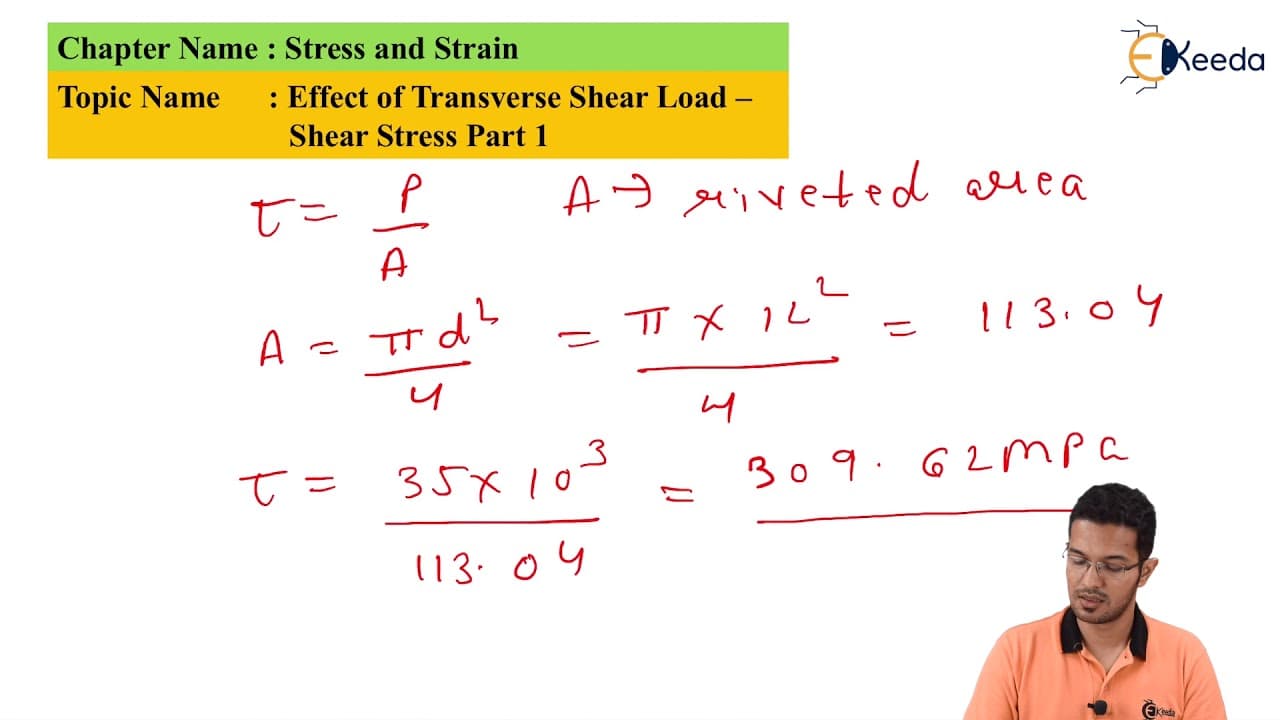
Transverse shear load refers to a load applied parallel to the cross-sectional area of a structural member, resulting in shear stress, denoted by 'tau.' Shear stress can be classified as single shear or double shear, depending on the number of planes involved. It is calculated using the formula tau = P/A for single shear and tau = P/2A for double shear.
Transcript
hello friends in the last lecture we discussed normal stresses and bending stresses and also took some good examples of normal stresses and combined normal and bending stress in this lecture we will discuss the effect of transverse shear load that is shear stress let's write it down the effect of transverse shear load or shear stress we know that w... Read More
Key Insights
- 🧑🏭 Transverse shear load, or shear stress, is a significant factor to consider in engineering.
- 😵 Shear stress is mathematically represented by the symbol "tau" and is equal to the applied load divided by the cross-sectional area.
- 🔂 Shear stresses can be categorized as single shear or double shear, depending on the type of connection.
- 😴 Examples of single shear connections include rivets, pins, and splice joints.
- ⏫ Examples of double shear connections include welding double lap joints.
- ♍ Shear stress in single shear is calculated using the formula tau = V/A, where V is the resisting force and A is the cross-sectional area.
- ☠️ Shear stress in double shear is calculated using the formula tau = P/2A, where P is the applied force and A is the cross-sectional area.
Install to Summarize YouTube Videos and Get Transcripts
Explore YouTube Video Summarizer or Get YouTube Transcript Extractor
Questions & Answers
Q: What is transverse shear load or shear stress?
Transverse shear load, or shear stress, refers to a load applied along a transverse axis that passes through the axis and is parallel to the cross-sectional area of the section. It is represented by the symbol "tau" and is mathematically equal to the applied load divided by the cross-sectional area.
Q: What are the types of shear stresses?
Shear stresses can be categorized as single shear or double shear. Single shear occurs when there is a single plane on which the shear stresses transfer from one member to the adjacent member. Double shear occurs when there are two planes on which shear stresses act to transfer from one member to the adjacent member.
Q: What is the formula for calculating shear stress in single shear?
In single shear, the shear stress is calculated using the formula tau = V/A, where V is the resisting force acting on the rivet section and A is the cross-sectional area of the rivet.
Q: Can shear stress be developed by indirect action?
Yes, shear stress can also be developed by indirect action as a result of tension, torsion, or bending of a member. This shear stress is known as indirect shear stress or shear stress developed in other directions.
Summary & Key Takeaways
-
Transverse shear load, or shear stress, refers to a load applied along a transverse axis that passes through the axis and is parallel to the cross-sectional area of the section.
-
Shear stress is represented by the symbol "tau" and is mathematically equal to the applied load divided by the cross-sectional area.
-
Shear stresses can be categorized as single shear or double shear, depending on the type of connection and the number of planes on which the shear stress acts.
Read in Other Languages (beta)
Share This Summary 📚
Summarize YouTube Videos and Get Video Transcripts with 1-Click
Try YouTube Summary with ChatGPT & Claude or YouTube Transcript Generator
Explore More Summaries from Ekeeda 📚




Summarize YouTube Videos and Get Video Transcripts with 1-Click
Try YouTube Summary with ChatGPT & Claude or YouTube Transcript Generator