AC through Series R-L-C circuit - AC Circuits - Basic Electrical Engineering
TL;DR
Analyzing the behavior of current and power in a series RLC circuit when an AC voltage is applied.
Transcript
hi friends in this video we are going to see if a ac voltage is applied to series connection of all the passive elements that is resistance capacitance and inductance what will be the nature of current and power so i have drawn a circuit where all the components passive components are connected in series rlc to the applied voltage v which is vm sin... Read More
Key Insights
- ✊ In a series RLC circuit, the behavior of current and power depends on the relationship between the inductive and capacitive reactance.
- ❓ When the inductive reactance is greater than the capacitive reactance, the circuit is inductive in nature.
- ❓ When the capacitive reactance is greater than the inductive reactance, the circuit is capacitive in nature.
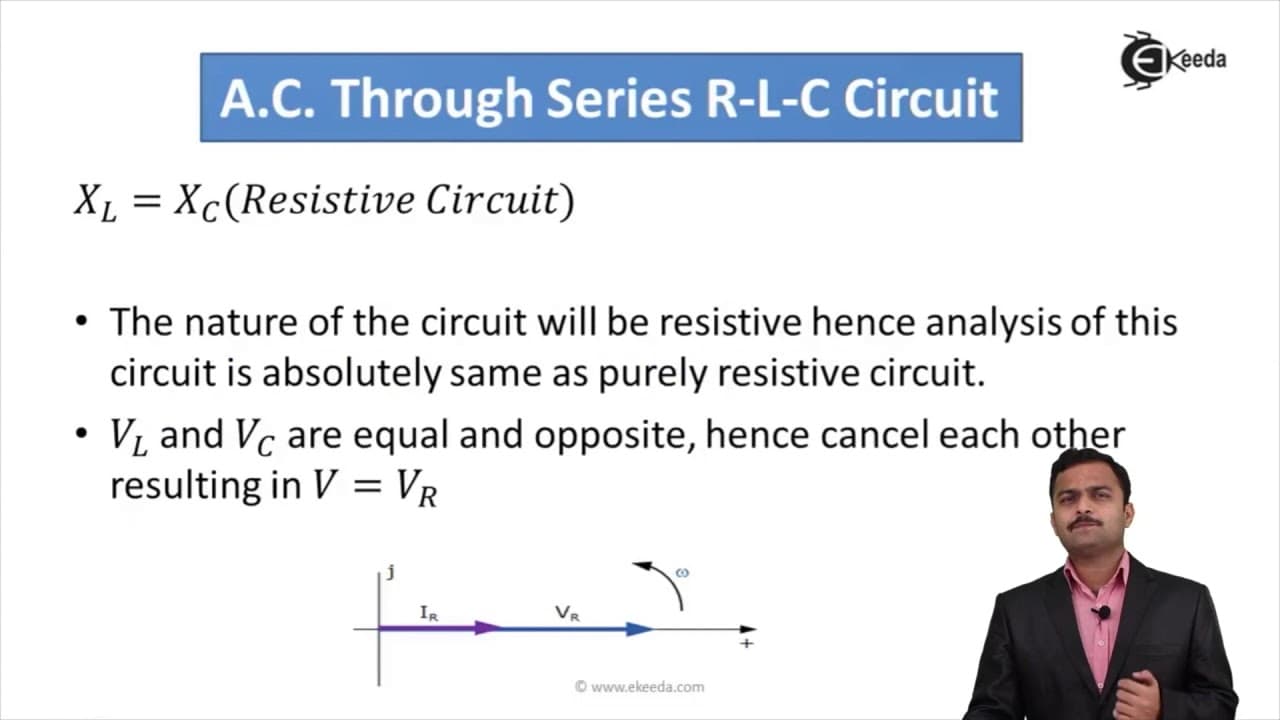
- 🟰 When the inductive and capacitive reactance are equal, the circuit behaves as a purely resistive circuit.
- ⚡ The voltage and current waveforms, as well as phasor diagrams, can help determine the nature of the circuit.
- ✊ Power triangles can be used to analyze the power characteristics of the circuit.
- 💼 The three cases in a series RLC circuit are similar to those of RL circuit, RC circuit, and purely resistive circuit.
Install to Summarize YouTube Videos and Get Transcripts
Explore YouTube Video Summarizer or Get YouTube Transcript Extractor
Questions & Answers
Q: How is the current and voltage related in a resistor in a series RLC circuit?
In the resistor, the voltage waveform will be identical to the current waveform since the resistor has only a resistance component. Their phasor diagram will be in phase.
Q: What is the relationship between current and voltage in an inductor in a series RLC circuit?
The voltage across an inductor lags the current by 90 degrees. This means that the voltage waveform of the inductor will be shifted 90 degrees behind the current waveform in the phasor diagram.
Q: How does the voltage and current behave in a capacitor in a series RLC circuit?
The voltage across a capacitor leads the current by 90 degrees. This means that the voltage waveform of the capacitor will be shifted 90 degrees ahead of the current waveform in the phasor diagram.
Q: What happens when the inductive reactance is greater than the capacitive reactance in a series RLC circuit?
In this case, the circuit will be inductive in nature. The total voltage will be dominated by the inductor, resulting in a phase difference between current and voltage.
Q: What happens when the capacitive reactance is greater than the inductive reactance in a series RLC circuit?
In this case, the circuit will be capacitive in nature. The total voltage will be dominated by the capacitor, resulting in a phase difference between current and voltage.
Q: What happens when the inductive and capacitive reactance are equal in a series RLC circuit?
In this case, the voltage drops across the inductor and capacitor will cancel each other out. The circuit will behave as a purely resistive circuit with no phase difference between current and voltage.
Summary & Key Takeaways
-
The video discusses the behavior of current and power in a series RLC circuit when an AC voltage is applied.
-
It explains the voltage drops across resistance, inductance, and capacitance, and how they affect the overall circuit.
-
Three cases are considered: when the inductive reactance is greater than the capacitive reactance, when the capacitive reactance is greater than the inductive reactance, and when the two reactances are equal.
Read in Other Languages (beta)
Share This Summary 📚
Summarize YouTube Videos and Get Video Transcripts with 1-Click
Try YouTube Summary with ChatGPT & Claude or YouTube Transcript Generator
Explore More Summaries from Ekeeda 📚






Summarize YouTube Videos and Get Video Transcripts with 1-Click
Try YouTube Summary with ChatGPT & Claude or YouTube Transcript Generator