How to Calculate Mean, Median, Mode, and Range in Statistics
TL;DR
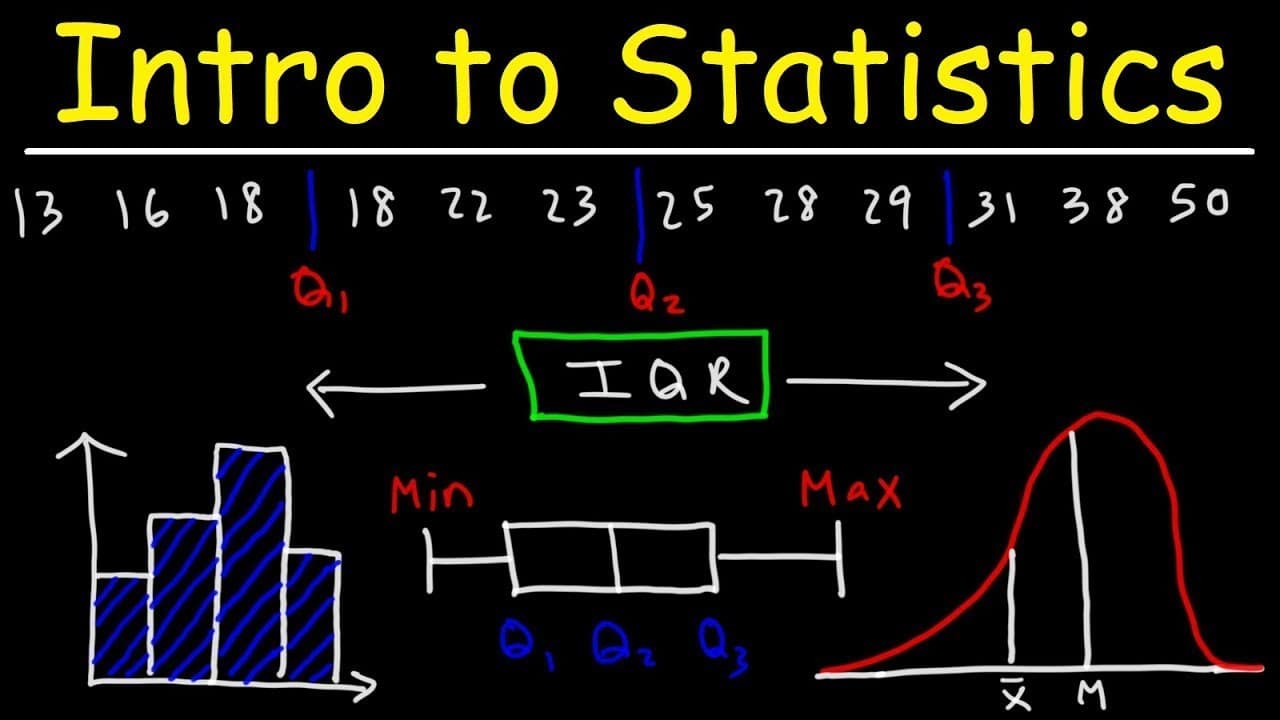
To calculate the mean, sum the data set values and divide by the number of values. The median is the middle value when the data is ordered, the mode is the most frequent value, and the range is the difference between the highest and lowest values. Quartiles help understand data distribution, and identifying outliers can highlight significant deviations in data.
Transcript
let's start with this problem find the mean median mode and range of the following data set now the first thing that i would recommend doing is arranging the numbers in increasing order so the lowest number is seven and we have two of them after that the next number is 10 and then 14 15 23 and 32. now to calculate the mean what we need to do is we ... Read More
Key Insights
- 😫 Mean, median, mode, and range are essential measures to understand the central tendency and spread of a data set.
- 🧡 Quartiles and interquartile range help analyze the distribution and variability of data.
- 😥 Identifying outliers is crucial to identify data points that deviate significantly from others.
Install to Summarize YouTube Videos and Get Transcripts
Explore YouTube Video Summarizer or Get YouTube Transcript Extractor
Questions & Answers
Q: How do you calculate the mean, median, mode, and range of a data set?
To calculate the mean, you sum up all the numbers and divide the total by the count of numbers. The median is the middle value when the data is sorted, or the average of the two middle values. The mode is the most frequently occurring number. The range is found by subtracting the lowest number from the highest number.
Q: How do you find the quartiles and interquartile range of a data set?
The first quartile (Q1) is the median of the lower half of the data set, the second quartile (Q2) is the median of the entire data set, and the third quartile (Q3) is the median of the upper half of the data set. The interquartile range (IQR) is the difference between Q3 and Q1.
Q: How can you identify outliers in a data set?
To identify outliers, you can use the rule of 1.5 times the IQR. Any number below Q1 minus 1.5 times the IQR or above Q3 plus 1.5 times the IQR is considered an outlier.
Q: How do you construct a histogram using a frequency table?
On the x-axis, you plot the ranges or categories, and on the y-axis, you plot the frequency of occurrence. The height of each bar represents the frequency of a particular range or category. The bars in a histogram are connected to each other.
Summary & Key Takeaways
-
The content provides a step-by-step guide on calculating the mean, median, mode, and range of a data set.
-
It also explains how to find quartiles and interquartile range to analyze data distribution.
-
The content discusses how to identify outliers using a range formula and provides instructions on creating a box and whisker plot.
-
Additionally, it explains how to construct stem and leaf plots, dot plots, and histograms using frequency tables.
Read in Other Languages (beta)
Share This Summary 📚
Summarize YouTube Videos and Get Video Transcripts with 1-Click
Try YouTube Summary with ChatGPT & Claude or YouTube Transcript Generator
Explore More Summaries from The Organic Chemistry Tutor 📚




Summarize YouTube Videos and Get Video Transcripts with 1-Click
Try YouTube Summary with ChatGPT & Claude or YouTube Transcript Generator