What Are Arithmetic Sequences and How Do They Work?
TL;DR
Arithmetic sequences follow a pattern of addition or subtraction based on a common difference. The arithmetic mean is the average of two numbers, while the geometric mean involves the square root of their product. Distinguishing between sequences (a list of numbers) and series (the sum of those numbers) is essential for understanding these concepts.
Transcript
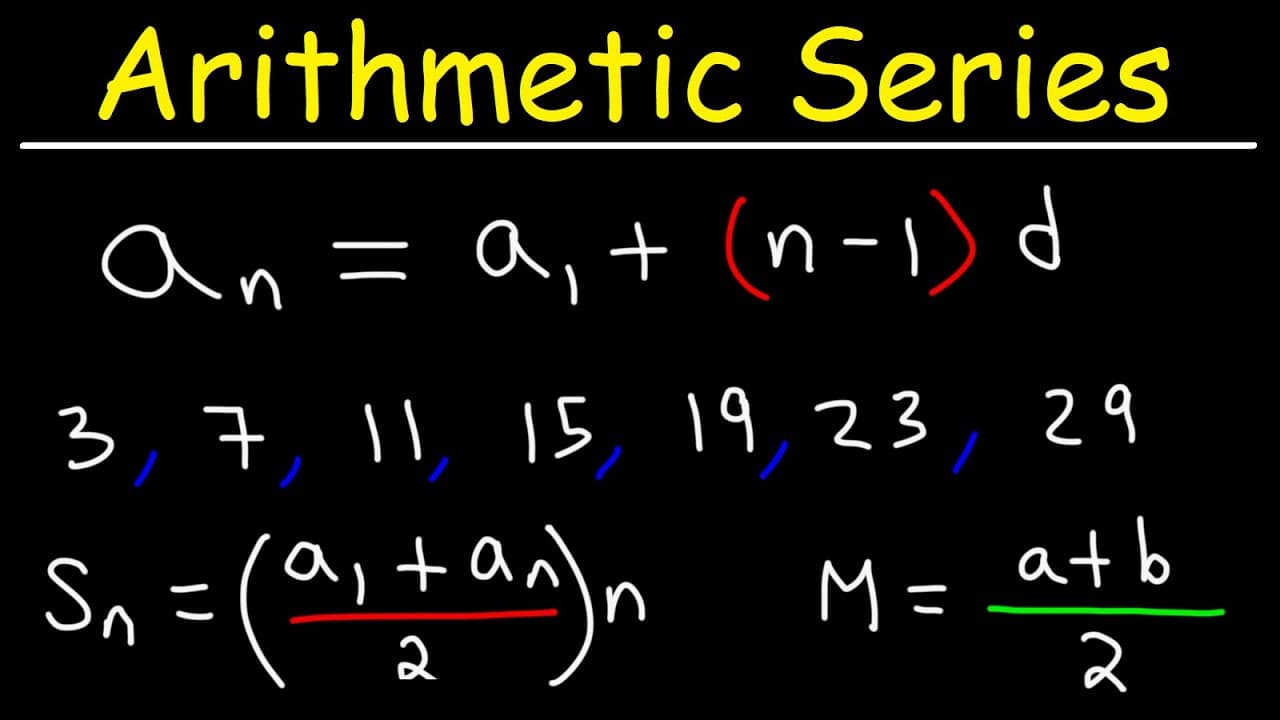
in this video we're going to focus mostly on arithmetic sequences now to understand what an arithmetic sequence is it's helpful to distinguish it from a geometric sequence so here's an example of an arithmetic sequence the numbers 3 7 11 15 19 23 and 27 represents an arithmetic sequence this would be a geometric sequence 3 6 12 24 48 96 192. do you... Read More
Key Insights
- ⚾ Arithmetic sequences involve a common difference and are based on addition and subtraction patterns.
- 🥳 Geometric sequences involve a common ratio and are based on multiplication and division patterns.
- #️⃣ The arithmetic mean is the average of two numbers in an arithmetic sequence, while the geometric mean is the square root of the product of two numbers in a geometric sequence.
- 🍉 Formulas are provided for finding the nth term and the sum of terms in both arithmetic and geometric sequences.
- #️⃣ Understanding the difference between sequences and series is crucial, as sequences are lists of numbers and series are the sums of those numbers.
- ❓ It is important to determine if a sequence or series is finite or infinite.
Install to Summarize YouTube Videos and Get Transcripts
Explore YouTube Video Summarizer or Get YouTube Transcript Extractor
Questions & Answers
Q: What is the difference between an arithmetic and a geometric sequence?
An arithmetic sequence involves a common difference and is based on addition and subtraction, while a geometric sequence involves a common ratio and is based on multiplication and division.
Q: How do I calculate the arithmetic mean and geometric mean of two numbers?
The arithmetic mean is calculated by adding two numbers and dividing by 2. The geometric mean is calculated by taking the square root of the product of the two numbers.
Q: How can I find the nth term of an arithmetic sequence?
The formula for the nth term of an arithmetic sequence is a sub n = a sub 1 + (n-1) * d, where a sub n is the nth term, a sub 1 is the first term, n is the number of terms, and d is the common difference.
Q: What is the formula for the sum of the first n terms in an arithmetic sequence?
The formula for the sum of the first n terms in an arithmetic sequence is S sub n = (a sub 1 + a sub n) * n / 2, where S sub n is the sum, a sub 1 is the first term, a sub n is the nth term, and n is the number of terms.
Q: How can I find the geometric mean between two numbers?
To find the geometric mean between two numbers, take the square root of their product. For example, the geometric mean between 3 and 12 is sqrt(3*12) = sqrt(36) = 6.
Q: What is the difference between a sequence and a series?
A sequence is a list of numbers, while a series is the sum of the numbers in a sequence. A sequence can be finite or infinite, while a series can also be finite or infinite.
Q: How can I identify if a sequence or series is arithmetic or geometric?
In an arithmetic sequence, there is a common difference between consecutive terms, while in a geometric sequence, there is a common ratio between consecutive terms. Analyzing the pattern of the terms will help determine if it is arithmetic or geometric.
Q: How do I calculate the partial sum of a sequence or series?
For an arithmetic sequence, the partial sum is calculated using the formula S sub n = (a sub 1 + a sub n) * n / 2. For a geometric sequence, the partial sum is calculated using the formula S sub n = a sub 1 * (1 - r^n) / (1 - r), where r is the common ratio.
Summary & Key Takeaways
-
Arithmetic sequences involve a common difference and are based on addition and subtraction patterns, while geometric sequences involve a common ratio and are based on multiplication and division patterns.
-
The arithmetic mean is calculated by taking the average of two numbers in an arithmetic sequence, while the geometric mean is calculated by taking the square root of the product of two numbers in a geometric sequence.
-
Formulas are provided for finding the nth term of an arithmetic sequence and a geometric sequence, as well as the sum of terms in both sequences.
-
The difference between a sequence and a series is that a sequence is a list of numbers, while a series is the sum of the numbers in a sequence.
Read in Other Languages (beta)
Share This Summary 📚
Summarize YouTube Videos and Get Video Transcripts with 1-Click
Try YouTube Summary with ChatGPT & Claude or YouTube Transcript Generator
Explore More Summaries from The Organic Chemistry Tutor 📚




Summarize YouTube Videos and Get Video Transcripts with 1-Click
Try YouTube Summary with ChatGPT & Claude or YouTube Transcript Generator