How to Determine Limits of Composite Functions
TL;DR
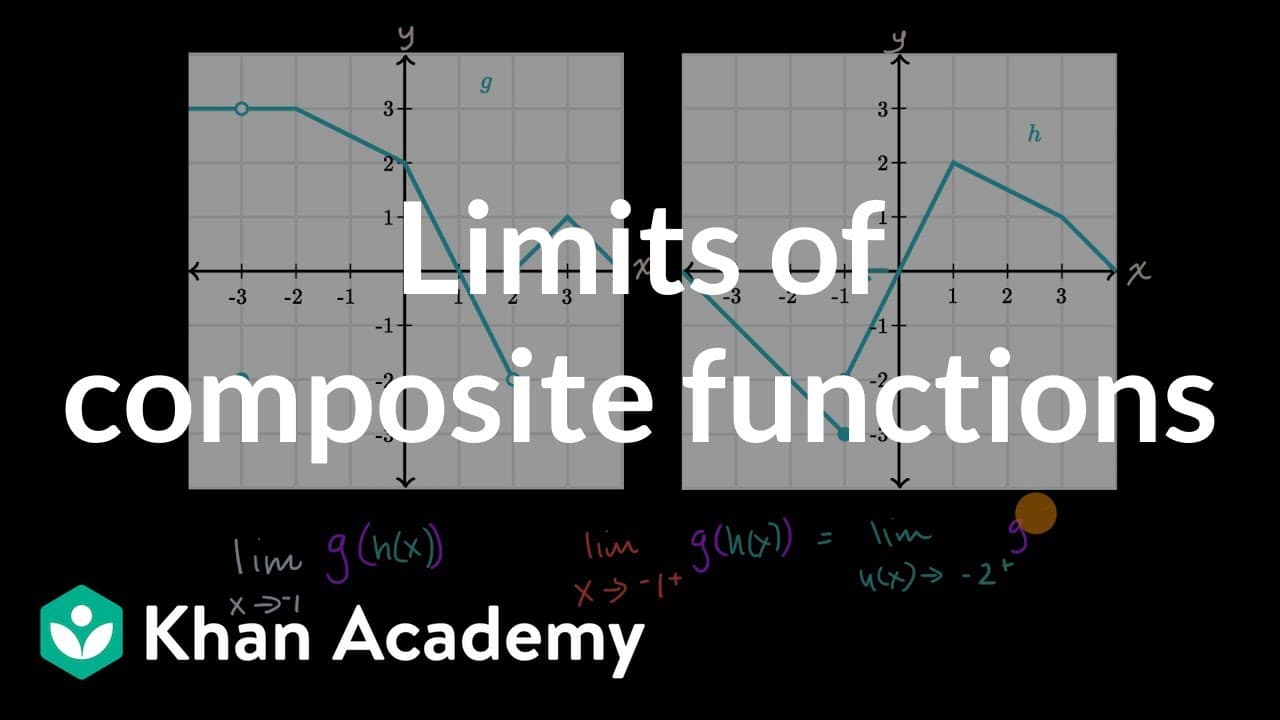
You can find the limit of a composite function even if the internal function's limit doesn't exist by calculating right-handed and left-handed limits. In the example, both limits approach the same value, allowing you to conclude that the overall limit of the composite function exists.
Transcript
- [Instructor] All right, let's get a little bit more practice taking limits of composite functions. Here, we want to figure out what is the limit as x approaches negative one of g of h of x? The function g, we see it defined graphically here on the left, and the function h, we see it defined graphically here on the right. Pause this video and have... Read More
Key Insights
- ⛔ The limit of a composite function can be found even if the limit of one of the internal functions does not exist.
- ⛔ Taking right-handed and left-handed limits can help determine the overall limit of the composite function.
- 🫱 When the right-hand and left-hand limits of a composite function are equal, the overall limit of the composite function exists and is equal to that value.
Install to Summarize YouTube Videos and Get Transcripts
Explore YouTube Video Summarizer or Get YouTube Transcript Extractor
Questions & Answers
Q: How can we find the limit of a composite function when one of the internal functions has a non-existent limit?
By taking right-handed and left-handed limits, we can determine the overall limit of the composite function, even if the limit of an internal function does not exist.
Q: What does it mean when the right-hand and left-hand limits of a composite function are equal?
If the right-hand and left-hand limits of a composite function are equal, then we know that the overall limit of the composite function exists and is equal to that value.
Q: What role do right-handed and left-handed limits play in finding the limit of composite functions?
Right-handed and left-handed limits help us analyze the behavior of internal functions as they approach a specific value, which allows us to determine the overall limit of the composite function.
Q: Can we determine the limit of a composite function solely based on the limits of its internal functions?
No, the limit of a composite function may not solely depend on the limits of its internal functions, as demonstrated in the example where the internal function's limit did not exist, but the composite function's limit still existed.
Summary & Key Takeaways
-
The video teaches how to find the limit of a composite function when the limit of one of the internal functions does not exist.
-
It demonstrates that taking right-handed and left-handed limits can help determine the overall limit.
-
The video provides an example where the internal function's limit does not exist, but the composite function's limit can still be found.
Read in Other Languages (beta)
Share This Summary 📚
Summarize YouTube Videos and Get Video Transcripts with 1-Click
Try YouTube Summary with ChatGPT & Claude or YouTube Transcript Generator
Explore More Summaries from Khan Academy 📚



Summarize YouTube Videos and Get Video Transcripts with 1-Click
Try YouTube Summary with ChatGPT & Claude or YouTube Transcript Generator