What Makes a Programmer 'Real'?
TL;DR
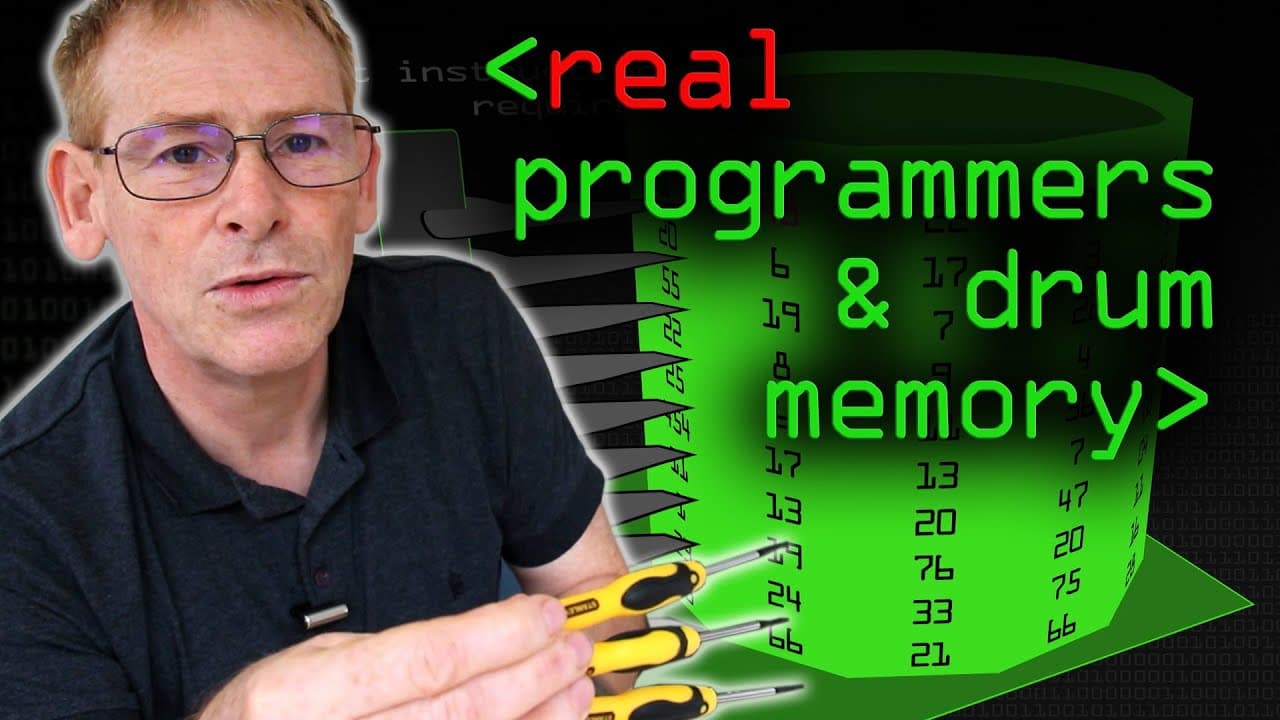
Mel Kay's story illustrates the unique skills of 'real programmers' who manipulate early technology like drum memory. These programmers maximised speed and efficiency through clever techniques, strategically placing instructions to optimise performance at a time when storage was limited and every operation counted.
Transcript
great to see you on computer file in this sort of strange uh remote manner what is it you've got um to talk to us about there was a really nice story about uh a real programmer who who did all sorts of tricks with things a guy called mel kay who worked for the royal mcb uh computer company and uh he he was the ultimate real programmer and uh you ca... Read More
Key Insights
- 👨💻 Real programmers possess advanced coding skills and work at the hardware level, unafraid to modify binary code directly and utilize low-level languages.
- 🛢️ Early computers used drum memory as the first commercial storage, offering minimal seek time and relying on strategic instruction placement for optimal performance.
- 🛢️ Programmers like Mel Kay employed clever techniques, such as using drum memory to introduce delay loops and optimize the timing of operations.
- 🐎 Speed was crucial in early computers, which used valves instead of transistors, making efficient programming techniques essential.
- 💨 Real programmers had to be resourceful with limited storage capacity, constantly seeking ways to squeeze the maximum out of their computer systems.
- 🫥 The video hinting at a story about mercury delay lines suggests the challenges associated with early memory technologies.
- 💻 The content teases further discussion on additional tricks and techniques employed by early programmers to enhance computer performance.
Install to Summarize YouTube Videos and Get Transcripts
Explore YouTube Video Summarizer or Get YouTube Transcript Extractor
Questions & Answers
Q: What makes a programmer a "real" programmer?
A real programmer is someone skilled in low-level coding and is not afraid to use go-to's or modify binary code directly to achieve their desired outcomes. They have an intimate understanding of computers and can work at the hardware level.
Q: What was the role of Mel Kay and what did he accomplish as a programmer?
Mel Kay worked for an early computer manufacturer in the late 1950s. He demonstrated real programming techniques and created a program to play pontoon or 21 blackjack, showcasing the capabilities of the new computer at shows and for customers.
Q: What was the earliest form of memory in computers?
The earliest computers did not have conventional memory like magnetic cores or hard disks. Instead, they used drum memory, which involved a drum with fixed heads positioned over tracks. It offered minimal latency as the heads were always positioned over the data.
Q: How did programmers optimize the use of drum memory?
Real programmers would strategically position instructions on the drum to minimize seek time and maximize program speed. By determining the time it took for an instruction to execute, they could position subsequent instructions for efficient processing.
Summary & Key Takeaways
-
The content explores the story of a real programmer named Mel Kay who worked for an early computer company and used unconventional methods to make machines work.
-
In the early days of computers, drum memory was used as the first form of commercial storage, with fixed heads and the ability to position instructions strategically.
-
The video also discusses how real programmers maximize the speed and efficiency of computers with limited storage and the importance of speed in early computer systems.
Read in Other Languages (beta)
Share This Summary 📚
Summarize YouTube Videos and Get Video Transcripts with 1-Click
Try YouTube Summary with ChatGPT & Claude or YouTube Transcript Generator
Explore More Summaries from Computerphile 📚




Summarize YouTube Videos and Get Video Transcripts with 1-Click
Try YouTube Summary with ChatGPT & Claude or YouTube Transcript Generator