What Is the A7V Tank and Its Unique Features?
TL;DR
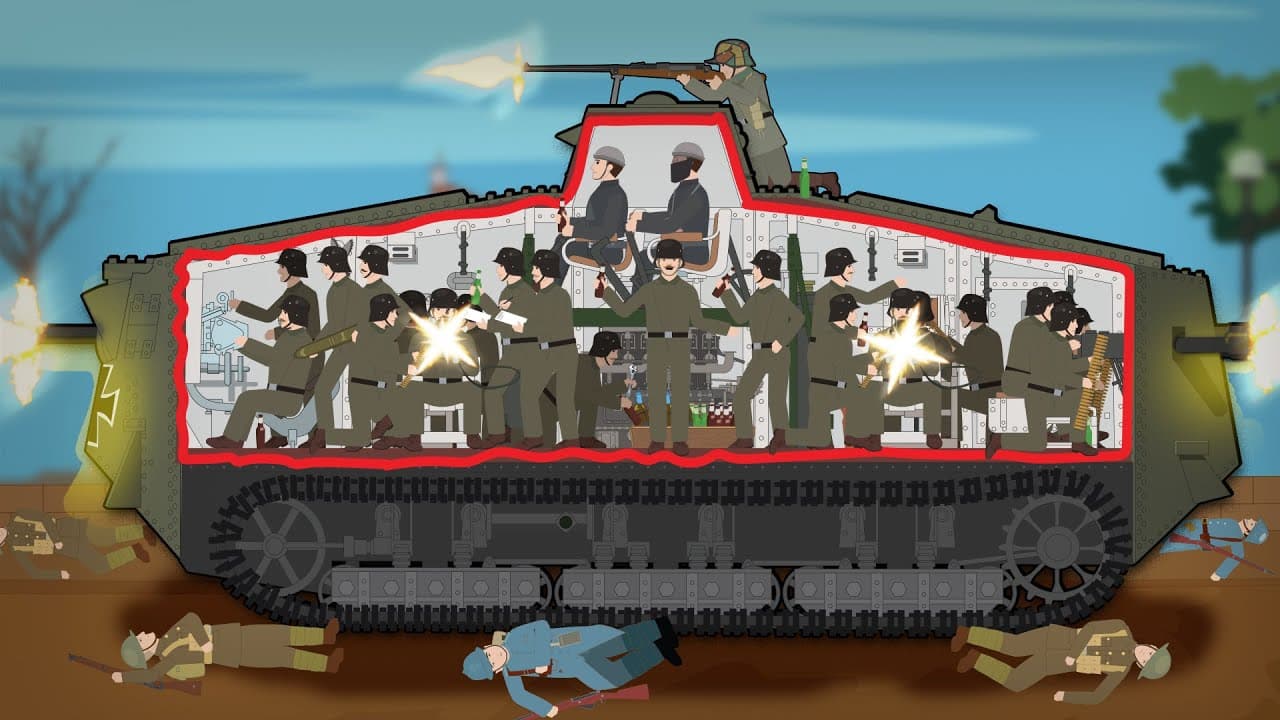
The A7V tank, Germany's first tank design in WWI, featured a large crew of up to 25 and limited visibility through small slits. Armed with a fixed 57mm gun and six machine guns, its armor was inadequate, leading to a lack of battlefield success. Only 20 units were produced, and the surviving unit, Mephisto, is now a historical artifact.
Transcript
cross-section of the a7v tank one of the most iconic visual elements of the second world war are German panzers blitzing their way across enemy territory leaving a trail of death and destruction in their wake during the first world war German tanks had a less than auspicious start their first attempt at a tank design was the a7v a clunky metal box ... Read More
Key Insights
- 🎨 The A7V tank was Germany's first attempt at tank design in World War I.
- 🍟 It had a larger crew and less visibility compared to French and British tanks.
- 🔫 The A7V's main armament was a fixed bow-mounted 57mm field gun surrounded by six machine guns.
- ❤️🔥 The tank had subpar armor thickness and was vulnerable to enemy fire.
- 🐕🦺 The A7V had limited success and was later removed from active service.
- 🎨 Germany's later tank designs incorporated lessons learned from the A7V.
- 🌏 The only surviving A7V, named Mephisto, is now a museum piece in Australia.
Install to Summarize YouTube Videos and Get Transcripts
Explore YouTube Video Summarizer or Get YouTube Transcript Extractor
Questions & Answers
Q: Why did Germany have a slow start in adopting armored vehicles during World War I?
The German High Command was hesitant to adopt armored vehicles and primarily relied on artillery and infantry, utilizing Stormtrooper tactics to break the stalemate on the Western Front.
Q: What were the crew conditions like inside the A7V tank?
The inside of the A7V was extremely hot and cramped, with petrol fumes permeating the atmosphere. Crew members often rode outside the tank to escape the discomfort.
Q: How was the A7V tank armed?
The A7V had a bow-mounted 57mm field gun as its main armament, surrounded by six machine guns. The tank could carry around 50-60 belts of machine gun ammunition.
Q: What was the fate of the A7V tank after World War I?
After its limited success, the A7V tanks were removed from active service, and most of the remaining tanks were scrapped. Germany's later tank designs learned from the A7V's shortcomings and became more famous and effective.
Summary & Key Takeaways
-
German tanks in World War I had a rough start, with the A7V being their first attempt at a tank design, producing only 20 units.
-
The A7V had a crew of 18, including infantrymen to operate the vehicle's six machine guns, and no compartmentalization inside the tank.
-
The tank's main armament was a bow-mounted 57mm field gun, surrounded by six machine guns, with limited firing arcs.
Read in Other Languages (beta)
Share This Summary 📚
Summarize YouTube Videos and Get Video Transcripts with 1-Click
Try YouTube Summary with ChatGPT & Claude or YouTube Transcript Generator
Explore More Summaries from Simple History 📚



Summarize YouTube Videos and Get Video Transcripts with 1-Click
Try YouTube Summary with ChatGPT & Claude or YouTube Transcript Generator