Products
Features
YouTube Video Summarizer
Summarize YouTube videos
Web & PDF Highlighter
Highlight web pages & PDFs
Chat with PDF
Ask any PDF questions with AI
Ask AI Clone
Chat with your highlights & memories
Audio Transcriber
Transcribe audio files to text
Glasp Reader
Read and highlight articles
Kindle Highlight Export
Export your Kindle highlights
Idea Hatch
Hatch ideas from your highlights
Integrations
Obsidian Plugin
Notion Integration
Pocket Integration
Instapaper Integration
Medium Integration
Readwise Integration
Snipd Integration
Hypothesis Integration
Apps & Extensions
Chrome Extension
Safari Extension
Edge Add-ons
Firefox Add-ons
iOS App
Android App
Discover
Discover
Ideas
Discover new ideas and insights
Articles
Curated articles and insights
Books
Book recommendations by great minds
Posts
Essays and notes from readers
Quotes
Inspiring quotes collection
Videos
Curated videos and summaries
Explore Glasp
Glasp Newsletter
Weekly insights and updates
Glasp Talk
Interview series with great minds
Glasp Blog
Latest news and articles
Glasp Use Cases
Learn how others use Glasp
Build & Support
Glasp API
Access Glasp's API for developers
MCP Connector
Connect Glasp to Claude & ChatGPT
Community
Glasp Reddit Community
Students
Student discount and benefits
FAQs
Frequently Asked Questions
AboutPricing
DashboardLog inSign up

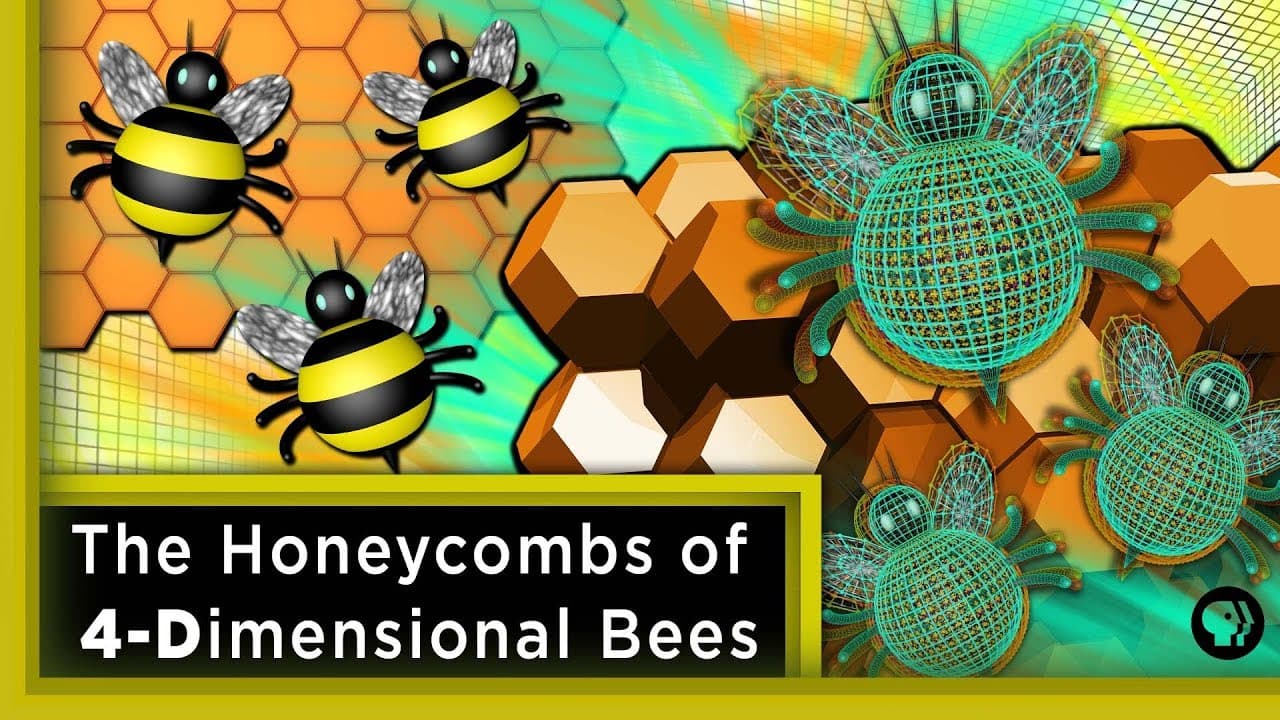
The Honeycombs of 4-Dimensional Bees ft. Joe Hanson | Infinite Series
332.0K views
•
August 3, 2017
by
PBS Infinite Series
YouTube video player
The Honeycombs of 4-Dimensional Bees ft. Joe Hanson | Infinite Series

TL;DR

Bees choose hexagons for honeycombs due to efficiency. Math and physics explain optimal structures.

Transcript

This episode is brought to you by curiosity stream. What shape honeycomb would a four dimensional bee make? Let's start with good old three dimensional honeybees. Why is there a hexagonal structure in there honeycombs? Why not squares or asymmetrical blobs? In 36 BC, the Roman scholar, Marcus Terentius Varro, wrote about the two leading theories o... Read More

Key Insights

  • 🐝 Bees choose hexagons for honeycombs due to efficiency in wax usage and storage.
  • ⚾ Mathematical principles explain the efficiency of hexagons for honeycomb patterns based on geometry.
  • 💁 Physics principles such as minimal surfaces guide the formation of honeycomb structures.
  • ❓ Pappus of Alexandria and Thomas Hales made significant contributions to understanding optimal honeycomb structures.
  • 🥺 Soap foams and bubbles demonstrate how physical processes lead to ordered structures like honeycombs.
  • ✋ Higher dimensions, like 4D honeycombs, present more complex partitioning questions for efficient structures.
  • 👾 The Weaire-Phelan structure in three-dimensional space may be more efficient than Kelvin's structure for honeycombs.

Install to Summarize YouTube Videos and Get Transcripts

Explore YouTube Video Summarizer or Get YouTube Transcript Extractor

Questions & Answers

Q: Why do bees choose hexagons for honeycombs?

Bees choose hexagons for honeycombs due to efficiency in wax usage and storage. Hexagons minimize wax needed while maximizing honey storage.

Q: How did Pappus of Alexandria explain the efficiency of hexagons for honeycomb patterns?

Pappus explained that bees favor regular polygons like triangles, squares, and hexagons for tiling the plane due to symmetry. Hexagons are the most efficient in minimizing perimeter relative to area.

Q: How did Thomas Hales contribute to understanding the optimal honeycomb structure?

Thomas Hales rigorously proved that hexagonal honeycombs are optimal by eliminating bulging sides. He improved on Pappus' results and confirmed the efficiency of hexagonal honeycombs with mathematics.

Q: How do physics and math principles guide the formation of honeycomb structures?

Physics principles such as minimal surfaces guide the formation of honeycomb structures. The forces of air pressure and surface tension in bubbles and soap films lead to stable, efficient honeycomb patterns.

Summary & Key Takeaways

  • Bees choose hexagons for honeycombs for efficiency in wax usage and storage.

  • Pappus of Alexandria explained the efficiency of hexagons for honeycomb patterns based on geometry.

  • Physics and math principles such as minimal surfaces guide the formation of honeycomb structures.


Read in Other Languages (beta)

English

Share This Summary 📚

Summarize YouTube Videos and Get Video Transcripts with 1-Click

Download browser extensions on:

Try YouTube Summary with ChatGPT & Claude or YouTube Transcript Generator

Explore More Summaries from PBS Infinite Series 📚
Splitting Rent with Triangles | Infinite Series thumbnail
Splitting Rent with Triangles | Infinite Series
PBS Infinite Series
The Mathematics of Diffie-Hellman Key Exchange | Infinite Series thumbnail
The Mathematics of Diffie-Hellman Key Exchange | Infinite Series
PBS Infinite Series
Solving the Wolverine Problem with Graph Coloring | Infinite Series thumbnail
Solving the Wolverine Problem with Graph Coloring | Infinite Series
PBS Infinite Series
Topology Riddles | Infinite Series thumbnail
Topology Riddles | Infinite Series
PBS Infinite Series
Can a Chess Piece Explain Markov Chains? | Infinite Series thumbnail
Can a Chess Piece Explain Markov Chains? | Infinite Series
PBS Infinite Series
Building an Infinite Bridge | Infinite Series thumbnail
Building an Infinite Bridge | Infinite Series
PBS Infinite Series

Summarize YouTube Videos and Get Video Transcripts with 1-Click

Download browser extensions on:

Try YouTube Summary with ChatGPT & Claude or YouTube Transcript Generator

Apps & Extensions

  • Chrome Extension
  • Safari Extension
  • Edge Add-ons
  • Firefox Add-ons
  • iOS App
  • Android App

Key Features

  • YouTube Video Summarizer
  • Web & PDF Summarizer
  • Web & PDF Highlighter
  • Chat with PDF
  • Ask AI Clone
  • Audio Transcriber
  • Glasp Reader
  • Kindle Highlight Export
  • Idea Hatch

Integrations

  • Obsidian Plugin
  • Notion Integration
  • Pocket Integration
  • Instapaper Integration
  • Medium Integration
  • Readwise Integration
  • Snipd Integration
  • Hypothesis Integration

More Features

  • APIs
  • MCP Connector
  • Blog & Post
  • Embed Links
  • Image Highlight
  • Personality Test
  • Quote Shots

Company

  • About us
  • Blog
  • Community
  • FAQs
  • Job Board
  • Newsletter
  • Pricing
Terms

•

Privacy

•

Guidelines

© 2026 Glasp Inc. All rights reserved.