IIT JEE trigonometry problem 1 | Trig identities and examples | Trigonometry | Khan Academy
TL;DR
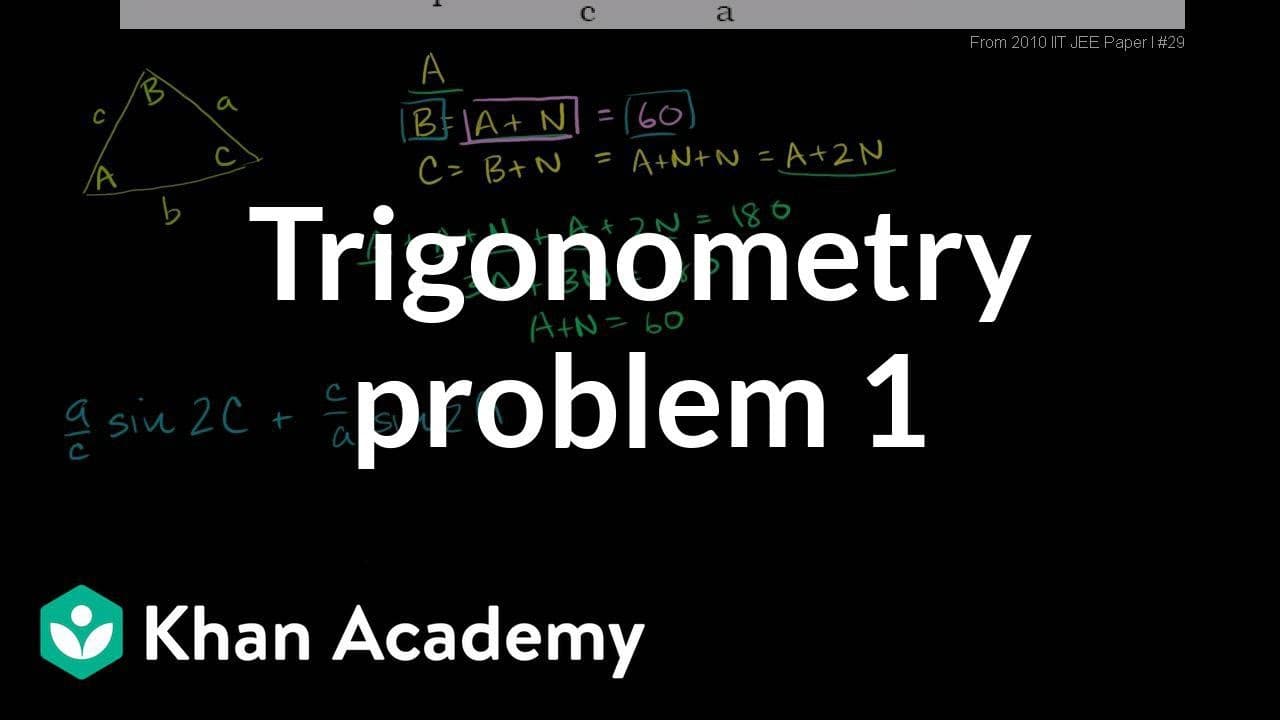
In a triangle, if the angles are in an arithmetic progression, and certain lengths of sides are given, we can determine the value of a trigonometric expression using the law of sines and the double angle formula.
Transcript
- [Instructor] If the angles A, B and C of a triangle are in an arithmetic progression, and if a, b and c, lowercase, a, b and c, denote the lengths of the sides opposite to the capital, the angles A, capital A, capital B and capital C respectively, then what is the value of this expression right over here? So let's see if we can work our way throu... Read More
Key Insights
- 🔺 The angles of a triangle can be in an arithmetic progression, where the difference between consecutive angles is constant.
- 👨💼 The law of sines relates the ratios of side lengths to the sines of the corresponding angles in a triangle.
- 🔺 The double angle formula allows us to express the sine of twice an angle in terms of the sine and cosine of the angle itself.
- 😑 Manipulating trigonometric expressions using the law of sines and the double angle formula can simplify the problem and lead to a solution.
- 👨💼 The solution to the problem requires knowledge of the law of sines, the double angle formula, and basic arithmetic operations.
- 🛀 The solution shows the connection between geometric properties of triangles and trigonometric identities.
- 🏆 The example problem is from a competitive exam in India, highlighting the application of geometry and trigonometry in challenging test scenarios.
Install to Summarize YouTube Videos and Get Transcripts
Explore YouTube Video Summarizer or Get YouTube Transcript Extractor
Questions & Answers
Q: How can we determine if the angles in a triangle are in arithmetic progression?
In an arithmetic progression, the difference between consecutive terms is constant. In the context of a triangle, if the difference between angles A, B, and C is the same, then the angles are in an arithmetic progression.
Q: How does the law of sines help in solving the problem?
The law of sines states that the ratios of the lengths of sides to the sines of the corresponding angles are equal. By applying this law and rearranging the equation, we can manipulate the trigonometric expression to simplify it and obtain a solution.
Q: What is the significance of the double angle formula in the solution?
The double angle formula allows us to express the sine of twice an angle in terms of the sine and cosine of the angle itself. This enables us to transform the given expression and make it dependent on the angle B, which we already know the value of.
Q: Can the solution be applied to triangles with different side lengths and angles?
Yes, the solution can be applied to any triangle where the angles are in arithmetic progression and the corresponding side lengths are known. The specific values of the angles and side lengths will determine the numerical result of the expression.
Summary & Key Takeaways
-
The video discusses how to determine the value of a trigonometric expression in a triangle where the angles are in arithmetic progression and side lengths are given.
-
The law of sines is used to relate the ratios of the lengths of sides to the sines of the corresponding angles.
-
The double angle formula is employed to simplify the given expression, eventually leading to the solution.
Read in Other Languages (beta)
Share This Summary 📚
Summarize YouTube Videos and Get Video Transcripts with 1-Click
Try YouTube Summary with ChatGPT & Claude or YouTube Transcript Generator
Explore More Summaries from Khan Academy 📚



Summarize YouTube Videos and Get Video Transcripts with 1-Click
Try YouTube Summary with ChatGPT & Claude or YouTube Transcript Generator