What is Blockchain? | Stanford Blockchain and Cryptocurrency Course | 2019
TL;DR
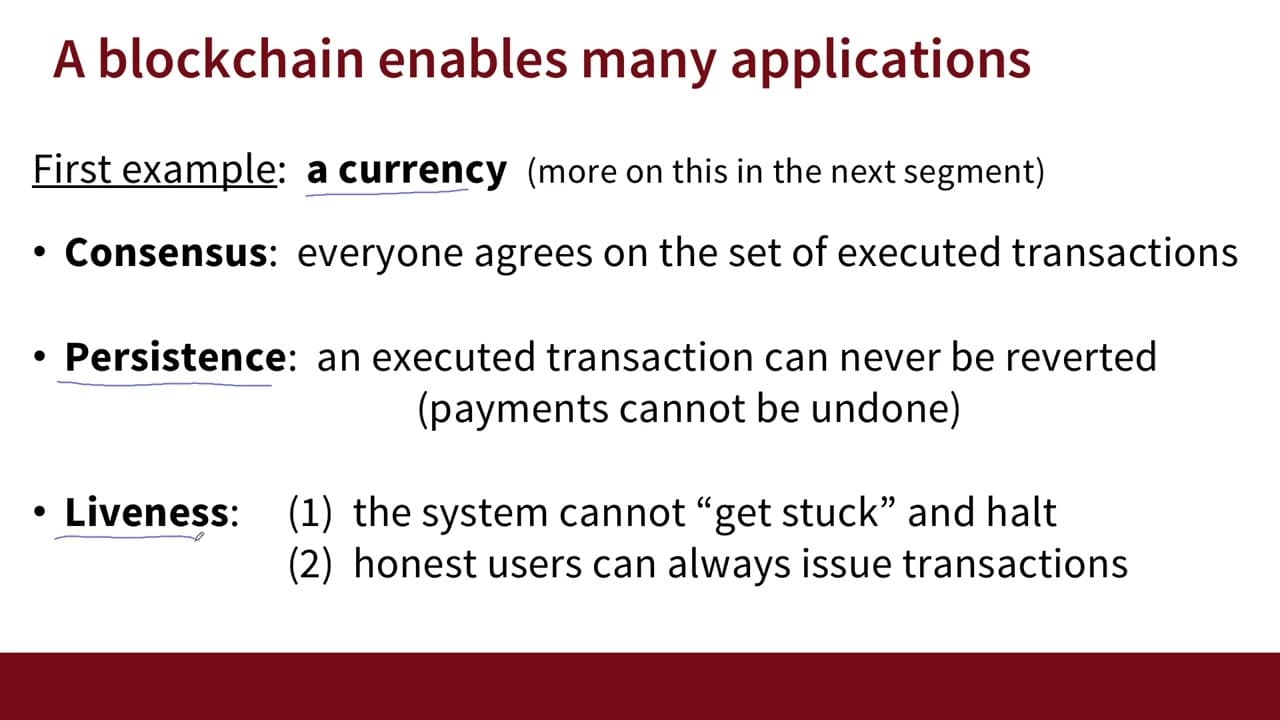
Blockchain is a data structure that offers consensus, persistence, and liveness, making it suitable for applications like currency.
Transcript
so let's start by first explaining what is a blockchain well a blockchain is just a data structure that basically provides the capabilities of a ledger so the properties of a blockchain are essentially three-fold the first one is it provides this mechanism called consensus which means that all the participants in the system agree on what data lives... Read More
Key Insights
- ❓ Blockchain offers consensus, persistence, and liveness as fundamental properties.
- 👻 The consensus property ensures agreement on data, while persistence prevents data removal and liveness allows for continuous data addition.
- 💱 A blockchain's properties make it suitable for applications like currency systems.
- 🥶 Persistence in a blockchain is achieved through replication across multiple parties, making it difficult to revert to an old state.
- 👻 Consensus, combined with replication, allows everyone to validate the data and agree on the state of the blockchain.
- 🙈 Invalid transactions are dropped since they are ignored by participants who validate the blockchain.
- 🈸 Blockchain's properties make it a trustless and transparent system for various applications.
Install to Summarize YouTube Videos and Get Transcripts
Explore YouTube Video Summarizer or Get YouTube Transcript Extractor
Questions & Answers
Q: What are the three fundamental properties provided by a blockchain?
The three properties are consensus, persistence, and liveness. Consensus ensures agreement on data, persistence prevents data removal, and liveness allows for continuous data addition.
Q: How does a blockchain provide a currency system?
Consensus in a blockchain ensures that all participants agree on executed transactions, determining how much money each participant owns. Persistence prevents transaction reversals, ensuring once paid, money cannot be taken back. Liveness allows users to add transactions and spend their owned money freely.
Q: How is persistence achieved in a blockchain?
Persistence is achieved through replication across multiple parties. Miners write new data and store the entire blockchain history. End users replicate the blockchain to monitor their data, and service providers analyze the blockchain. Reverting to an old state is difficult due to the widespread replication of the data.
Q: Why is consensus important in a blockchain?
Consensus ensures that all participants view and validate the same data. This agreement on the state of the blockchain confirms the validity of transactions and allows for a trustless system.
Summary & Key Takeaways
-
A blockchain provides consensus, ensuring that all participants agree on the data in the system, with a caveat for recent entries.
-
Persistence is a key property of a blockchain, ensuring that once data is added, it cannot be removed.
-
Liveness allows anyone to add data to the blockchain and prevents the system from getting stuck.
Read in Other Languages (beta)
Share This Summary 📚
Summarize YouTube Videos and Get Video Transcripts with 1-Click
Try YouTube Summary with ChatGPT & Claude or YouTube Transcript Generator
Explore More Summaries from Stanford Online 📚


Summarize YouTube Videos and Get Video Transcripts with 1-Click
Try YouTube Summary with ChatGPT & Claude or YouTube Transcript Generator