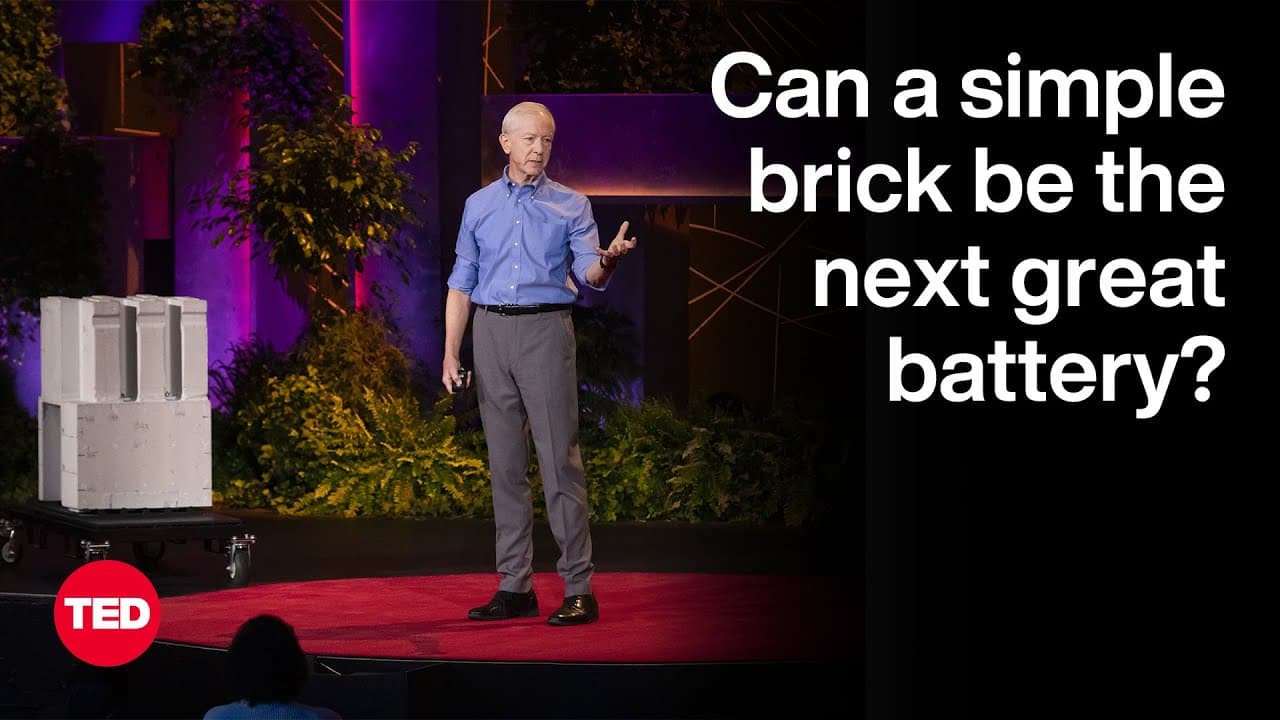
Can a Simple Brick Be the Next Great Battery? | John O'Donnell | TED
TL;DR
Electrifying industrial heat using wind and solar power is a cost-effective and efficient way to decarbonize the industry and reduce CO2 emissions by 15 percent.
Transcript
I get a deep sense of hope when I look at this brick. (Laughter) It's going to spend the next 50 years of its life cutting CO2, and bricks like it are going to cut 15 percent of world CO2. So let's talk about that, but first, we have to talk about fire. Fire warms us, heats our homes, cooks our food. We also use fire to make almost everything. Indu... Read More
Key Insights
- 🔥 Industrial heat is responsible for 25% of world carbon emissions, making it a crucial area for decarbonization.
- 🔌 Electrification of industrial heat using wind and solar power is becoming more economically feasible and could create a trillion-dollar market. ⌛ Storing electricity as heat could provide a cost-effective solution for continuous clean heat in heavy industries.
- 🧱 Brick and iron wire can be used to store and deliver clean heat, with brick storing as much energy as a lithium-ion battery at a fraction of the cost.
- 🌍 Scaling up this technology could save 15% of world CO2 emissions and contribute to a safer, more prosperous world for future generations.
- 💡 "New and boring" technologies have the potential to go to scale faster and provide certainty for investment, making them an excellent option for rapid deployment in the energy sector.
- 📈 Leading climate investment funds and industrial producers are supporting the development of this technology, indicating its potential for widespread adoption.
- 🌞 Wind and solar-powered heat batteries could lower the cost of manufacturing essential goods in a decarbonized world, making sustainable production more affordable.
Install to Summarize YouTube Videos and Get Transcripts
Explore YouTube Video Summarizer or Get YouTube Transcript Extractor
Questions & Answers
Q: How can electrification help decarbonize the industrial sector?
Electrification can decarbonize the industrial sector by replacing fossil fuel use with clean energy sources like wind and solar power. By using electricity, industries can reduce their carbon emissions and dependence on fossil fuels, leading to a more sustainable and greener future. This transition can result in a reduction in CO2 emissions by 15 percent.
Q: What are the advantages of storing heat as a form of energy?
Storing heat as a form of energy offers several advantages. Firstly, it is a simple and low-cost solution compared to other methods of storing electricity. Additionally, using materials like brick and iron wire for heat storage is economical and efficient. The stored heat can then be used to power kilns, furnaces, boilers, or other industrial processes, thereby providing a continuous supply of clean heat.
Q: How do materials like brick and iron wire contribute to heat storage?
Brick and iron wire have proven to be effective materials for heat storage. Brick, when heated evenly, can store as much energy as a lithium-ion battery, at a lower cost and with a longer lifespan. Iron wire, when combined with brick, can create a cost-effective solution for storing heat. The challenge lies in ensuring even heating to prevent cracking or the failure of the wire. By leveraging the principle of radiant heat, or heating brick with radiation, it becomes possible to safely and evenly store energy in brick stacks.
Q: What is the potential impact of electrifying industrial heat on CO2 emissions?
Electrifying industrial heat using wind and solar power has the potential to reduce CO2 emissions by 15 percent. By shifting away from fossil fuel-based heat generation, industries can significantly lower their carbon footprints. This reduction in emissions is not only environmentally beneficial but also aligns with global efforts to combat climate change. The electrification of industrial heat could lead to a safer, more prosperous, and more just world for future generations.
Summary & Key Takeaways
-
Industrial production using fossil fuels is responsible for the largest part of the world economy's energy use and carbon emissions.
-
Electrifying industrial heat using wind and solar power is a more economical and scalable solution.
-
Storing heat as a form of energy through the use of materials like brick and iron wire can provide a cost-effective and efficient way to power industrial heat.
Read in Other Languages (beta)
Share This Summary 📚
Summarize YouTube Videos and Get Video Transcripts with 1-Click
Try YouTube Summary with ChatGPT & Claude or YouTube Transcript Generator
Explore More Summaries from TED 📚

Summarize YouTube Videos and Get Video Transcripts with 1-Click
Try YouTube Summary with ChatGPT & Claude or YouTube Transcript Generator