Exchange-traded funds
TL;DR
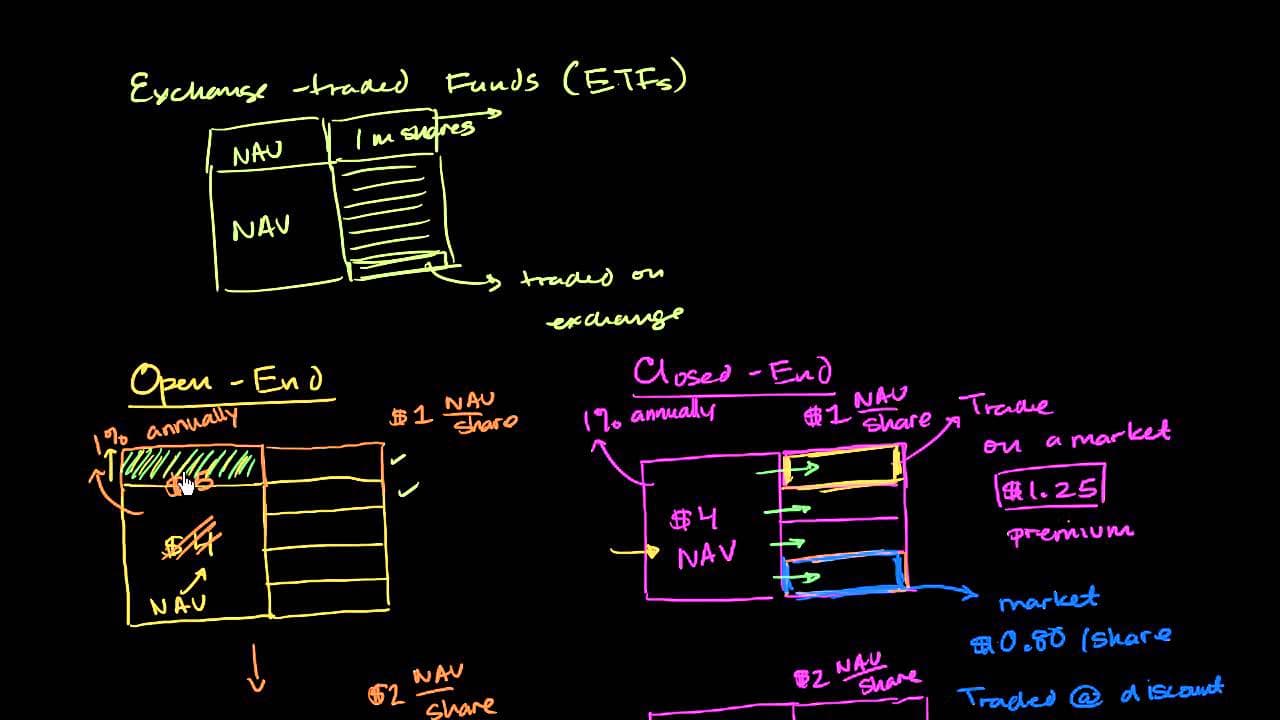
Exchange Traded Funds (ETFs) are a type of investment fund that combines the features of open-end and closed-end funds, offering lower expenses and fees due to bulk transactions and passive management.
Transcript
we've already talked a good bit about open end and closed and fund and you might say hey maybe there's something in between the open end fund had the advantage of being able to grow the actual net asset value just for more investors coming in the closed end fund but there's a disadvantage there is that you had to keep some cash on hand if people go... Read More
Key Insights
- ❤️🩹 ETFs offer a middle ground between open-end and closed-end funds, providing liquidity while keeping expenses lower.
- 😘 Bulk transactions and passive management contribute to the lower costs associated with ETFs.
- 👻 The ability to trade on an exchange allows for easy access to investments and flexibility for investors.
- 💐 ETFs are beneficial for individual investors seeking diversification and exposure to various asset classes.
- 🧚 The transparency of ETFs makes it easier to determine their net asset value and ensure fair pricing.
Install to Summarize YouTube Videos and Get Transcripts
Explore YouTube Video Summarizer or Get YouTube Transcript Extractor
Questions & Answers
Q: What is the main advantage of an ETF compared to an open-end fund?
The main advantage of an ETF is that it offers liquidity to investors without the need for daily transactions. Investors can trade ETF shares on an exchange, providing easy access to their investments.
Q: How do ETFs keep expenses and fees lower than open-end funds?
ETFs have lower expenses and fees because they issue shares in bulk instead of daily transactions. This reduces overhead costs and allows them to pass on the savings to shareholders.
Q: Why are ETFs considered to be not actively managed?
ETFs are not actively managed because they usually track an index or commodity. Instead of trying to beat the market, they aim to replicate the performance of a specific benchmark, resulting in lower expenses.
Q: How do ETFs maintain their share prices close to their net asset value?
ETFs trade close to their net asset value because of arbitrage opportunities. Large shareholders can buy shares at a discount and redeem them with the fund or create new shares to sell at a premium, ensuring the price remains aligned with net asset value.
Summary & Key Takeaways
-
Open-end funds have the advantage of growing their net asset value for more investors, but may face liquidity issues. Closed-end funds have a fixed net asset value, limiting investor access but allowing for trading on an exchange. ETFs offer a compromise between the two.
-
ETF shares can be traded on an exchange, providing liquidity for investors without the need for daily transactions. They issue shares in bulk, reducing overhead and expenses, which leads to lower fees for investors.
-
ETFs are passively managed and usually track an index or commodity, providing diversification and ease of investing for individuals. They tend to trade at or close to their net asset value due to arbitrage opportunities.
Read in Other Languages (beta)
Share This Summary 📚
Summarize YouTube Videos and Get Video Transcripts with 1-Click
Try YouTube Summary with ChatGPT & Claude or YouTube Transcript Generator
Explore More Summaries from Khan Academy 📚



Summarize YouTube Videos and Get Video Transcripts with 1-Click
Try YouTube Summary with ChatGPT & Claude or YouTube Transcript Generator